
Can You Build Your Marketing Around That Phrase?
A Real Trade Mark Search, Start to Finish
Some of the most expensive marketing mistakes start with a phrase everybody in the room likes.
It happens like this. Someone suggests a line that captures the customer’s problem perfectly. It’s familiar, it’s funny, everyone nods. It goes into the campaign, onto the packaging, into the launch video, across six weeks of social content – and then a letter arrives from a company that registered it in 2007.
Here’s a real search that stopped exactly that, and it took about thirty seconds.
The setup
Kidera is the practice of a paediatric occupational therapist in Perth. Alongside clinical work, she publishes play-based resources for parents, and she’s bringing out her first physical product – the Kidera Travel Play Kit, an OT-designed activity kit built to hold a child’s attention on a long trip without defaulting to a screen.
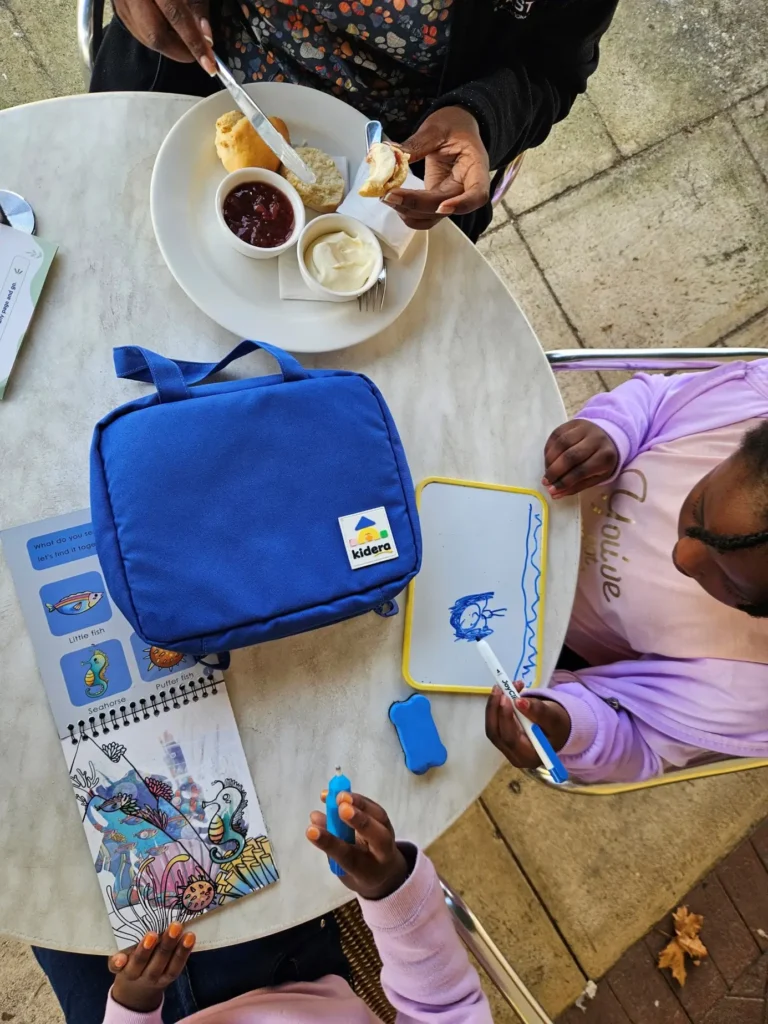
The obvious phrase for a product like that is the one every parent in the country has heard from the back seat: “Are we there yet?”
It’s a good instinct. The phrase does a lot of work in very few words – it names the moment, it’s instantly understood, and it makes people smile. The plan was to use it across the marketing and promotion of the kit: campaign line, social content, possibly more.
The question was whether that was actually available to do. Familiar phrases feel like public property precisely because everyone uses them, which is exactly why people skip the check – and jumping straight in without looking is how campaigns get pulled after the money is spent.
So before anything was written, it went into ATMOSS.
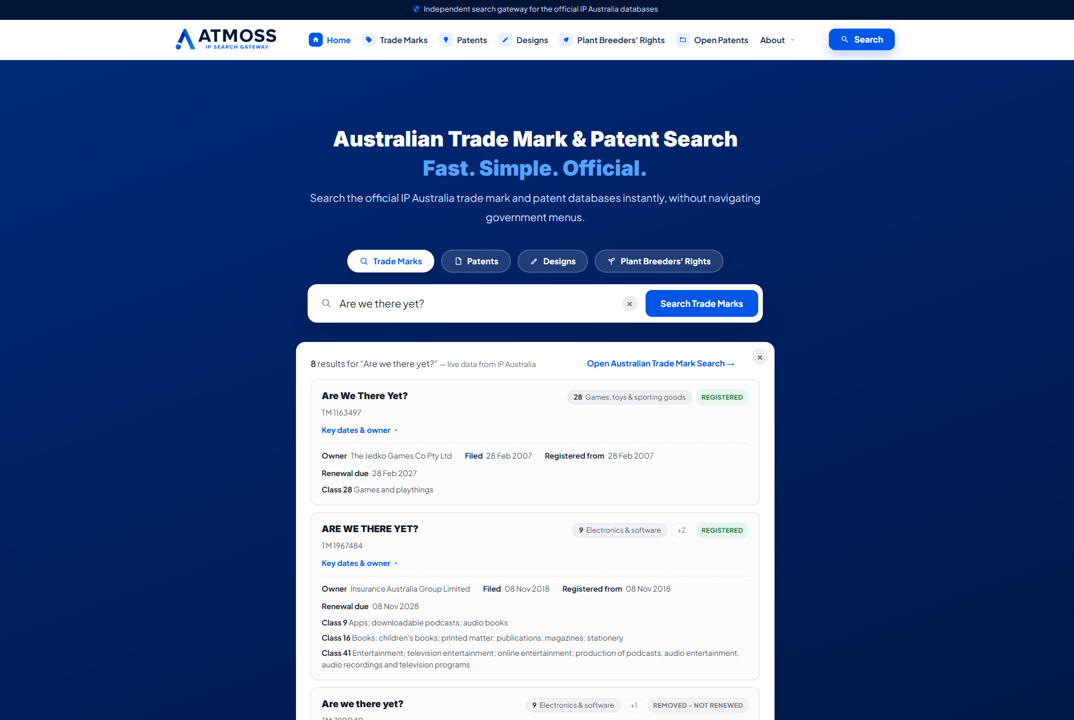
Eight results, and two that mattered
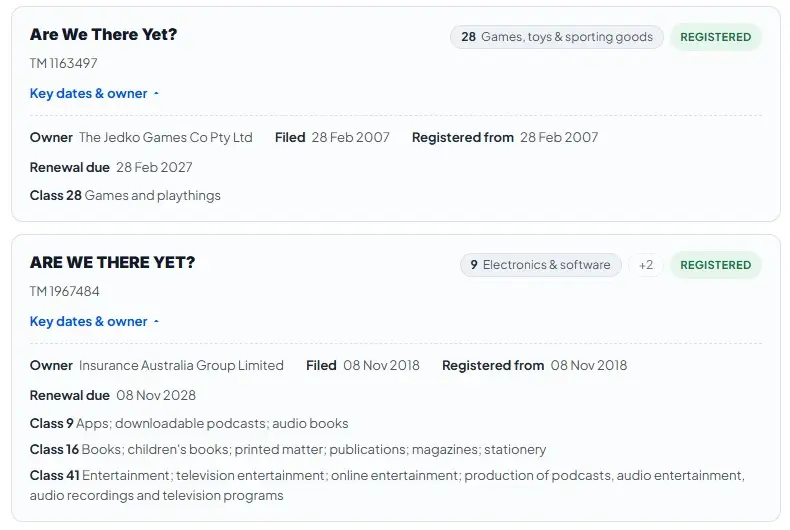
The search returned eight Australian trade marks containing the phrase. Two of them changed the plan.
TM 1163497 – “Are We There Yet?”
Owner: The Jedko Games Co Pty Ltd
Filed and registered: 28 February 2007
Status: Registered
Class 28 – games and playthings
TM 1967484 – “ARE WE THERE YET?”
Owner: Insurance Australia Group Limited
Filed and registered: 8 November 2018
Status: Registered
Class 9 – apps, downloadable podcasts, audio books
Class 16 – books, children’s books, printed matter, publications, magazines, stationery
Class 41 – entertainment, television and online entertainment, podcast production
A children’s activity kit sits squarely in class 28. Printed components inside it – activity cards, a booklet, anything on paper – sit in class 16.
There is meaningful protection around this phrase, and it happens to sit in precisely the two classes this kind of product cannot avoid. One registration held by a games company since 2007. The other by one of Australia’s largest insurers.
The nuance worth understanding
At this point it’s tempting to conclude that nobody can ever say “are we there yet” in an advertisement again. That’s not right either, and it’s worth being precise about the difference.
Australian trade mark infringement turns on whether a sign is used as a trade mark – that is, as a badge of origin that tells customers who a product comes from. A tagline, a campaign name, a product name or a repeated brand line generally functions that way. A phrase used incidentally inside a sentence of ordinary copy generally does not.
So the two uses sit in quite different places:
- “Are We There Yet – the travel kit” is functioning as a brand. In these classes, that is a real problem.
- “You know that moment when they ask if you’re there yet?” inside a paragraph of body copy is ordinary descriptive use, and sits much further from the line.
Where exactly a given use falls is a question for a trade mark attorney, not a blog post. But there’s a commercial answer that doesn’t require one, and it’s the one that settled this decision.
The strategic reason to walk away anyway
Even where a use might be lawful, building marketing equity into a phrase you cannot own is a poor investment.
Every dollar spent making that phrase memorable in connection with your product is a dollar spent on an asset that isn’t yours. You can’t register it. You can’t stop a competitor using it. And if your use drifts – as campaign lines naturally do, from body copy into a tagline into a product name – you can find yourself on the wrong side of a boundary you didn’t notice crossing.
That’s the real cost, and it shows up long before any legal risk does. A campaign built on a borrowed phrase builds someone else’s recognition, not yours.
What was done instead
The search turned a naming problem into a positioning exercise, and the result was stronger than the phrase that was lost.
The task became finding other ways to communicate the same idea – the same moment, the same parent pain – using terms that could actually be owned. Four approaches did the work.
1. Describe the moment rather than borrowing the catchphrase. “Are we there yet” is shorthand for a specific experience: the point on a long trip where a child has run out of things to do. That experience can be evoked directly – the fourth hour of a road trip, the back seat at hour three – without leaning on a registered phrase. It’s more vivid, and it’s free.
2. Lead with the outcome, not the complaint. The phrase names the problem. Marketing usually works harder when it names the result: a quieter back seat, a trip that doesn’t end in tears, arriving without having handed over a screen at the halfway point.
3. Put the distinctive element on the front. The product became the Kidera Travel Play Kit. Nobody can monopolise the words “travel play kit” – descriptive terms aren’t ownable, and that’s fine. But the brand name in front of them is protectable, and it’s the part worth investing in. Every impression now builds an asset the business actually holds.
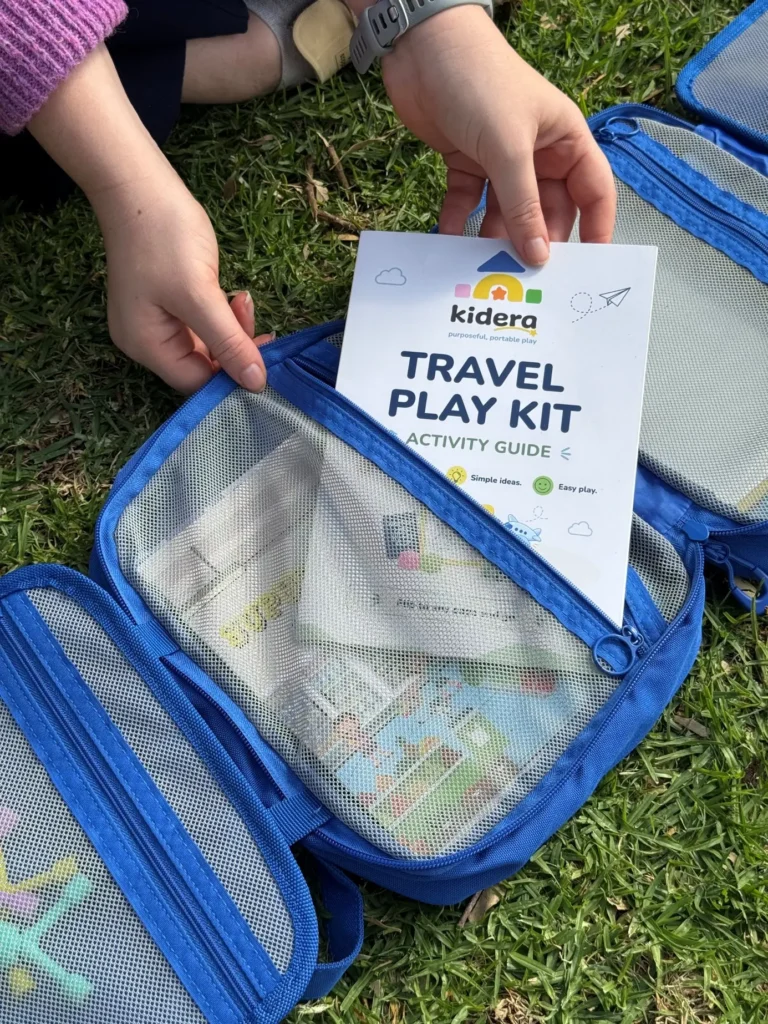
4. Build the campaign on a line that can be owned. The strongest line in the launch turned out to be one written specifically for the product: eight activities, and an activity guide showing more than forty ways to use them. It’s distinctive, it’s true, it’s provable, and it belongs to the business. That’s the difference between a campaign line and a borrowed phrase – one you can own, and one you’re only renting.
The phrase was lost on a Tuesday afternoon. The positioning that replaced it was better by Wednesday.
Two more lessons sitting in the same results
Look further down the same search and there’s more to learn.
TM 1062085 – “ARE WE THERE YET?” – A W Faber-Castell (Aust) Pty Limited, registered in 2005 over class 16 for pencils, crayons and drawing materials. Status: Removed – not renewed.
A lapsed registration looks like an opening. It isn’t a green light. The previous owner may still be using the name commercially, and unregistered use can support a passing-off claim or an action under the Australian Consumer Law regardless of what the register says. “Removed” means not currently registered – not free to take.
The same caution applies to renewal dates. The Jedko registration falls due in February 2027, and planning a launch around the hope that it lapses would be a bad bet. Assume anything valuable gets renewed.
How to run this check yourself
Five minutes, before the design brief rather than after it.
1. Write down what you’re actually selling. Not the concept – the physical thing and everything that goes with it. “A children’s activity kit” is class 28. “With printed activity cards” adds class 16. “And a downloadable guide” may add class 9. Each component can pull in another class.
2. Search the phrase on ATMOSS. Type it into the trade mark search, hit Search Trade Marks. You get live results from the official IP Australia databases without navigating government menus.
3. Read the class, not just the name. A hit in an unrelated class is usually not your problem. A hit in your class usually is.
4. Read the status. Registered is a live blocker. Removed – not renewed is not permission. Pending means someone is ahead of you in the queue.
5. Search the variations. Plurals, misspellings, the version without punctuation, the version with your brand in front of it. The test is whether marks are deceptively similar, not whether they’re identical.
6. Ask how you intend to use it. As a brand, tagline or product name? Treat any hit in your classes as serious. Incidental use in body copy? Lower risk – but see the point above about not investing in something you can’t own.
7. Then get professional advice. A search tells you what’s on the register. It doesn’t tell you whether your mark is registrable, whether it’s deceptively similar to something already there, or what your unregistered-use exposure looks like. Those are questions for a registered trade mark attorney – and you’ll have a far shorter, cheaper conversation having already cleared the obvious blockers yourself.
The cost of skipping it
This search took thirty seconds and cost a phrase somebody liked.
The alternative version involves a logo, a packaging print run, a product page, a launch campaign, several weeks of social content – and then a letter, followed by doing all of it again with stock already sitting in a warehouse under the old name.
The search is the cheapest thing in the entire launch.
Search any Australian trade mark, patent, design or Plant Breeder’s Right – free, instant, and drawn live from the official IP Australia databases. Start a trade mark search.
Frequently asked questions
Can I use a common phrase in my advertising if someone has trade marked it?
It depends on how you use it. Trade mark infringement generally requires use as a trade mark – as a badge of origin, like a tagline or product name. Ordinary descriptive use inside a sentence sits further from the line. But if a phrase is registered in your classes, building your campaign identity around it is risky and, commercially, a poor investment regardless.
Is a registered business name the same as a trade mark?
No, and this catches people out constantly. Registering a business name with ASIC, or buying a domain, gives you no trade mark rights. It’s an administrative registration, not ownership. Someone holding a registered trade mark can stop you trading under a business name you’ve used for years.
Can two businesses hold the same trade mark in Australia?
Yes, where they’re registered in different classes and there’s no realistic likelihood of confusion. The search in this article found the same phrase held simultaneously by a games company, an insurer and a travel business.
What does “Removed – not renewed” mean?
The registration lapsed because it wasn’t renewed. The mark is off the register, but the previous owner may still be trading under it, which can create passing-off or consumer-law exposure. Treat it as something to investigate, not a clear run.
How many trade mark classes do I need?
Only those covering what you actually sell. Each class adds to the application fee, so over-claiming has a real cost – but a gap in coverage is worse. This is where professional advice pays for itself.
Does a trade mark search count as legal clearance?
No. Searching tells you what’s on the register. Formal clearance – an opinion on registrability and infringement risk, registered or otherwise – is work for a qualified trade mark attorney. Search first so that conversation is short and cheap.
ATMOSS is an independent search gateway to the official IP Australia databases. This article is general information, not legal advice. Trade mark registrability and infringement depend on facts specific to your circumstances – speak to a registered trade mark attorney before committing to a name or campaign. Product images used with permission of Kidera.