
IP First Response: IP Australia’s Free First Stop for IP Disputes
The letter usually arrives without warning. A competitor says your brand is too close to theirs. Or it’s the other way around: you spot a product online that looks a lot like yours, with a logo that’s uncomfortably familiar.
Most small business owners have three instincts in that moment: ignore it, panic, or ring a lawyer and brace for the bill. IP Australia has built something to sit in front of all three. It’s called IP First Response, it’s free, and while it’s still in beta, it’s one of the most useful plain-language IP resources we’ve seen for Australian founders.
We spent some time working through it. Here’s what it is, how the main tools work, and, just as importantly, what IP Australia says it doesn’t do.
What is IP First Response?
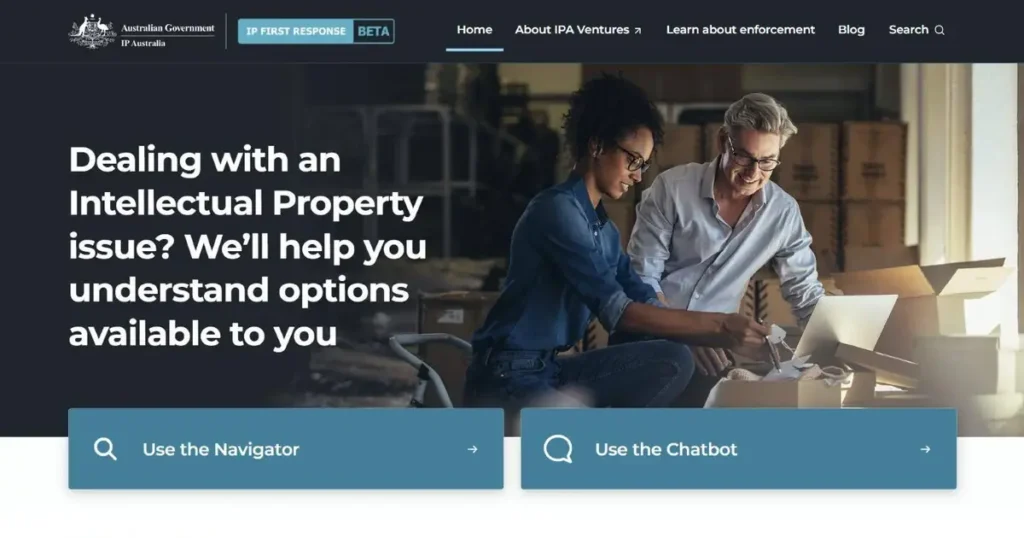
IP First Response is a free online service from IP Australia, developed by its innovation team, IPAVentures. It’s designed to help you understand your options when you’re dealing with an intellectual property issue, whether someone has copied your work or someone says you’ve copied theirs.
It’s a pilot. A first prototype launched in March 2025, it has been reworked since based on feedback from small businesses, rights holders and IP professionals, and an AI chatbot was added in May 2026. The site carries a BETA badge and says plainly that features and content may change as the team tests and refines its approach.
IP Australia’s own research behind the project found that many small businesses and individual rights holders struggle to navigate enforcement. Options aren’t visible, smaller players are often out-resourced, and there’s little practical information about negotiation and dispute resolution. IP First Response is their attempt to fix the first part of that problem: knowing what your options actually are.
It covers the four registered IP rights (trade marks, patents, designs and Plant Breeders’ Rights, or PBRs), as well as copyright and unregistered trade marks.
Four ways in
The tool starts by asking which situation you’re in. There are four starting points:
- I believe my IP has been infringed. Someone has copied your business name, brand, invention or product design.
- I’ve been accused of infringement. You’ve received a complaint, a takedown notice or a letter of demand.
- I want to understand how IP works. Plain-English guidance if you’re new to the system.
- I want to prevent future IP headaches. Practical ways to protect what you’ve built before there’s a problem.
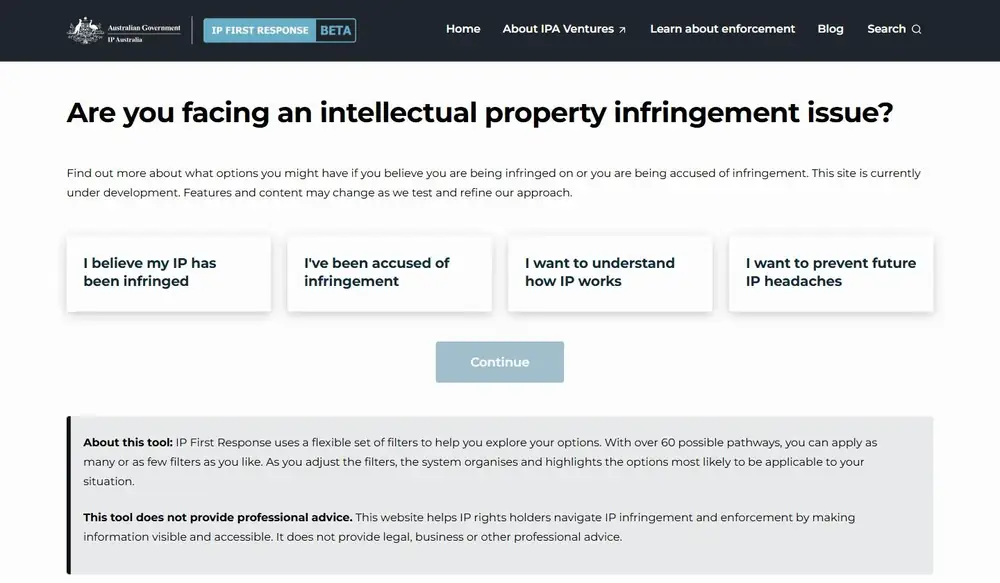
From there you can use the Navigator, the Chatbot, or browse the full library of guides directly.
The Navigator: your options, side by side
The Navigator is the heart of the tool. After choosing your situation, you select the rights involved (for example, trade marks), and it returns a set of possible options. You can then narrow them with filters such as your preferences, the details of the infringement, the status of your own IP and what you know about the other party. None of the filters are required, and the tool says there are more than 60 possible pathways through it.
What makes it genuinely useful is that each option comes with a rough guide to cost, time and likely outcome. When we ran the “my IP has been infringed” path for a trade mark, it returned 27 options, including:
- Informal contact: giving the other party a chance to stop. Free, days to weeks.
- Letter of demand: a formal written demand to stop. Listed at $1,500 to $10,000 with legal representation, days to weeks.
- ASBFEO: help from the Australian Small Business and Family Enterprise Ombudsman. Free to access (dispute resolution costs extra), with the tool noting up to 80% of cases are resolved with ASBFEO’s help.
- eCommerce platform: asking an online marketplace to remove infringing listings. Free, hours.
- Notice of objection: asking the Australian Border Force to stop infringing goods entering the country. Free to lodge.
- Gauge the situation: deliberately choosing not to act yet. Free, plus optional professional fees.
- Court: binding decisions, but listed at $80,000 or more in legal fees and a timeframe of years.
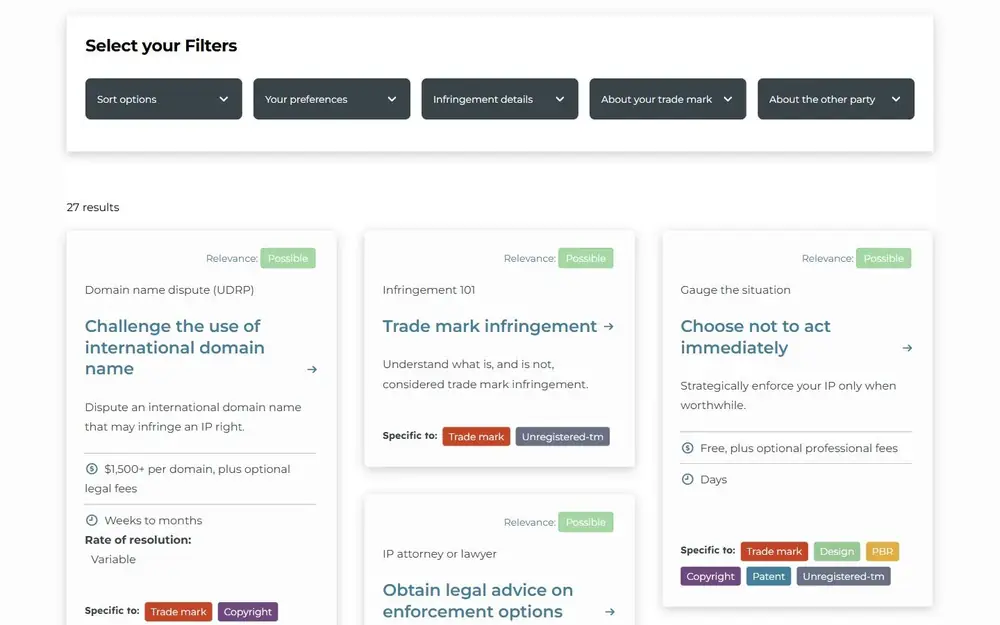
Seeing “free, days to weeks” next to “$80,000+, years” on the same screen is a useful reality check. It makes clear that court is rarely the first step, and that there are quieter, cheaper options worth understanding before anything escalates. The tool is also upfront that there usually won’t be one clear answer: you may have several options to consider, and some can be used together.
The figures are general indications, not quotes, so treat them as a starting point for planning rather than a budget.
The Chatbot: ask it in your own words
If you’d rather describe your problem than click through filters, the IP First Response Chatbot lets you type a question in plain English. It suggests starters like “What are my options if a competitor has accused me of infringing their intellectual property?” and “How could I address an IP issue and keep a good business relationship?”
To see how it handles a common scenario, we asked: “A competitor has sent me a letter saying my business name infringes their registered trade mark. What are my options?”
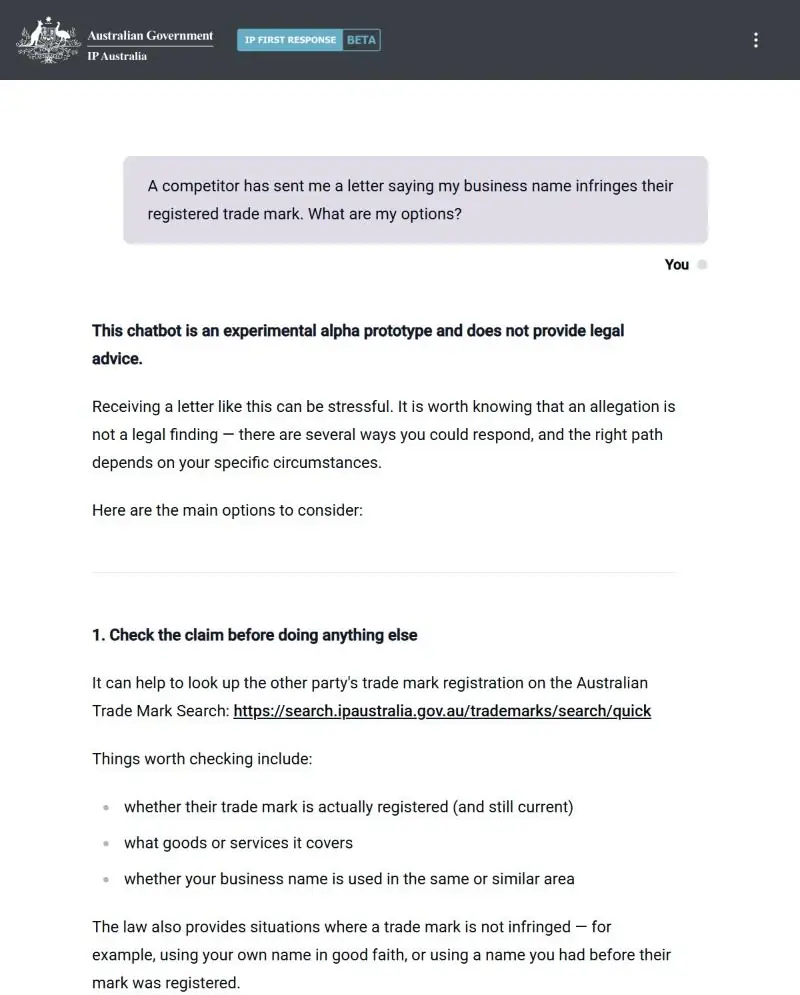
The answer opened by reminding us that the chatbot is an experimental prototype and doesn’t provide legal advice, then pointed out that an allegation isn’t a legal finding. It set out five options in a sensible order: check the claim on the trade mark register first, get advice from an IP professional, try to negotiate, consider challenging the other party’s registration, and treat court as a last resort. Each option came with a short note on benefits and risks. It also made a point many founders miss: registering a business name doesn’t give you trade mark rights.
Under each answer you’ll find plain-English explanations of key terms (such as revocation and passing off), the sources the answer drew on, and suggested follow-up questions to keep digging.
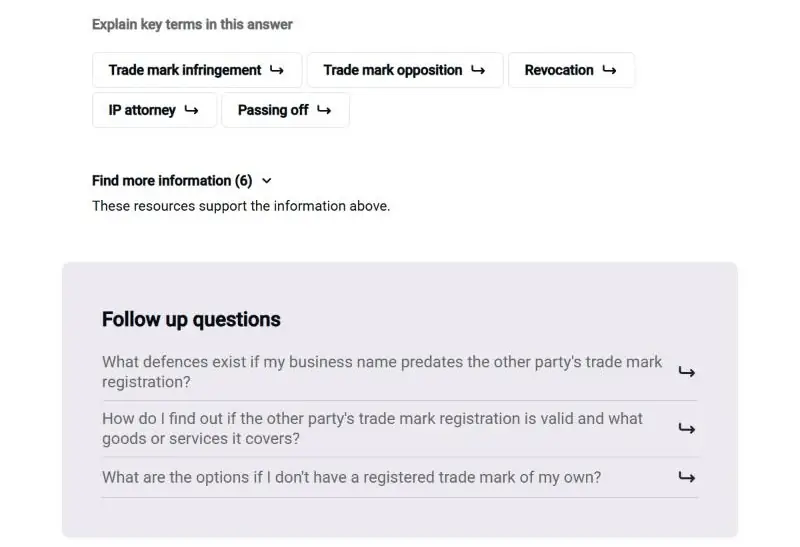
IP Australia’s explanation of how the chatbot works is refreshingly transparent. A few points worth knowing:
- It works like a librarian, not an IP expert. It searches a curated library, mostly IP First Response content plus selected IP Australia web pages, and summarises what it finds with links to the source pages.
- It can’t browse the open internet. If the answer isn’t in its library, it should say it doesn’t know. It may also decline questions outside its scope or ask follow-up questions.
- It can still get things wrong. Like any AI tool, it can be inaccurate or give information that applies to another country’s laws. Check the linked sources for anything important.
- No account needed. It doesn’t remember previous sessions and nothing is kept in your browser once a session ends, so use the Download chat button if you want a record.
- Keep sensitive details out. The input box asks you to avoid sensitive details. IP Australia says a filter tries to strip common personal information before conversations are stored (in Australia), but it doesn’t catch everything.
If you’d prefer not to use AI at all, the Navigator covers the same ground with filters instead.
Infringement 101 and the rest of the library
Behind both tools sits a library of more than 100 plain-language guides, and you can browse the whole lot without using the Navigator at all. Highlights include:
- Infringement 101: what does and doesn’t count as infringement for trade marks, patents, designs, PBRs, copyright and unregistered trade marks, plus how to avoid infringing others and what to consider overseas.
- Receiving a letter of demand: what to look for in the letter, what the sender is actually asking for, and why ignoring it without advice is usually a bad idea.
- Prevention guides: IP audits, IP strategy, contract clauses, monitoring competitors and your supply chain, and when rebranding is the smarter move.
- Easy English versions of several key guides.
- A blog with articles from Australian IP lawyers and attorneys on topics like start-up IP basics and AI-generated infringement allegations.
For the technically minded, the entire library is also published as an open data feed under a CC BY 4.0 licence, so businesses and developers can build it into their own tools with attribution.
What IP First Response doesn’t do
IP Australia is careful and consistent about the limits, and it’s worth taking them seriously. In its own words and disclaimers:
- It isn’t legal advice. It doesn’t provide legal, financial, business or other professional advice, and it’s not a substitute for it.
- It doesn’t tell you what to do. None of the content should be read as recommending a particular course of action. The decision stays with you.
- It can’t decide whether infringement has happened. Only a court can confirm that.
- It isn’t guaranteed to be complete or error-free. You’re expected to check the information against your own circumstances.
- It’s a pilot. Content and features may change as it’s tested and refined.
Even the Chatbot opens with a notice headed “Chatbots aren’t lawyers”, which sets expectations well.
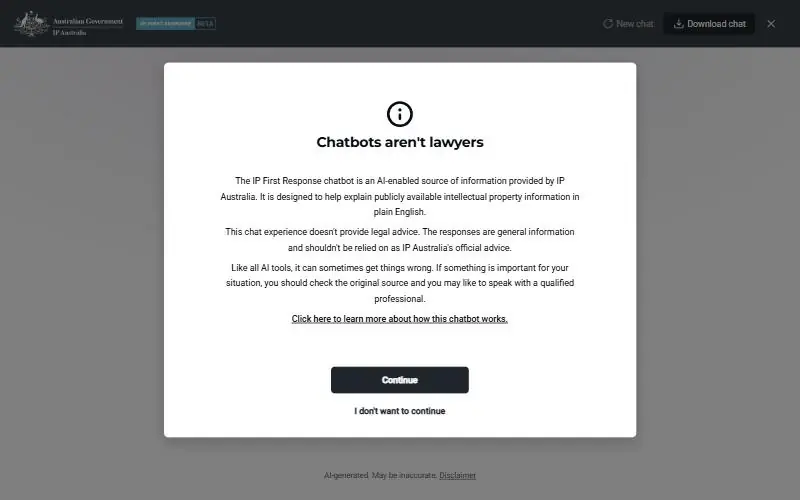
One caution from the site is worth repeating: only the owner of an IP right (or someone entitled to act for them) can start infringement proceedings, and if you make a false claim of infringement, you could be liable for damages. Being better informed cuts both ways.
A first stop, not a replacement for a lawyer
The best way to think about IP First Response is as preparation. It won’t replace a qualified IP attorney or lawyer, but it can help you understand the landscape before you speak to one: which right is involved, what the realistic options are, roughly what each costs and how long it takes.
That matters. Walking into a first meeting already understanding the difference between a letter of demand, mediation and a court case means less time (and fewer billable hours) spent on the basics, and more time on your actual situation. For anything with real money or a real deadline attached, such as a letter of demand or a takedown that’s hurting sales, professional advice is still the right next step. You can find a registered IP attorney through the Trans-Tasman IP Attorneys Board.
Where searching fits in
One of the first things IP First Response suggests, whichever side of a dispute you’re on, is checking the register. If someone claims rights over a name, logo, invention or design, you want to know whether those rights are real, current and actually cover the goods or services in question. If you think you’ve been copied, it’s worth searching the other party’s name, business name and possible associates to see what they hold.
That’s exactly the kind of quick check ATMOSS is built for. You can search Australian trade marks, patents, designs and Plant Breeders’ Rights from one box, with results straight from IP Australia’s official databases. Look up the owner, the status and what the right covers in seconds, then take that into IP First Response or a conversation with your adviser.
Just remember that a search tells you what’s on the register, not whether infringement has occurred. That’s a legal question, and it’s where professional advice comes in.
Getting the most out of it
- Start with your situation. Pick the starting point that fits, and use the Navigator if you want to compare options side by side.
- Search the register early. Confirm what rights actually exist, who owns them and their status.
- Use the Chatbot for specific questions, then follow its links to the source pages.
- Keep a record. Download chats and note the options that seem relevant to you.
- Don’t sit on a letter of demand. Read it carefully and get professional advice before you respond.
- Share your feedback. It’s a pilot, and IP Australia is actively asking for input through its feedback form.
IP disputes are stressful, and a lot of that stress comes from not knowing what your options are. IP First Response won’t make the decision for you, but it does make the options visible, and for many small businesses that’s the hardest part.
ATMOSS is an independent gateway and is not affiliated with IP Australia or the Australian Government. IP First Response is a service of IP Australia. Screenshots were taken from the IP First Response website in November 2026 and the tool may have changed since. This article is general information only and is not legal advice.