
Application Number: AU 2024430251
Advanced Sealing Assembly Enhances Cold Drink Machine Durability
This patent introduces a multi-layer sealing assembly that significantly improves both durability and sealing performance. The innovative system comprises three primary components: an outer sleeve that contacts the rotating shaft, a through sleeve embedded around it for structural support, and a fixed sleeve positioned on the evaporator casing interior. The through sleeve passes through the
View the Advanced Sealing Assembly Enhances Cold Drink Machine Durability PDF
Download the PDF version of this Application Open to Public Inspection
Cold drink dispensers are essential commercial appliances that blend refrigeration with precision engineering. The evaporator, a critical component, must maintain a perfect seal between its rotating shaft and the outer casing to prevent leakage and contamination. This invention addresses a persistent problem in the industry: existing sealing solutions deteriorate over time, allowing material leakage that can compromise both the product quality and machine reliability.
The Problem
Current sealing devices used in cold drink machine evaporators rely on a single seal that cannot compensate for wear during operation. As the seal degrades, leakage becomes inevitable, potentially introducing mold growth and creating serious safety hazards including electrical short-circuits. The wear rate accelerates without a self-compensating mechanism, requiring frequent maintenance and reducing the effective service life of the equipment.
Traditional sealing assemblies cannot adapt to the surface irregularities that develop as components age. This static approach fails to accommodate the micro-movements and friction inherent in continuous operation. For high-volume beverage manufacturers, equipment downtime directly impacts productivity and profitability.
What This Invention Does
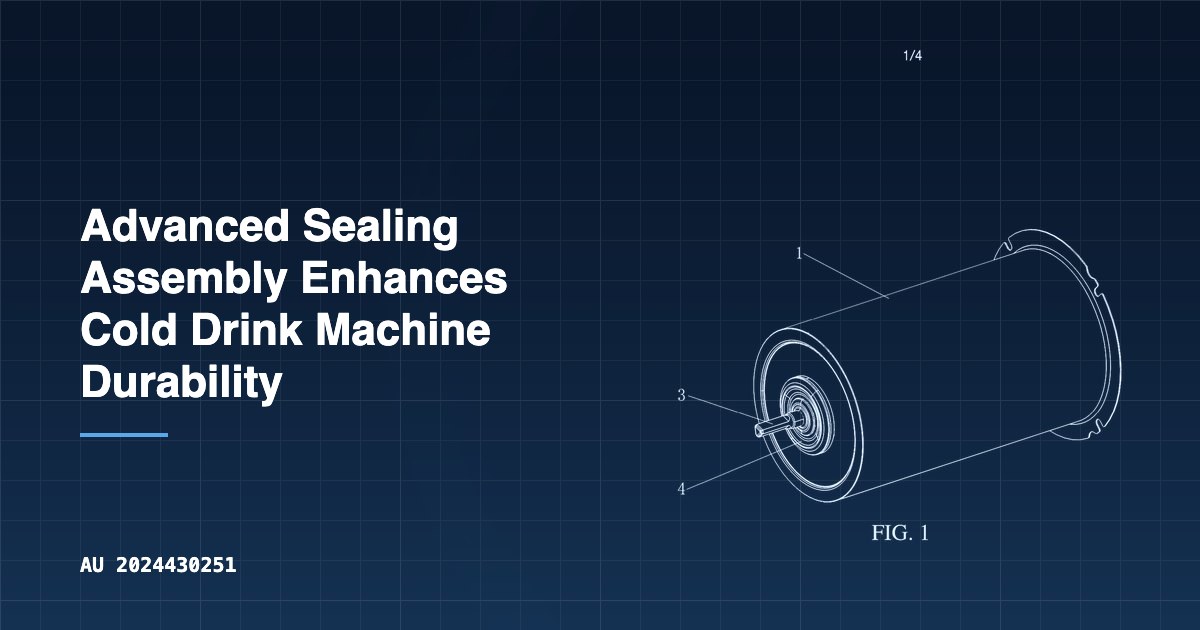
This patent introduces a multi-layer sealing assembly that significantly improves both durability and sealing performance. The innovative system comprises three primary components: an outer sleeve that contacts the rotating shaft, a through sleeve embedded around it for structural support, and a fixed sleeve positioned on the evaporator casing interior. The through sleeve passes through the front opening and embeds within the fixed sleeve through a gasket sleeve, creating a robust assembly.
The breakthrough lies in the elastic material composition of both the outer and inner sleeves. Made from materials like rubber or nylon, these components maintain continuous contact with the rotating shaft even as they gradually wear. The elastic properties allow the sealing assembly to self-compensate by automatically adjusting its contact surfaces, maintaining effective sealing throughout the machine’s operational life. Reinforcement strips and matching tracks throughout the assembly provide additional structural stability and vibration reduction.
Key Features
- Multi-Layer Design. The assembly features an outer sleeve, through sleeve, and inner sleeve working in concert to maintain contact with the rotating shaft while accommodating wear.
- Elastic Material Construction. Rubber or nylon components provide flexibility and self-compensation for surface wear, extending the seal’s effective lifespan.
- Structural Reinforcement. Matching reinforcement strips and tracks distributed throughout the assembly minimize vibration and enhance mechanical stability.
- Gasket System. First and second gasket sleeves positioned strategically reduce friction and provide additional sealing surfaces for enhanced protection.
- Self-Adjusting Contact. The inner sleeve with secondary contact portions maintains pressure on the shaft automatically, compensating for minor degradation without manual intervention.
Who Is Behind It?
The invention is attributed to inventor Zhou Quan and managed by Guangzhou Xin’an Trading Co., Ltd., a China-based manufacturer specializing in refrigeration and beverage dispensing equipment. The patent was filed through Australian patent attorney Patents AU Pty Ltd, indicating a strategy to secure intellectual property protection in the Asia-Pacific region and potential international markets. The priority filing dates from August and September 2024 in China demonstrate the rapid path from development to international filing.
Why It Matters
For manufacturers of cold drink dispensers and similar refrigeration equipment, this innovation offers substantial economic benefits. Reducing seal failures translates directly into lower warranty costs, fewer service calls, and increased customer satisfaction. The self-compensating mechanism extends equipment service life, a critical selling point in a competitive market where total cost of ownership significantly influences purchasing decisions.
More broadly, this solution represents a shift toward intelligent material engineering in industrial applications. Rather than designing for periodic replacement, the assembly is engineered to adapt and perform reliably throughout its intended operational period. This approach aligns with contemporary sustainability objectives by reducing waste and extending product lifecycles.
Related Concepts
Mechanical seals are critical components in rotating equipment across many industries, preventing fluid leakage where a shaft passes through a housing. In refrigeration systems, the evaporator relies on such seals to maintain system integrity and hygiene, particularly in food and beverage applications where contamination risks are high.
The choice of elastomeric materials like rubber and nylon in sealing applications directly determines wear resistance and service life. Self-compensating seal designs represent an important development in tribology – the science of friction, wear, and lubrication – enabling longer maintenance intervals in commercial equipment.
AU 2024430251 was published in the Australian Official Journal of Patents on 19 March 2026 and is open for public inspection. Patent applications represent inventions that are sought to be protected and do not necessarily reflect commercially available products.
Related Patents Open to Public Inspections
See related Patents open to public inspection.

Advanced Spiral Stirring Mechanism Solves Ice Machine Distribution Problems

Smart Infrared Induction Revolutionizes Cold Drink Machine Operation

Advanced Discharging Mechanism for Cold Drink Dispensers Eliminates Splashing

Integrated Drive Body System for Cold Beverage Makers
Disclaimer
The information presented in this article is provided for general informational and illustrative purposes only.
Content on this page may be derived from publicly available intellectual property records, including patent documentation and related materials. While reasonable care is taken in compiling and summarising this information, ATMOSS does not guarantee the accuracy, completeness, currency, or reliability of any content presented.
This article is not a substitute for reviewing the original source documents. Patent applications, specifications, claims, and related records may contain detailed technical, legal, and contextual information that is not fully represented in this summary.
ATMOSS does not provide legal, technical, or commercial advice. Users should not rely on this content for decision-making purposes.
For authoritative and up-to-date information, users should refer directly to the official records available via IP Australia and other relevant intellectual property databases. Links to these official sources are provided where applicable.
ATMOSS accepts no liability for any loss, damage, or consequences arising from the use of, or reliance on, the information contained in this article.