
Application Number: AU 2026201928
Battery Connections and Metallized Film Components in Energy Storage Safer Internal Fuses for Lithium Batteries
The patent provides tab and connection structures for a lithium battery cell that has an internal fuse component. The tabs are designed to carry current from the internal part of the cell to the outside to power a device, while working together with the thin film metallized current collectors. According to the patent, these tabs

View the Battery Connections and Metallized Film Components in Energy Storage PDF
Download the PDF version of this Application Open to Public Inspection
This patent describes the electrical connections, the tabs and current collectors, used inside a lithium battery cell that contains an internal fuse for safety. It comes from the Soteria Battery Innovation Group, an organisation focused on making lithium-ion batteries inherently safer.
The Problem
Lithium-ion batteries store a lot of energy in a small space, which is what makes them useful and also what makes a failure dangerous. One safety strategy is to build a fuse-like behaviour into the cell using thin metallized film current collectors, which can break the internal circuit if a fault causes excessive current, helping to prevent thermal runaway. But this creates an engineering tension. The tabs that carry current out of the cell to power a device must connect reliably to these very thin films, stay firmly in place during use, handle high current and temperature, and still allow the fuse behaviour to work. Welding sturdy tabs to delicate metallized films, without losing either the safety function or the electrical performance, is difficult.
What This Invention Does
The patent provides tab and connection structures for a lithium battery cell that has an internal fuse component. The tabs are designed to carry current from the internal part of the cell to the outside to power a device, while working together with the thin film metallized current collectors. According to the patent, these tabs deliver several things at once: enough mechanical pull strength to stay in place during use, complete coverage with the thin film current collectors for good electrical conductivity, and effective welds at the contacts. The result is a connection that handles surprisingly high current and resists temperature while preserving the internal fuse safety behaviour. The patent frames this as a practical improvement to the lithium battery art.
Key Features
- Internal fuse compatible. The connections work with a cell that has an internal fuse component.
- Strong tab attachment. The tabs offer high pull strength so they stay in place during use.
- Full film coverage. Tabs fully contact the thin metallized current collectors for good conductivity.
- Effective welds. Welded contacts handle high amperage and resist temperature.
- Safety preserved. The design keeps the internal fuse behaviour that guards against runaway faults.
Who Is Behind It
The applicant is Soteria Battery Innovation Group Inc., a consortium-based organisation that develops and licenses safer lithium-ion battery technologies. The named inventors are Brian G. Morin and Carl C. Hu.
Why It Matters
As lithium-ion batteries power everything from phones to vehicles to grid energy storage, reducing the risk of fire and thermal runaway is a priority for industry and regulators alike. Internal-fuse designs using metallized films are a promising safety route, but they only work if the everyday connections can be made robustly. Solving the tab and weld problem makes the safety approach manufacturable at scale. Protecting the technology in Australia supports its adoption by local battery and product makers.
Related Concepts
- Lithium-ion battery – the energy storage device this work makes safer.
- Thermal runaway – the dangerous failure mode the internal fuse guards against.
- Current collector – the conductive layer the tabs connect to.
- Metallized film – the thin coated material used as a fusible collector.
- Soteria Battery Innovation Group – the organisation behind the safety technology.
AU 2026201928 was published in the Australian Official Journal of Patents on 2 April 2026 and is open for public inspection. Patent applications represent inventions that are sought to be protected and do not necessarily reflect commercially available products.
Related Patents Open to Public Inspections
See related Patents open to public inspection.

Next-Generation Electrodes for Efficient Power Generation and Water Processing
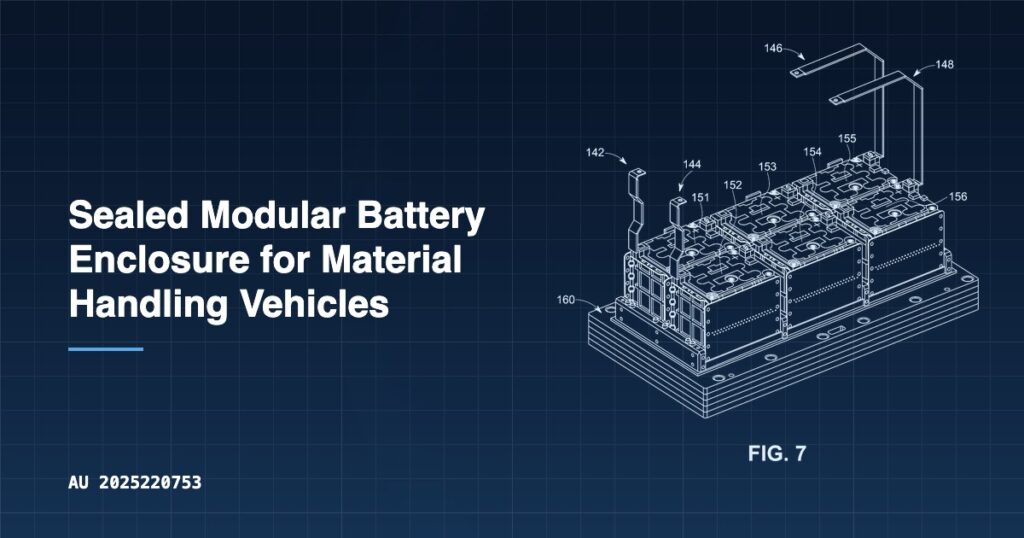
Sealed Modular Battery Enclosure for Material Handling Vehicles

Isolated Switching Architecture for Battery Heating Management
Disclaimer
The information presented in this article is provided for general informational and illustrative purposes only.
Content on this page may be derived from publicly available intellectual property records, including patent documentation and related materials. While reasonable care is taken in compiling and summarising this information, ATMOSS does not guarantee the accuracy, completeness, currency, or reliability of any content presented.
This article is not a substitute for reviewing the original source documents. Patent applications, specifications, claims, and related records may contain detailed technical, legal, and contextual information that is not fully represented in this summary.
ATMOSS does not provide legal, technical, or commercial advice. Users should not rely on this content for decision-making purposes.
For authoritative and up-to-date information, users should refer directly to the official records available via IP Australia and other relevant intellectual property databases. Links to these official sources are provided where applicable.
ATMOSS accepts no liability for any loss, damage, or consequences arising from the use of, or reliance on, the information contained in this article.