
Application Number: AU 2026201552
Better Absorbed, More Effective An Amorphous Form of Pretomanid for Improved Tuberculosis Treatment
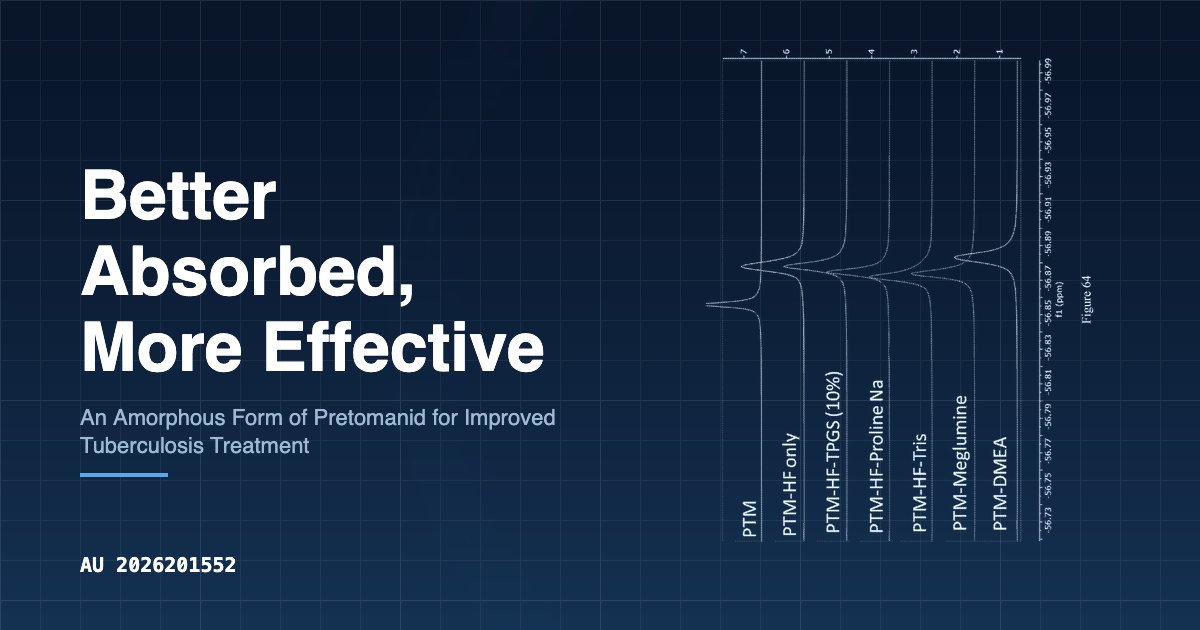
The invention describes pretomanid in amorphous form - a disordered solid state that lacks the regular crystal lattice of the conventional crystalline form. Amorphous solids typically have higher surface energy and greater solubility than their crystalline counterparts, which can translate to improved dissolution rate and oral bioavailability.
View the Better Absorbed, More Effective PDF
Download the PDF version of this Application Open to Public Inspection
The Global Alliance for TB Drug Development has patented an amorphous form of pretomanid – a key component of one of the few new antibiotic regimens approved for drug-resistant tuberculosis in decades. The amorphous form offers improved pharmaceutical properties over the crystalline form of the drug, potentially enabling better bioavailability and more effective treatment of a disease that kills over a million people every year.
The Problem
Tuberculosis (TB) remains one of the world’s deadliest infectious diseases, estimated to kill approximately two million people annually. The emergence of drug-resistant TB strains – including multidrug-resistant TB (MDR-TB) and extensively drug-resistant TB (XDR-TB) – has made treatment increasingly difficult. Patients with drug-resistant TB face treatment regimens lasting up to two years, with high rates of side effects, poor adherence and treatment failure.
Pretomanid is a relatively new antibacterial agent approved as part of a three-drug combination regimen (with bedaquiline and linezolid) specifically for XDR-TB and treatment-intolerant MDR-TB. It works through a novel mechanism – inhibiting mycobacterial cell wall synthesis and generating toxic reactive nitrogen species – that makes it effective against strains resistant to conventional TB drugs.
a persistent challenge with many pharmaceutical compounds is that their crystalline form – the most thermodynamically stable solid state – may have poor water solubility and thus poor oral bioavailability. If the drug dissolves slowly in the gastrointestinal tract, less of it reaches the bloodstream, reducing therapeutic efficacy and potentially requiring higher doses to achieve the desired effect. The amorphous form of a drug is typically more soluble than its crystalline counterpart, as it lacks the ordered lattice structure that resists dissolution.
What This Invention Does
The invention describes pretomanid in amorphous form – a disordered solid state that lacks the regular crystal lattice of the conventional crystalline form. Amorphous solids typically have higher surface energy and greater solubility than their crystalline counterparts, which can translate to improved dissolution rate and oral bioavailability.
By developing and characterising the amorphous form of pretomanid, and protecting it with a patent, the TB Alliance creates the intellectual property foundation for formulations of pretomanid that take advantage of these improved properties. The invention covers the amorphous form of the compound itself and its use in treating mycobacterial infections, including tuberculosis.
The pharmaceutical formulation aspects of the patent – including the use of microparticle and nanoparticle formulation approaches (covered under A61K 9/16) – provide pathways to stabilising the amorphous form in a pharmaceutical product, addressing the inherent tendency of amorphous solids to recrystallise over time.
Key Features
Amorphous solid form. The disordered solid state of pretomanid offers greater solubility and potentially improved bioavailability compared to the crystalline form – key advantages for a drug administered orally to patients who may also have compromised gastrointestinal absorption.
Mycobacterial infection treatment. The amorphous form is specifically claimed for use in treating mycobacterial infections – covering both tuberculosis and related conditions caused by mycobacterial species.
Microparticle and nanoparticle formulation. The IPC classification A61K 9/16 covers microparticle and nanoparticle pharmaceutical formulations – approaches that can stabilise amorphous drug material and control its dissolution profile.
Drug-resistant TB relevance. Pretomanid’s primary indication is in combination therapy for drug-resistant TB – one of the most difficult-to-treat infectious disease presentations – making improvements to its pharmaceutical properties directly relevant to global TB control.
Respiratory and antibacterial coverage. IPC classifications A61P 11/00 (respiratory disease), A61P 31/04 (antibacterials) and A61P 31/06 (antimycobacterials) reflect the full therapeutic scope of the invention.
Who Is Behind It?
The Global Alliance for TB Drug Development, Inc. (TB Alliance) is a non-profit organisation dedicated to accelerating the discovery and development of new, faster-acting and affordable tuberculosis drugs. It played a central role in the development and regulatory approval of pretomanid. The inventors are Rajneesh Taneja and Poonam G. Pande. This application is a divisional of AU 2022214530, with priority to a US provisional application filed 1 February 2021. The application is managed by Griffith Hack in Melbourne.
Why It Matters
The global battle against drug-resistant TB is one of the most pressing challenges in infectious disease medicine. The approval of pretomanid as part of the BPaL regimen (bedaquiline, pretomanid, linezolid) was a landmark development – providing a six-month oral treatment option for patients with virtually no other choices. Any improvement in the pharmaceutical properties of pretomanid – including better bioavailability through amorphous formulation – could translate to improved treatment outcomes for patients with the most severe forms of this devastating disease.
The TB Alliance’s work represents the best tradition of non-profit pharmaceutical innovation: filling the gaps left by commercial market incentives to develop treatments for diseases that predominantly affect low-income populations. With IPC classifications spanning the drug’s chemistry (C07D 498/04), formulation (A61K 9/16, A61K 31/5365) and therapeutic application (A61P 31/04, A61P 31/06), the patent covers the full pharmaceutical development arc for this important amorphous form.
AU 2026201552 was published in the Australian Official Journal of Patents on 19 March 2026 and is open for public inspection. Patent applications represent inventions that are sought to be protected and do not necessarily reflect commercially available products.
Related Concepts
Amorphous solids lack the long-range crystalline order of conventional drug forms, giving them higher surface energy and solubility. In pharmaceutics, amorphous drug formulations can significantly improve oral bioavailability – the fraction of a dose that reaches systemic circulation – which is critical for drugs like pretomanid that must be absorbed reliably in patients who may have compromised gastrointestinal function.
Pretomanid was developed by the TB Alliance and approved by the US FDA in 2019 as part of the BPaL regimen for extensively drug-resistant tuberculosis – only the third new TB drug approved in over 40 years.
Related Patents Open to Public Inspections
See related Patents open to public inspection.

Dissolve and Deliver

Better Shoulder Replacement

A Better Night’s Sleep

BioNTech’s Engineered Endolysins for Bacterial Vaginosis
Disclaimer
The information presented in this article is provided for general informational and illustrative purposes only.
Content on this page may be derived from publicly available intellectual property records, including patent documentation and related materials. While reasonable care is taken in compiling and summarising this information, ATMOSS does not guarantee the accuracy, completeness, currency, or reliability of any content presented.
This article is not a substitute for reviewing the original source documents. Patent applications, specifications, claims, and related records may contain detailed technical, legal, and contextual information that is not fully represented in this summary.
ATMOSS does not provide legal, technical, or commercial advice. Users should not rely on this content for decision-making purposes.
For authoritative and up-to-date information, users should refer directly to the official records available via IP Australia and other relevant intellectual property databases. Links to these official sources are provided where applicable.
ATMOSS accepts no liability for any loss, damage, or consequences arising from the use of, or reliance on, the information contained in this article.