
Application Number: AU 2025208482
Construction Machine Control System Adds New Movement Dimensions to Work Tools
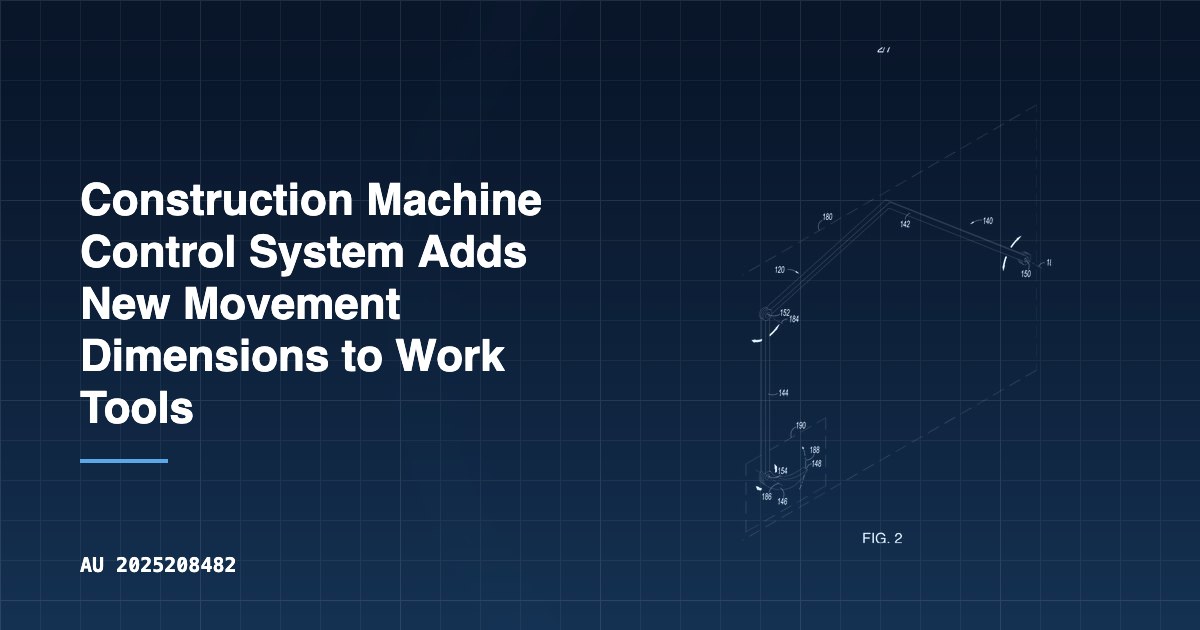
The machine control system integrates trajectory determination, velocity calculation, and coordinated control of multiple movement axes through a unified architecture. The operator specifies a desired trajectory for a point-of-interest on the working tool. The trajectory determination subsystem calculates the required motion path for this point through three-dimensional space.
View the Construction Machine Control System Adds New Movement Dimensions to Work Tools PDF
Download the PDF version of this Application Open to Public Inspection
Construction and forestry machines like excavators and loaders traditionally have fixed work implement geometries with limited movement dimensions. This patent introduces a system for controlling complex attachments that add additional freedom of movement to working tools, enabling machines to manipulate work tools with greater precision and flexibility while maintaining coordinated control across all movement axes.
The Problem
Traditional construction machines achieve working tool positioning through boom-and-arm systems that provide two primary degrees of freedom: vertical positioning and reach. While effective for many tasks, these conventional kinematic systems limit the range of positions accessible to working tools and cannot achieve certain angles or orientations without repositioning the entire machine.
Increasingly complex construction tasks and improving operator expectations have driven demand for work tools with additional movement dimensions. A tool that can additionally tilt and rotate around its own axes independent of boom-arm motion would enable dramatically expanded capability, but adding these movements creates control complexity that manual operator systems struggle to manage.
Coordinating multiple movement axes simultaneously requires sophisticated real-time calculation. An operator specifying desired work tool position and orientation must have the machine control system automatically calculate the required velocities for boom, arm, bucket, tilt, and rotation actuators such that the tool achieves the intended trajectory. Manual independent control of each axis by operators working with complex attachments becomes impractical and dangerous.
The machine control system integrates trajectory determination, velocity calculation, and coordinated control of multiple movement axes through a unified architecture. The operator specifies a desired trajectory for a point-of-interest on the working tool. The trajectory determination subsystem calculates the required motion path for this point through three-dimensional space.
The velocity determination subsystem generates a first set of velocities for work implement components (boom, arm, bucket) that move the point-of-interest along the desired trajectory. Simultaneously, the system generates a second set of velocities for the working tool itself (tilt and rotation movements), enabling the tool to orient appropriately as it moves through the trajectory.
A synchronization subsystem coordinates these two distinct velocity sets, ensuring that boom-arm-bucket movements and tool tilt-rotation movements occur in precisely synchronized timing. The complex attachment control system receives the synchronized velocity commands and actuates all hydraulic systems simultaneously, creating coordinated, smooth motion that the operator perceives as single unified tool movement despite underlying complexity.
Key Features
- Point-of-Interest Trajectory Control. The operator specifies motion for a critical point on the working tool rather than managing individual actuator velocities, providing intuitive control that matches how operators naturally think about positioning work tools.
- Dual Velocity Stream Generation. The system calculates independent velocity sets for implement positioning and tool orientation-rotation, enabling simultaneous control of these distinct motion dimensions with coordinated timing.
- Simplified Complex Bending. Multi-bend sequences that traditionally required multiple setup stages can be accomplished more efficiently with fewer repositioning steps, reducing operator fatigue and improving overall work pace.
- Synchronization Management. A dedicated synchronization subsystem coordinates timing between different velocity streams, ensuring smooth, coordinated motion despite the underlying complexity of managing five or more simultaneously actuated systems.
- Feedback Control Integration. The system incorporates measured velocity feedback from all actuators, enabling real-time correction to maintain intended trajectories despite variations in hydraulic system response or load conditions.
- Complex Attachment Interface. Standardized communication protocols enable integration of diverse complex attachments with varying movement configurations, providing machine manufacturers with modularity and customers with flexibility in tool selection.
Who Is Behind It?
Deere & Company (John Deere), the legendary American manufacturer of agricultural and construction machinery, developed this innovation. Inventors Aaron R. Kenkel, Jeffery W. Dobchuk, and Justin A. Sticksel contributed to the system design, representing Deere’s engineering expertise in heavy equipment control systems. The patent filed in the United States on 27 August 2024 reflects Deere’s forward-looking approach to construction equipment capabilities.
Davies Collison Cave Pty Ltd provides patent representation from their Melbourne office, indicating Deere’s commitment to protecting this technology in Australian and international markets.
Why It Matters
Construction and forestry equipment represents a multi-billion dollar global industry where incremental capability improvements drive significant productivity gains. By expanding the motion dimensions available to working tools, this technology enables single machine configurations to accomplish tasks previously requiring equipment repositioning or multiple machines.
The control architecture also represents sophisticated engineering thinking about managing complexity. Rather than requiring operators to control five or more hydraulic actuators independently, the system abstracts the desired tool behavior and automatically calculates actuator requirements. This reduces operator cognitive load, enables smoother coordinated movements, and improves safety by reducing the possibility of unintended conflicting actuator commands.
The flexibility to accommodate diverse complex attachment designs through standardized control interfaces creates ecosystem potential. Equipment manufacturers can design specialized tools knowing the base machine can provide coordinated control, while machine manufacturers can support diverse specialized tools without redesigning core control systems.
Related Concepts
Hydraulic machinery underlies the motion systems of most modern excavators and construction equipment. Coordinating multiple hydraulic actuators simultaneously is a fundamental control engineering challenge that directly determines how precisely and efficiently a machine can position its working tools across complex three-dimensional workspaces.
Adding degrees of freedom to a mechanical arm is a well-established concept in kinematics and industrial robotics. In heavy equipment, each additional axis of movement multiplies the range of accessible positions while also increasing the computational complexity of coordinated control, requiring sophisticated trajectory planning to remain safe and practical for operators.
AU 2025208482 was published in the Australian Official Journal of Patents on 19 March 2026 and is open for public inspection. Patent applications represent inventions that are sought to be protected and do not necessarily reflect commercially available products.
Related Patents Open to Public Inspections
See related Patents open to public inspection.

Grinding Media Optimization System Reduces Mill Operating Costs

Multimode Autonomous Farming Machine Transforms Plant Treatment Flexibility

Variable Rate Treatment System Uses AI to Optimize Crop Management

Advanced Method for Installing Rock Strata Tendons Improves Underground Construction
Disclaimer
The information presented in this article is provided for general informational and illustrative purposes only.
Content on this page may be derived from publicly available intellectual property records, including patent documentation and related materials. While reasonable care is taken in compiling and summarising this information, ATMOSS does not guarantee the accuracy, completeness, currency, or reliability of any content presented.
This article is not a substitute for reviewing the original source documents. Patent applications, specifications, claims, and related records may contain detailed technical, legal, and contextual information that is not fully represented in this summary.
ATMOSS does not provide legal, technical, or commercial advice. Users should not rely on this content for decision-making purposes.
For authoritative and up-to-date information, users should refer directly to the official records available via IP Australia and other relevant intellectual property databases. Links to these official sources are provided where applicable.
ATMOSS accepts no liability for any loss, damage, or consequences arising from the use of, or reliance on, the information contained in this article.