
Application Number: AU 2026201844
Ex Vivo Organ Care System Keeping Donor Livers Alive and Assessable Outside the Body
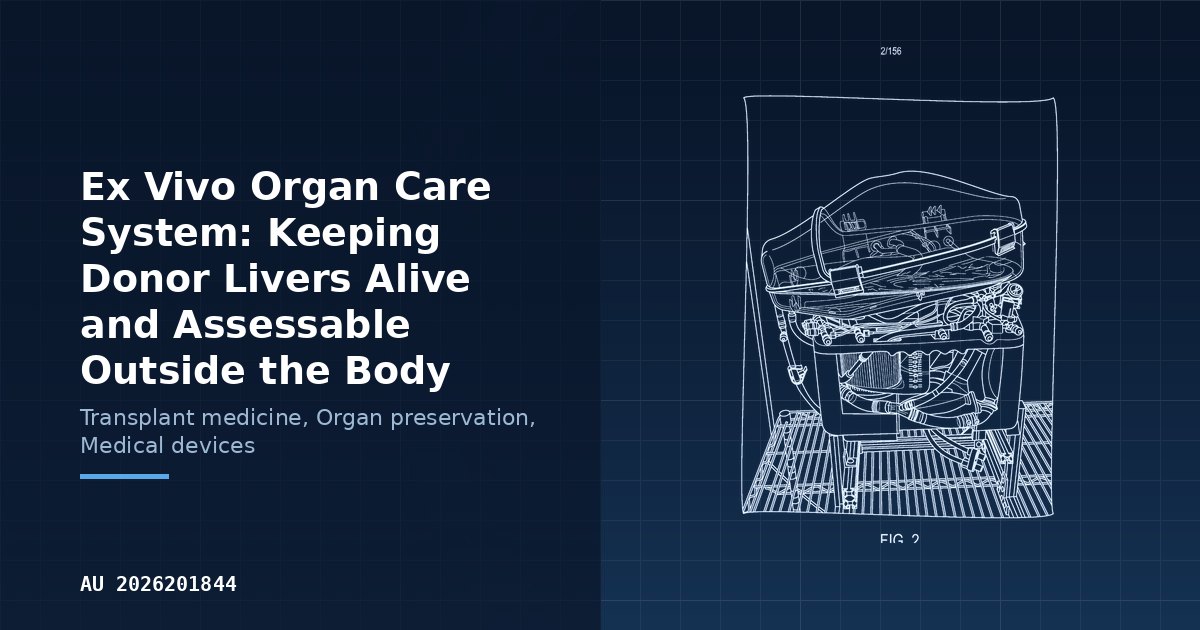
TransMedics' Organ Care System maintains a procured liver at physiologic or near-physiologic conditions outside the body, keeping the organ warm, perfused with oxygenated blood, and metabolically active, rather than cold and static. By mimicking the conditions inside a living body, the system dramatically extends the preservation window, allowing the organ to remain viable for substantially
View the Ex Vivo Organ Care System PDF
Download the PDF version of this Application Open to Public Inspection
This patent covers a system for maintaining and assessing donor livers outside the body at physiologic or near-physiologic conditions, enabling longer preservation times, better organ assessment before transplant, and access to donors that cannot be reached within the time limits of conventional cold storage.
The Problem
Organ transplantation depends on the interval between procurement of a donor organ and its implantation into a recipient remaining short enough that the organ survives without meaningful damage. Conventional preservation relies on packing the organ in ice with a chemical perfusate, reducing metabolic activity through hypothermia. For a liver, this approach typically allows around seven hours of preservation before the organ becomes unsuitable for transplantation. Seven hours is a narrow window that limits how far a recipient can be from the donor, reduces the number of viable recipients who can be matched and reached in time, and forces surgical teams to work under time pressure. Within this window, ischemic damage still accumulates progressively, and because the organ is cold and static, its functional quality cannot be adequately assessed before the decision to transplant. The result is that some marginal livers are discarded out of caution, while others that appear acceptable are transplanted and then fail. The global shortage of transplantable livers means that both outcomes — discard and transplant failure — represent significant losses of life-saving resources.
What This Invention Does
TransMedics‘ Organ Care System maintains a procured liver at physiologic or near-physiologic conditions outside the body, keeping the organ warm, perfused with oxygenated blood, and metabolically active, rather than cold and static. By mimicking the conditions inside a living body, the system dramatically extends the preservation window, allowing the organ to remain viable for substantially longer than is possible with cold storage. The warm perfusion environment also allows clinicians to observe the organ functioning in real time, measuring bile production, vascular resistance, lactate clearance, and other parameters that reflect hepatic function. These assessments can support more confident decisions about whether a marginal organ is suitable for transplantation. The system covers the apparatus, methods, and devices for performing this ex vivo care, with particular application to the liver but in a family of related patents that also addresses the heart and lung.
Key Features
- Warm perfusion at physiologic conditions. The system maintains the liver at temperatures and perfusion conditions that support active cellular metabolism rather than suppressing it, reducing ischemic injury during the preservation period and allowing the organ to perform its normal biological functions outside the body.
- Extended viable preservation time. By avoiding the progressive ischemic damage of cold static storage, the system extends the period during which the organ remains suitable for transplantation, widening the geographic and logistic envelope within which donors and recipients can be matched.
- Real-time organ assessment. Observation of the liver’s functional outputs during perfusion — including bile production, haemodynamic behaviour, and metabolic parameters — enables clinicians to evaluate marginal organs that would otherwise be discarded or transplanted with uncertainty, improving both utilisation of available organs and recipient outcomes.
- Expanded donor pool. Extended preservation time and improved assessment capability together support acceptance of organs from donation after circulatory death (DCD) donors and older or higher-risk donors, categories that cold storage protocols may exclude.
- Deep divisional lineage. This application descends through four prior Australian divisionals back to a 2015 filing and claims priority from 2014, reflecting TransMedics’ long-standing and layered IP strategy around the Organ Care System platform.
Who Is Behind It?
The applicant is TransMedics, Inc., a Massachusetts-based medical device company that commercially markets the Organ Care System for liver, heart, and lung transplantation. The named inventors are Waleed H. Hassanein, Tamer I. Khayal, Ahmed Elbetanony, Jeff Barnes, Greg Ritchie, Richard Bringham, Mark Anderson, and John Sullivan. The application is a divisional of AU 2023200688, itself a divisional of AU 2020270499, of AU 2019206070, and of AU 2015271799 (national phase of PCT/US2015/033839), with priority from US provisional applications filed 2 June 2014. The Australian patent attorney is Spruson and Ferguson in Sydney.
Why It Matters
Australia faces a persistent shortage of transplantable organs. Each year, hundreds of patients on transplant waiting lists deteriorate or die before a suitable organ becomes available. Technology that extends the preservation window for donor livers, enables use of organs from DCD donors, and reduces the transplant failure rate from marginal organs accepted in uncertainty could materially improve outcomes for Australian transplant patients. TransMedics’ OCS is already commercially deployed in transplant centres internationally, and its adoption in Australian hospitals has direct implications for the throughput and outcomes of the liver transplant programmes at institutions such as the Austin Health and Princess Alexandra transplant units. The patent family underpinning the OCS is commercially significant and its Australian filings position TransMedics’ technology for protection and licensing in this jurisdiction.
Related Concepts
The TransMedics OCS belongs to the broader field of machine perfusion, a technique in which donor organs are maintained in a physiologically active state outside the body rather than placed in static cold storage. Normothermic machine perfusion has been shown to extend viability windows and improve assessment of marginal organs for liver, heart, and lung transplantation.
A central challenge addressed by this technology is the management of ischaemic injury – the cellular damage that accumulates when tissue is deprived of oxygenated blood. By keeping the organ warm and perfused, the system reduces ischaemia and enables pre-transplant assessment that cold storage cannot provide, with particular relevance to the expanding use of donation after circulatory death donors.
AU 2026201844 was published in the Australian Official Journal of Patents on 9 April 2026 and is open for public inspection. Patent applications represent inventions that are sought to be protected and do not necessarily reflect commercially available products.
Related Patents Open to Public Inspections
See related Patents open to public inspection.

Wireless Pain Relief

Sterilization Method

Keeping Breathing Equipment Dry

Integrated Drive Body System for Cold Beverage Makers
Disclaimer
The information presented in this article is provided for general informational and illustrative purposes only.
Content on this page may be derived from publicly available intellectual property records, including patent documentation and related materials. While reasonable care is taken in compiling and summarising this information, ATMOSS does not guarantee the accuracy, completeness, currency, or reliability of any content presented.
This article is not a substitute for reviewing the original source documents. Patent applications, specifications, claims, and related records may contain detailed technical, legal, and contextual information that is not fully represented in this summary.
ATMOSS does not provide legal, technical, or commercial advice. Users should not rely on this content for decision-making purposes.
For authoritative and up-to-date information, users should refer directly to the official records available via IP Australia and other relevant intellectual property databases. Links to these official sources are provided where applicable.
ATMOSS accepts no liability for any loss, damage, or consequences arising from the use of, or reliance on, the information contained in this article.