
Application Number: AU 2026201803
Foldable Locking Mechanism Simpler One-Action Folding for Multi-Joint Stroller Frames
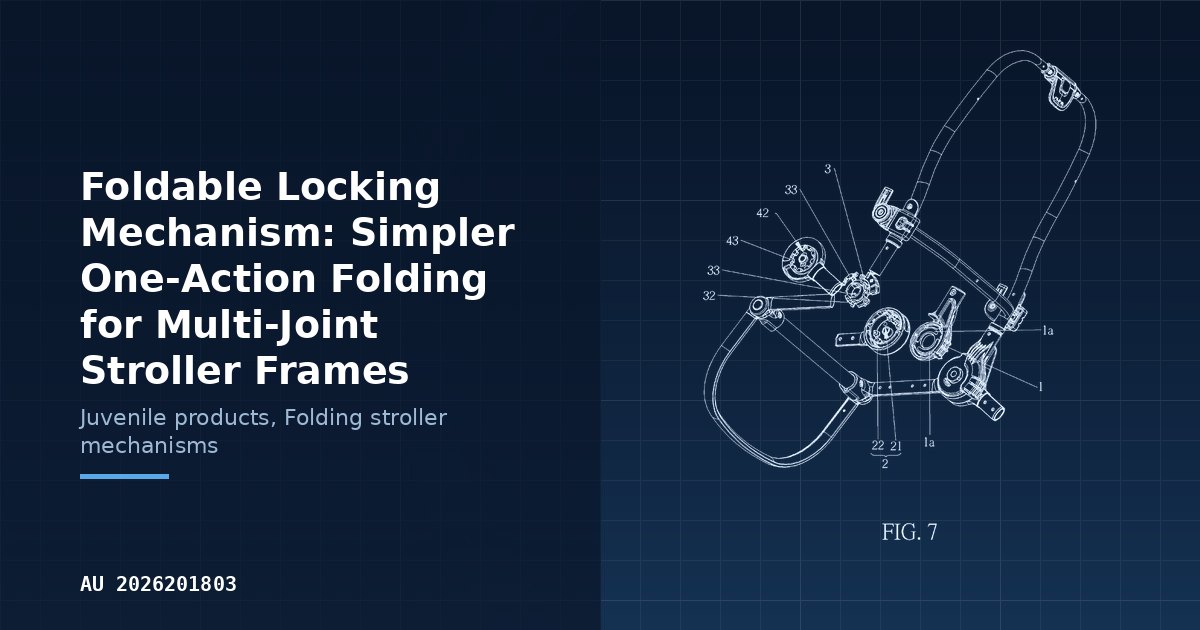
The mechanism organises the frame's joints around a chain of mounting seats, each pivotally connected to the next. A first locking component sits between the second and third mounting seats and toggles between a releasing position (joint free to fold) and a locking position (joint held rigid). A driving component on the first mounting seat
View the Foldable Locking Mechanism PDF
Download the PDF version of this Application Open to Public Inspection
This patent describes a multi-stage locking mechanism for foldable child stroller frames that lets multiple joints unlock at the same time from a single driving action, eliminating the bend-down release button that conventional strollers rely on.
The Problem
A child stroller frame is built from a chain of pivoting rods: backrest, seat, rear leg, front leg, and handle, with locking devices between them so the frame holds its shape when unfolded and collapses for storage. Conventional locking devices have two persistent drawbacks. They tend to be mechanically complex, with separate latches that have to be released individually rather than as a set. And the release control is usually a button somewhere low on the frame, so the carer has to bend down and operate it with one hand while supporting the stroller with the other. Both issues compound when a parent is also holding a child or shopping bags.
What This Invention Does
The mechanism organises the frame’s joints around a chain of mounting seats, each pivotally connected to the next. A first locking component sits between the second and third mounting seats and toggles between a releasing position (joint free to fold) and a locking position (joint held rigid). A driving component on the first mounting seat pushes that locking component into the releasing position when the user starts the folding motion at the top of the frame.
The same single push then propagates down the chain. The first locking component carries an abutting portion that pokes through the third mounting seat to nudge a second locking component, which in turn nudges a third locking component between the fourth and fifth mounting seats. One driving action at the top of the frame therefore releases every joint in the foldable chain in sequence, allowing the whole frame to collapse without the user touching a separate release button.
Key Features
- Cascaded locking components. Up to three locking components in series, each pushing the next, so a single driving action releases multiple joints at once.
- Helical pushing surface. The driving component uses a helical inclined surface against a protrusion on the locking component, converting the natural pivoting motion of unfolding the frame into a smooth axial release stroke.
- Engaging-tooth lock geometry. Each locking component carries an engaging tooth that meshes with left and right engaged teeth on the adjacent mounting seats, holding the joint rigid in the locked position and disengaging cleanly when pushed to the releasing position.
- Resilient return. Each stage includes a resilient component that biases the locking component back to its locking position, so the frame relocks automatically when unfolded again.
- Limiting assembly. A limiting component and slot pair restricts the relative pivot angle of the first and second mounting seats, preventing over-folding during the release stroke.
Who Is Behind It?
The applicant is Wonderland Switzerland AG, the holding company for the Wonderland group, one of the largest manufacturers of child mobility products globally. The group’s brands include Graco, Cybex, Joie, Maxi-Cosi-adjacent product lines and a wide portfolio of stroller and car-seat platforms sold worldwide. The named inventors are Wanquan Zhu and Jialiang Yuan, both based in the group’s mainland-China engineering operations. The Australian filing is a divisional of AU 2024204953 and traces back to PCT/EP2021/059228 with priority from Chinese application 202010284012.7 filed in April 2020. The Australian patent agent is Griffith Hack in Melbourne.
Why It Matters
Folding mechanisms are one of the most patent-active areas in juvenile products, because every percentage point of improvement in one-handed usability translates to real shelf advantage in a competitive category. Replacing a bend-down release button with a top-of-frame folding action that propagates through three coupled joints is the kind of structural change that, once protected, makes it harder for competitors to clone the user experience without redesigning the entire frame architecture. The Australian application sits within a broader international family covering Europe, China and other major child-products markets.
Related Concepts
Folding mechanism design is one of the most competitive and IP-dense areas of stroller engineering. The core challenge is enabling one-handed collapse from the handle while ensuring the frame relocks automatically when unfolded – a usability goal with direct implications for parental safety when holding a child.
Wonderland Switzerland AG, whose portfolio spans brands including Graco and Joie, holds broad IP across juvenile mobility platforms. The Australian filing, handled by patent attorneys Griffith Hack, extends protection from a PCT family with Chinese priority into a significant retail market for premium stroller products.
AU 2026201803 was published in the Australian Official Journal of Patents on 2 April 2026 and is open for public inspection. Patent applications represent inventions that are sought to be protected and do not necessarily reflect commercially available products.
Related Patents Open to Public Inspections
See related Patents open to public inspection.

Smart Leg, Safe Seat

Secure Locking Mechanism for Household and Container Closures


Advanced Child Vehicle Seat Features Innovative Step Configuration
Disclaimer
The information presented in this article is provided for general informational and illustrative purposes only.
Content on this page may be derived from publicly available intellectual property records, including patent documentation and related materials. While reasonable care is taken in compiling and summarising this information, ATMOSS does not guarantee the accuracy, completeness, currency, or reliability of any content presented.
This article is not a substitute for reviewing the original source documents. Patent applications, specifications, claims, and related records may contain detailed technical, legal, and contextual information that is not fully represented in this summary.
ATMOSS does not provide legal, technical, or commercial advice. Users should not rely on this content for decision-making purposes.
For authoritative and up-to-date information, users should refer directly to the official records available via IP Australia and other relevant intellectual property databases. Links to these official sources are provided where applicable.
ATMOSS accepts no liability for any loss, damage, or consequences arising from the use of, or reliance on, the information contained in this article.