
Application Number: AU 2026201809
Game Management System Optimising Casino Floor Throughput Through Connected Tables
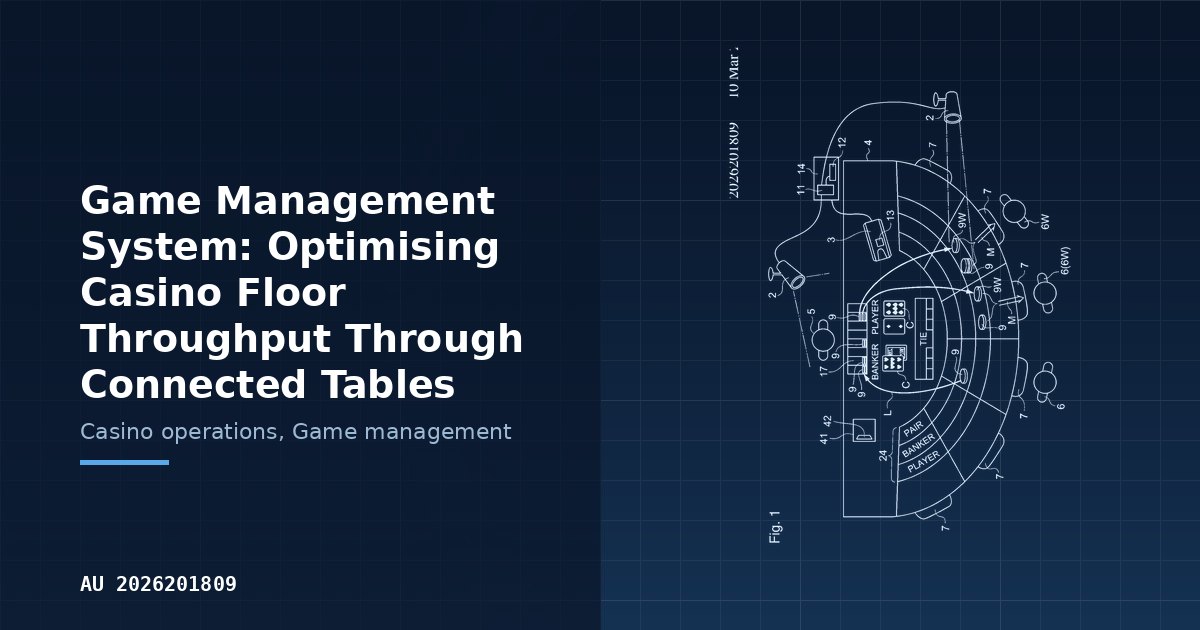
The invention is a centralised management system that gathers continuous data from each gaming table in the casino, including whether the table is open or closed, the number of players seated, the rate of bets, and other operational metrics. The system processes that data to surface decisions to the casino operator: which closed tables should
View the Game Management System PDF
Download the PDF version of this Application Open to Public Inspection
This patent describes a casino-floor game management system that monitors gaming tables in real time and adjusts table availability, dealer placement and player flow to maximise total bet volume across the venue.
The Problem
A casino’s revenue depends on how efficiently the floor is used. A table that is closed because demand is low at one moment but sits idle when demand surges later is a missed earning opportunity, while a table that is left open with too few players ties up a dealer and floor space that could be productive elsewhere. Operators today rely heavily on the experience and observation of pit bosses to decide when to open or close tables. That works at small scale but breaks down across a venue with dozens or hundreds of tables, multiple game variants, and shifting player populations through the day. Without an integrated information layer, the operator cannot tell at a glance whether a closed table is the best one to open next, or whether a particular open table is dragging on staff productivity.
What This Invention Does
The invention is a centralised management system that gathers continuous data from each gaming table in the casino, including whether the table is open or closed, the number of players seated, the rate of bets, and other operational metrics. The system processes that data to surface decisions to the casino operator: which closed tables should be opened next, which open tables can be closed without losing players, and how dealers should be assigned to maximise the aggregate bet amount across the floor.
The system is designed to integrate with table-side hardware: chip and card recognition, dealer-station displays, and player-tracking sensors. The result is a casino-wide picture of demand and a recommendation engine that helps the operator squeeze more revenue from the same dealer headcount.
Key Features
- Real-time state monitoring. Each table reports its open or closed status, player count, and gameplay metrics to a central management server.
- Operator-facing decision view. The system presents an aggregated floor view that highlights opportunities to open or close tables, redirect dealers, or rebalance loads.
- Aggregate bet maximisation logic. Rather than optimising one table in isolation, the system reasons over the whole venue to maximise the total bet amount across all open tables.
- Dealer scheduling support. Helps casino managers position dealers efficiently, including avoiding situations where an open table runs short of players or where a closed table has a queue of waiting customers.
- Hooks into existing gaming-table hardware. Designed to interoperate with chip recognition, card-shoe sensors, and player-card systems already deployed at the table.
Who Is Behind It?
The applicant is Angel Group Co., Ltd., a Japanese gaming-equipment maker headquartered in Kyoto. Angel is one of the largest manufacturers of playing cards and casino-grade chips in the world and a major supplier of casino-floor technology in Asia and beyond. The named inventor is Yasushi Shigeta. The Australian application is a divisional of AU 2024264588 and traces back to Japanese application JP 2018-27023 filed in February 2018. The Australian patent agent is Davies Collison Cave in Melbourne.
Why It Matters
Casino margins are sensitive to dealer hours and table utilisation, and the largest integrated resorts run hundreds of tables across multiple game types simultaneously. The operational challenge of allocating dealers and opening tables in response to fluctuating demand has historically depended on human judgement that does not scale. A system that fuses table-side telemetry with floor-wide optimisation logic has direct revenue impact, and is one of the levers that drives competitive differentiation among integrated-resort operators in Macau, Singapore, the Philippines and Australia. The Australian filing protects the technology in a market with multiple major casino operators.
Related Concepts
Automated floor management systems sit within the broader field of casino operations technology, where real-time telemetry from table hardware – chip-tray sensors, card-shoe readers, player-tracking cards – feeds recommendation engines that help managers optimise dealer deployment and table utilisation across large integrated resorts.
Angel Group‘s filing extends its hardware expertise – playing cards and casino chips – into software-driven floor intelligence, a category where the marginal revenue impact of better table-game allocation decisions can be substantial in high-volume venues.
AU 2026201809 was published in the Australian Official Journal of Patents on 2 April 2026 and is open for public inspection. Patent applications represent inventions that are sought to be protected and do not necessarily reflect commercially available products.
Related Patents Open to Public Inspections
See related Patents open to public inspection.

Know Your Player

Betting on Intelligence

Eyes on the Table

Smart Gaming Tables
Disclaimer
The information presented in this article is provided for general informational and illustrative purposes only.
Content on this page may be derived from publicly available intellectual property records, including patent documentation and related materials. While reasonable care is taken in compiling and summarising this information, ATMOSS does not guarantee the accuracy, completeness, currency, or reliability of any content presented.
This article is not a substitute for reviewing the original source documents. Patent applications, specifications, claims, and related records may contain detailed technical, legal, and contextual information that is not fully represented in this summary.
ATMOSS does not provide legal, technical, or commercial advice. Users should not rely on this content for decision-making purposes.
For authoritative and up-to-date information, users should refer directly to the official records available via IP Australia and other relevant intellectual property databases. Links to these official sources are provided where applicable.
ATMOSS accepts no liability for any loss, damage, or consequences arising from the use of, or reliance on, the information contained in this article.