
Application Number: AU 2026201619
Growing Tissues That Work A Microphysiological Platform for 3D Tissue Culture
The invention addresses the stimulation challenge by embedding electrodes directly within the microphysiological platform. Rather than positioning electrodes externally for each tissue culture well, the electrodes are integrated into the device architecture itself - present and precisely positioned relative to the tissue growth area as an inherent feature of the platform design.
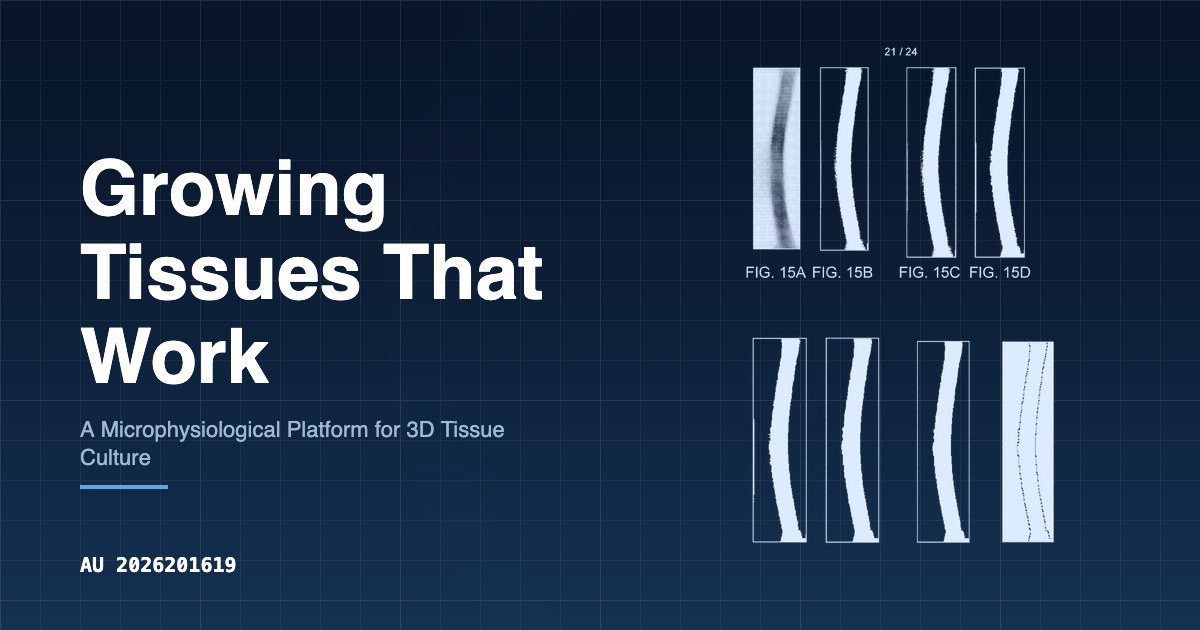
View the Growing Tissues That Work PDF
Download the PDF version of this Application Open to Public Inspection
A team of researchers from the University of Toronto and Valo Health, Inc. have filed a patent for a microphysiological platform that incorporates embedded electrodes for growing and stimulating three-dimensional tissue cultures. The invention enables scalable, automated electrical stimulation of engineered tissues – an advance with significant implications for drug discovery, disease modelling and regenerative medicine.
The Problem
The drug discovery and development pipeline has a fundamental problem: most compounds that show promise in cell culture and animal models fail when tested in humans. One major reason is that flat, two-dimensional cell cultures grown in standard laboratory dishes are poor models of how cells behave in actual human tissues. Cells in the body are organised in three dimensions, interact with a complex extracellular matrix, and receive mechanical, chemical and electrical signals from their environment. The disconnect between simple 2D cultures and the complexity of living tissue is a major contributor to the estimated 90 per cent failure rate of drug candidates in clinical trials.
Microphysiological systems – also called organ-on-chip or tissue-on-chip platforms – have emerged as a transformative approach to this problem. By engineering three-dimensional tissue constructs that more closely resemble the architecture, function and microenvironment of actual organs and tissues, these platforms can provide better predictions of how drugs, toxins and disease states affect human biology. Three-dimensional cardiac tissue models, for example, can beat spontaneously and respond to electrical stimulation in ways that much more closely mirror actual heart muscle than any 2D culture system.
However, microphysiological platforms face significant practical challenges. Providing electrical stimulation to 3D tissue constructs typically requires electrodes to be manually positioned near the tissue, which is imprecise, difficult to scale for high-throughput applications, and not amenable to automation. Without scalable electrical stimulation, these platforms cannot be practically deployed for drug screening programmes that require testing hundreds or thousands of compounds across large numbers of tissue samples.
What This Invention Does
The invention addresses the stimulation challenge by embedding electrodes directly within the microphysiological platform. Rather than positioning electrodes externally for each tissue culture well, the electrodes are integrated into the device architecture itself – present and precisely positioned relative to the tissue growth area as an inherent feature of the platform design.
This embedded electrode approach enables scalable, automated tissue stimulation. Because the electrodes are part of the device structure, the same electrical stimulation programme can be applied consistently and simultaneously to multiple tissue culture units without manual electrode positioning. Automated control systems can deliver precise, programmed stimulation protocols to all constructs in parallel, enabling high-throughput screening and reducing variability between individual tissue samples.
The platform is designed to grow, maintain and use 3D tissues in vitro – supporting both the formation and the ongoing culture of three-dimensional tissue constructs, not just their stimulation. The combination of 3D culture architecture and embedded electrical stimulation creates an integrated system for producing physiologically relevant tissue models that are practically compatible with drug discovery workflows.
Key Features
Embedded electrode integration. Electrodes are built directly into the microphysiological platform rather than being positioned externally, ensuring consistent and precise electrode placement relative to the 3D tissue construct in every well.
Scalable automated stimulation. The embedded design enables automated delivery of electrical stimulation to multiple tissue culture units simultaneously, making the platform suitable for high-throughput drug screening applications.
3D tissue culture support. The platform is specifically designed for growing and maintaining three-dimensional tissue constructs, supporting the formation of tissue architectures that more closely resemble in vivo biology than conventional 2D cultures.
Multi-well scalability. The device architecture supports scaling across many replicate culture units, enabling the statistical power needed for meaningful drug discovery assays.
Academic-commercial collaboration. The joint applicants include individual researchers (Boyang Zhang, Milica Radisic and Yimu Zhao) and Valo Health, Inc., reflecting a translational research pathway from academic innovation to commercial development.
Who Is Behind It?
This invention arises from the laboratory of Professor Milica Radisic at the University of Toronto, a world leader in cardiac tissue engineering and microphysiological systems. Professor Boyang Zhang and Dr Yimu Zhao are co-inventors and collaborators in this research programme. Valo Health, Inc. is a US-based AI-driven drug discovery company that has partnered with academic groups to translate research into commercial applications. The inventor team also includes Keith Yeager. The application is filed through Adams Pluck in Sydney and is a divisional of an earlier filing (AU 2020427585).
Why It Matters
The global pharmaceutical industry invests enormous resources in drug discovery and development, yet the majority of drug candidates fail – at great financial cost and with delayed benefits to patients. Improving the predictive accuracy of preclinical testing is one of the most important ways to reduce this failure rate and accelerate the delivery of effective medicines to patients.
Microphysiological systems with embedded electrodes represent a significant step toward better preclinical models for electrically active tissues, particularly cardiac and neurological tissues. The ability to apply consistent, automated electrical stimulation to 3D cardiac tissue constructs at scale means these platforms can be integrated into high-throughput drug screening workflows – enabling the testing of many more compounds against more physiologically relevant tissue models than was previously practical. For cardiac drug development in particular – where predicting electrophysiological effects and cardiotoxicity is critical – embedded electrode platforms could meaningfully improve the predictive value of preclinical testing and reduce the rate of costly late-stage clinical failures.
AU 2026201619 was published in the Australian Official Journal of Patents on 19 March 2026 and is open for public inspection. Patent applications represent inventions that are sought to be protected and do not necessarily reflect commercially available products.
Related Concepts
Organ-on-chip and microphysiological platforms are part of a broader effort to replace or reduce animal models in drug development. By incorporating engineered three-dimensional tissues that respond to physiological stimuli, these platforms promise better predictions of human drug responses. Electrically active tissues – particularly cardiac and neuronal – are among the most important targets, and the ability to deliver consistent, automated stimulation at scale is a key enabling step for high-throughput drug screening.
Related Patents Open to Public Inspections
See related Patents open to public inspection.

Growing Blood Cells from Stem Cells

Targeting the Root of Alzheimer’s

Construction Machine Control System Adds New Movement Dimensions to Work Tools
Thermoreversible Polymers with Improved Stability and Methods and Uses Thereof
Disclaimer
The information presented in this article is provided for general informational and illustrative purposes only.
Content on this page may be derived from publicly available intellectual property records, including patent documentation and related materials. While reasonable care is taken in compiling and summarising this information, ATMOSS does not guarantee the accuracy, completeness, currency, or reliability of any content presented.
This article is not a substitute for reviewing the original source documents. Patent applications, specifications, claims, and related records may contain detailed technical, legal, and contextual information that is not fully represented in this summary.
ATMOSS does not provide legal, technical, or commercial advice. Users should not rely on this content for decision-making purposes.
For authoritative and up-to-date information, users should refer directly to the official records available via IP Australia and other relevant intellectual property databases. Links to these official sources are provided where applicable.
ATMOSS accepts no liability for any loss, damage, or consequences arising from the use of, or reliance on, the information contained in this article.