
Application Number: AU 2026201935
Image or Video Coding Using Deblocking Filtering Sharper Compressed Video by Smoothing Block Edges
The patent sets out a way to perform deblocking filtering in which the filter length is determined on the basis of the distance between block boundaries. The deblocking is then carried out according to that filter length. By tying how far the filter reaches to the spacing of the boundaries, the method aims to enhance

View the Image or Video Coding Using Deblocking Filtering PDF
Download the PDF version of this Application Open to Public Inspection
This patent describes an improvement to video coding, the compression that makes streaming and storing video practical, focused on the deblocking filter that smooths out the visible edges between compression blocks. It comes from LG Electronics, a major contributor to international video standards.
The Problem
Modern video codecs compress a picture by splitting it into rectangular blocks and encoding each one. This is efficient, but at low bit rates it produces a tell-tale flaw: the boundaries between blocks become visible as hard edges, an artefact known as blocking. A deblocking filter is applied to soften these boundaries and restore a smoother, more natural image. The challenge is choosing how strongly and how widely to filter at each boundary. Filter too little and the blocky edges remain; filter too much, or over too long a span, and you blur real detail and waste processing power. Getting the filter length right at each block boundary is therefore central to balancing picture quality against complexity.
What This Invention Does
The patent sets out a way to perform deblocking filtering in which the filter length is determined on the basis of the distance between block boundaries. The deblocking is then carried out according to that filter length. By tying how far the filter reaches to the spacing of the boundaries, the method aims to enhance the picture quality of the image or video while keeping the process efficient. The patent notes benefits in subjective picture quality relative to complexity, and a simplification of the hardware design, meaning the approach is designed to be both effective and practical to build into chips and decoders. The method applies to image and video coding generally.
Key Features
- Distance-based filter length. Filter length is set from the distance between block boundaries.
- Boundary-aware deblocking. The smoothing is applied according to the chosen filter length.
- Better picture quality. The approach targets improved subjective image quality.
- Complexity control. It balances quality against processing complexity.
- Hardware friendly. The design aims to simplify decoder hardware.
Who Is Behind It
The applicant is LG Electronics Inc., the South Korean technology company and an active participant in developing video compression standards. The named inventor is Hyeongmoon Jang.
Why It Matters
Video accounts for the majority of internet traffic, so even small gains in how cleanly a codec reconstructs a compressed picture have a large cumulative impact on quality and bandwidth. Deblocking is a standard but important stage, and a method that picks filter length intelligently can improve what viewers see while keeping decoders simple enough for phones and televisions. Securing the technique in Australia supports the company’s standards and product interests in the local market.
Related Concepts
- Deblocking filter – the exact tool this patent improves.
- Video coding format – the compression context the method operates in.
- Compression artifact – the blocky flaw deblocking sets out to reduce.
- Versatile Video Coding – a modern standard where such filtering matters.
- LG Electronics – the company behind the invention.
AU 2026201935 was published in the Australian Official Journal of Patents on 2 April 2026 and is open for public inspection. Patent applications represent inventions that are sought to be protected and do not necessarily reflect commercially available products.
Related Patents Open to Public Inspections
See related Patents open to public inspection.

Video Signal Encoding and Decoding Method, and Apparatus Therefor

Transform-Based Image Coding Method, and Apparatus Therefor
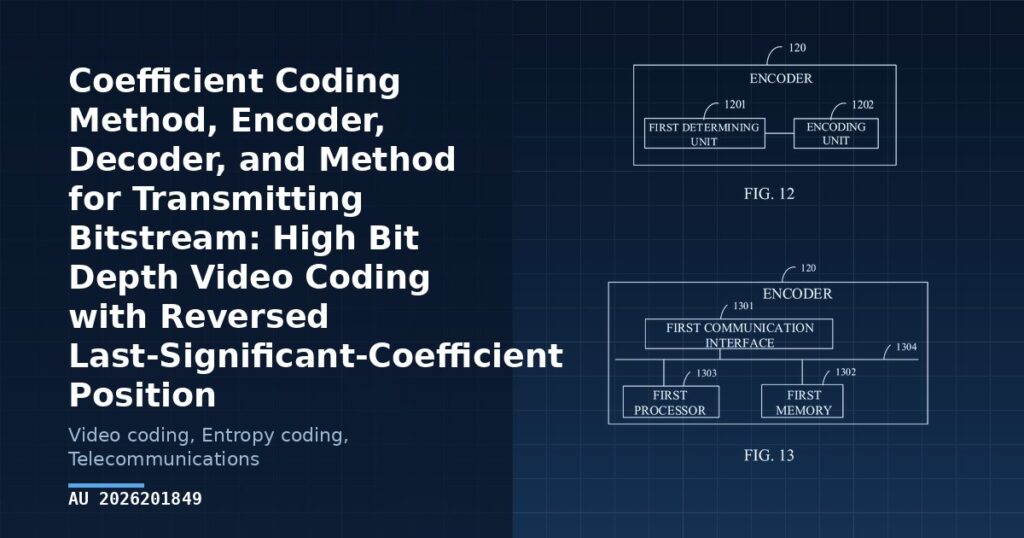
Coefficient Coding Method, Encoder, Decoder, and Method for Transmitting Bitstream
Disclaimer
The information presented in this article is provided for general informational and illustrative purposes only.
Content on this page may be derived from publicly available intellectual property records, including patent documentation and related materials. While reasonable care is taken in compiling and summarising this information, ATMOSS does not guarantee the accuracy, completeness, currency, or reliability of any content presented.
This article is not a substitute for reviewing the original source documents. Patent applications, specifications, claims, and related records may contain detailed technical, legal, and contextual information that is not fully represented in this summary.
ATMOSS does not provide legal, technical, or commercial advice. Users should not rely on this content for decision-making purposes.
For authoritative and up-to-date information, users should refer directly to the official records available via IP Australia and other relevant intellectual property databases. Links to these official sources are provided where applicable.
ATMOSS accepts no liability for any loss, damage, or consequences arising from the use of, or reliance on, the information contained in this article.