
Application Number: AU 2026201403
Innovative Patient Interfaces for Respiratory Therapy
Fisher & Paykel Healthcare has developed innovative patient interface designs that address these multiple requirements. The interfaces feature ergonomic designs that improve wearer comfort during extended use, advanced sealing mechanisms that maintain effective therapy delivery without excessive force, and simplified application procedures. The innovations represent a comprehensive approach to improving the patient experience in respiratory
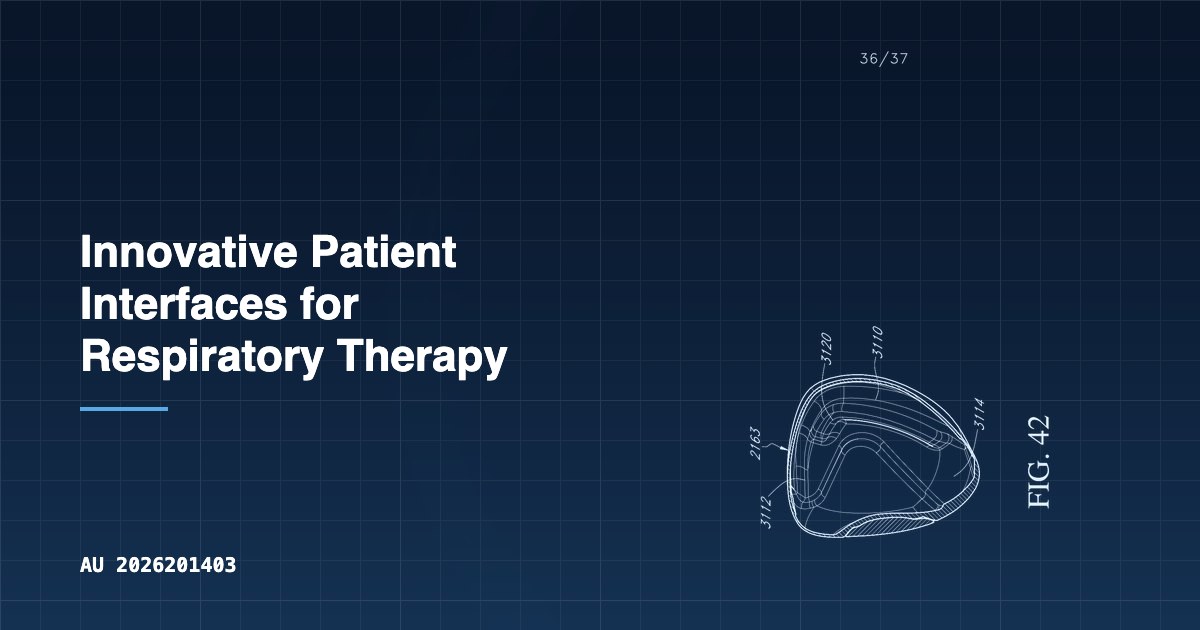
View the Innovative Patient Interfaces for Respiratory Therapy PDF
Download the PDF version of this Application Open to Public Inspection
Fisher & Paykel Healthcare Limited, a New Zealand-based medical device company, has developed innovative patient interfaces for respiratory therapy. This patent describes novel interface designs that improve patient comfort, seal quality, and ease of use for devices such as CPAP and BIPAP machines used in treating sleep apnea and other respiratory conditions.
The Problem
Patient interfaces for respiratory therapy – the masks and headgear worn during CPAP, BIPAP, and other respiratory support – are critical to therapy success and patient compliance. Patients must wear these devices for extended periods, often during sleep, making comfort paramount. However, interfaces must simultaneously maintain adequate seal quality to deliver therapeutic gas flow and pressure levels.
Challenges include: achieving comfort during long wear periods, maintaining consistent seal quality without excessive pressure, accommodating diverse patient facial anatomies, and simplifying application and removal procedures. Poor interface design leads to reduced patient compliance, therapy failure, skin irritation, and decreased treatment efficacy for sleep apnea and respiratory conditions.
What This Invention Does
Fisher & Paykel Healthcare has developed innovative patient interface designs that address these multiple requirements. The interfaces feature ergonomic designs that improve wearer comfort during extended use, advanced sealing mechanisms that maintain effective therapy delivery without excessive force, and simplified application procedures. The innovations represent a comprehensive approach to improving the patient experience in respiratory therapy.
The interfaces are designed based on understanding of patient needs and feedback, combined with advanced engineering and materials science. The result is equipment that supports better patient compliance and therapy outcomes in respiratory support applications.
Key Features
Ergonomic Design. Improved design for enhanced patient comfort during extended wear.
Seal Quality. Advanced sealing mechanism ensuring consistent gas delivery.
Ease of Use. Simplified interface application and removal procedures.
Respiratory Therapy Applications. Suitable for CPAP, BIPAP, and other respiratory support devices.
Who Is Behind It?
Fisher & Paykel Healthcare Limited is a major medical device company headquartered in New Zealand. The company specializes in respiratory care, acute care, and other medical devices used in hospital and home settings. The patent involves contributions from multiple inventors including Fadi Karim Moh’d Mashal, Kirstin Elizabeth Middelkoop, Roheet Patel, Peter David Alexander Bearne, Mark Andrew Thompson, and others, representing combined expertise in medical device design and respiratory care.
Why It Matters
Sleep apnea affects millions of people worldwide, and effective CPAP/BIPAP therapy significantly improves health outcomes and quality of life. However, poor interface design is a major cause of therapy non-compliance. Innovations that improve patient comfort and ease of use directly impact treatment success rates and patient health outcomes.
The IPC classification A61M 16/06 for respiratory protection and therapeutic devices reflects the medical device focus. Fisher & Paykel’s innovation contributes to improving respiratory therapy outcomes globally, demonstrating the importance of patient-centered medical device design.
AU 2026201403 was published in the Australian Official Journal of Patents on 19 March 2026 and is open for public inspection. Patent applications represent inventions that are sought to be protected and do not necessarily reflect commercially available products.
Related Concepts
Sleep apnea is a common condition in which breathing repeatedly stops during sleep, with obstructive sleep apnea (OSA) being the most prevalent form. CPAP therapy is the gold-standard treatment, but patient compliance is limited by comfort and usability of the interface. Improved respiratory therapy mask design – addressing seal, fit, and ease of use – directly impacts treatment success rates and long-term patient health outcomes for millions of users worldwide.
Related Patents Open to Public Inspections
See related Patents open to public inspection.

Advanced Respiratory Therapy

Smart Medical Devices Talk to Each Other
Medical Device Innovation

Gene Therapy Breakthrough
Disclaimer
The information presented in this article is provided for general informational and illustrative purposes only.
Content on this page may be derived from publicly available intellectual property records, including patent documentation and related materials. While reasonable care is taken in compiling and summarising this information, ATMOSS does not guarantee the accuracy, completeness, currency, or reliability of any content presented.
This article is not a substitute for reviewing the original source documents. Patent applications, specifications, claims, and related records may contain detailed technical, legal, and contextual information that is not fully represented in this summary.
ATMOSS does not provide legal, technical, or commercial advice. Users should not rely on this content for decision-making purposes.
For authoritative and up-to-date information, users should refer directly to the official records available via IP Australia and other relevant intellectual property databases. Links to these official sources are provided where applicable.
ATMOSS accepts no liability for any loss, damage, or consequences arising from the use of, or reliance on, the information contained in this article.