
Application Number: AU 2026201604
Precision Stapling for Bariatric Surgery Standard Bariatrics’ Flexible End Effector
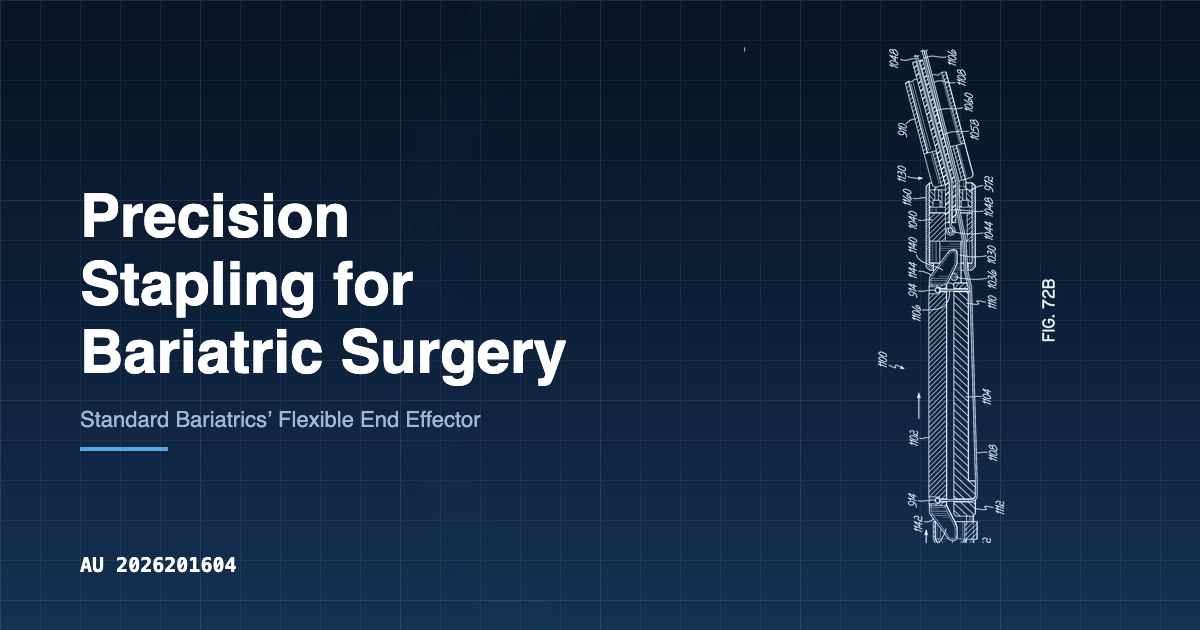
Standard Bariatrics' invention uses a flexible member routed through the shaft of the stapling device to operate the clamping mechanism of the end effector. The end effector comprises an anvil and a cartridge whose ends are coupled together. Crucially, each of these components can be inserted through a trocar separately, with assembly or final positioning
View the Precision Stapling for Bariatric Surgery PDF
Download the PDF version of this Application Open to Public Inspection
Standard Bariatrics, Inc. has filed a patent for a surgical end effector and stapling device designed for use in minimally invasive bariatric and gastrointestinal procedures. The invention uses a flexible clamping member routed through a shaft to operate an anvil-and-cartridge stapling mechanism from outside the patient’s body, enabling precise tissue control through a trocar without the limitations of conventional laparoscopic staplers.
The Problem
Minimally invasive surgery – including laparoscopic and robotic approaches – has transformed a wide range of abdominal and gastrointestinal procedures, offering patients faster recovery, reduced blood loss and smaller incisions compared to open surgery. In bariatric surgery in particular, procedures such as sleeve gastrectomy and gastric bypass involve the stapling of stomach and bowel tissue, and the precision and reliability of that stapling is directly linked to patient outcomes.
Conventional laparoscopic stapling devices must pass through a trocar – a small port placed through the abdominal wall – and then be operated in the confined space of the abdominal cavity. The challenge is that the end effector (the stapling head that contacts the tissue) must be large enough to grip and staple an adequate length of tissue while still being insertable through the relatively small trocar port. This creates an inherent tension between the operative capability of the instrument and the constraints of minimally invasive access.
Additionally, the clamping mechanism that brings the anvil and cartridge together to grip tissue must be designed to provide consistent, controlled clamping pressure – important because under-clamping risks an incomplete staple line, while over-clamping can cause tissue damage. Achieving reliable clamping through a long, thin laparoscopic instrument shaft adds mechanical complexity, and conventional designs often require the surgeon to apply substantial manual force at the handle to achieve adequate tissue compression at the distal end.
What This Invention Does
Standard Bariatrics’ invention uses a flexible member routed through the shaft of the stapling device to operate the clamping mechanism of the end effector. The end effector comprises an anvil and a cartridge whose ends are coupled together. Crucially, each of these components can be inserted through a trocar separately, with assembly or final positioning occurring inside the patient – enabling a larger effective working size at the tissue than the trocar diameter alone would permit.
The flexible member extends from the clamping mechanism at the handle end of the device, through the shaft, to the end effector where it is coupled to at least one of the anvil and cartridge. When the surgeon operates the clamping mechanism from outside the patient, the flexible member is withdrawn from the end effector, pulling the anvil and cartridge together to clamp the anatomical structure between them. This tension-based actuation through a flexible member provides a consistent, direct mechanical connection between the surgeon’s action at the handle and the tissue clamping at the operative end.
The flexibility of the member means the shaft and end effector can accommodate the bends and angles needed for laparoscopic manoeuvring without the mechanical binding that would occur with a rigid actuating rod. The design allows the instrument to be operated from outside the patient while the end effector performs precise tissue clamping and stapling internally.
Key Features
Insertable anvil and cartridge. Both the anvil and cartridge of the end effector are individually insertable through a trocar, allowing the effective tissue-contact area to be larger than the trocar port size alone.
Flexible tension member actuation. A flexible member routed through the shaft connects the external clamping mechanism to the internal end effector, providing direct, consistent actuation without the limitations of rigid push-pull rods in curved laparoscopic shafts.
Withdrawal-based clamping. Operating the clamping mechanism withdraws the flexible member from the end effector, which draws the anvil and cartridge together to clamp the tissue – a mechanically elegant and reliable actuation principle.
External surgeon control. The surgeon operates the stapling device entirely from outside the patient, with the shaft and flexible member transmitting all required mechanical actions to the end effector within the abdominal cavity.
Bariatric application focus. The device is specifically designed for use in procedures involving stapling of anatomical structures, with clear application to bariatric surgery procedures including sleeve gastrectomy and gastric bypass where precise, reliable stapling is critical to outcome.
Who Is Behind It?
Standard Bariatrics, Inc. is a US-based medical device company focused on surgical tools for bariatric and gastrointestinal procedures. The inventor team includes Jonathan Thompson, Ben Thompson, Richard P. Nuchols, Mark Steven Ortiz and James Wampler – a group with combined expertise in surgical device design, minimally invasive procedures and bariatric surgery. The application is filed through James and Wells Intellectual Property and is a divisional of an earlier filing (AU 2024201597).
Why It Matters
Bariatric surgery is one of the most effective interventions available for severe obesity, producing sustained weight loss and improvement or resolution of associated conditions including type 2 diabetes, sleep apnoea and hypertension in many patients. With obesity rates continuing to rise globally, the demand for bariatric surgical procedures is growing, and the quality of surgical instruments used in these procedures directly affects patient outcomes, operating time and cost.
A stapling device that can be inserted through a standard trocar while providing a larger effective working size – and that uses a flexible actuation mechanism to deliver reliable clamping force – could offer surgeons a more versatile and consistently performing tool. For patients, the potential benefits include reduced operating time, more consistent staple lines and lower complication rates. Standard Bariatrics’ focus on this specific surgical challenge reflects the company’s understanding that incremental but meaningful improvements in surgical device performance can translate into meaningfully better outcomes for a patient population where every complication has real consequences.
AU 2026201604 was published in the Australian Official Journal of Patents on 19 March 2026 and is open for public inspection. Patent applications represent inventions that are sought to be protected and do not necessarily reflect commercially available products.
Related Concepts
Bariatric surgery encompasses procedures performed to treat severe obesity, including sleeve gastrectomy and gastric bypass. These procedures require precise stapling of the stomach and bowel, making the reliability of laparoscopic stapling instruments a critical patient safety consideration.
Surgical stapler design for laparoscopic procedures must balance the geometric constraints of trocar access ports against the need for adequately sized tissue-contact areas. Flexible actuation mechanisms – transmitting clamping force through a curved shaft – are an active area of surgical device engineering innovation.
Related Patents Open to Public Inspections
See related Patents open to public inspection.
Medical Device Innovation

Smarter Surgery

Reshaping the Failing Heart

One Shaft, Three Modes
Disclaimer
The information presented in this article is provided for general informational and illustrative purposes only.
Content on this page may be derived from publicly available intellectual property records, including patent documentation and related materials. While reasonable care is taken in compiling and summarising this information, ATMOSS does not guarantee the accuracy, completeness, currency, or reliability of any content presented.
This article is not a substitute for reviewing the original source documents. Patent applications, specifications, claims, and related records may contain detailed technical, legal, and contextual information that is not fully represented in this summary.
ATMOSS does not provide legal, technical, or commercial advice. Users should not rely on this content for decision-making purposes.
For authoritative and up-to-date information, users should refer directly to the official records available via IP Australia and other relevant intellectual property databases. Links to these official sources are provided where applicable.
ATMOSS accepts no liability for any loss, damage, or consequences arising from the use of, or reliance on, the information contained in this article.