
Application Number: AU 2026201477
Purification of nucleic acids in a microfluidic chip by separation
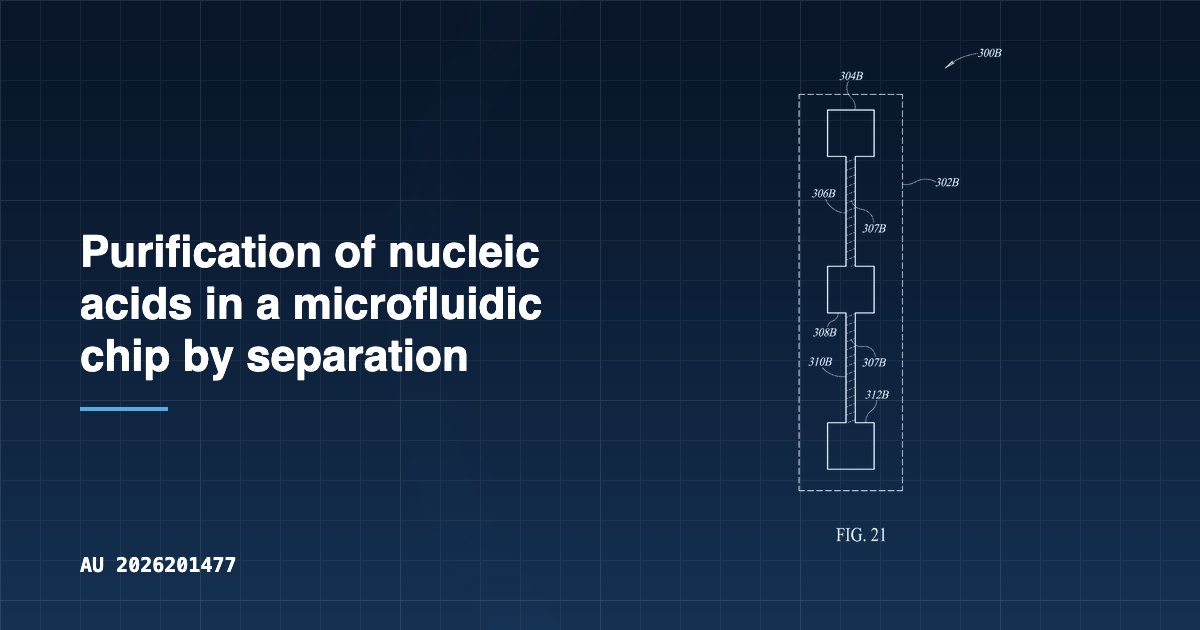
This patent describes a microfluidic chip-based system that performs nucleic acid purification through separation mechanisms optimized at the chip scale. By leveraging the physical properties of microfluidic environments, the system achieves efficient nucleic acid extraction and concentration in a compact, automated format that reduces the time, complexity, and chemical requirements compared to conventional methods.
View the Purification of nucleic acids in a microfluidic chip by separation PDF
Download the PDF version of this Application Open to Public Inspection
This invention introduces a microfluidic approach to nucleic acid purification, enabling rapid, efficient extraction and concentration of genetic material for diagnostic and research applications.
The Problem
Nucleic acid purification is a foundational step in molecular biology, required for diagnostics, research, and clinical testing. Conventional purification methods are labor-intensive, time-consuming, and often require hazardous chemical reagents that pose safety and environmental concerns. The throughput limitations of traditional approaches create bottlenecks in high-volume testing scenarios, such as pandemic response or population screening programs. Current methods also often produce variable results depending on operator technique and starting material quality.
What This Invention Does
This patent describes a microfluidic chip-based system that performs nucleic acid purification through separation mechanisms optimized at the chip scale. By leveraging the physical properties of microfluidic environments, the system achieves efficient nucleic acid extraction and concentration in a compact, automated format that reduces the time, complexity, and chemical requirements compared to conventional methods.
Key Features
Miniaturized Separation System. The microfluidic design performs purification in a compact chip format, reducing reagent consumption and improving efficiency compared to macroscale methods.
Standardized Processing. The chip-based approach minimizes operator-dependent variability, producing consistent results across different users and laboratory settings.
Rapid Turnaround. Microfluidic processing enables significantly faster nucleic acid purification compared to traditional column or precipitation-based methods.
Reduced Chemical Hazards. By minimizing the use of hazardous reagents and enabling automation, the system improves laboratory safety and environmental sustainability.
Scalable Design. The technology can be adapted for various sample volumes and nucleic acid sources, from research applications to clinical diagnostics.
Who Is Behind It?
Revvity Health Sciences Inc., a life sciences company specializing in diagnostic and research technologies, developed this invention with Derek Troiano as the listed inventor. The company’s focus on health science solutions and diagnostic technologies aligns with the clinical and research applications of improved nucleic acid purification. The technology reflects the broader industry trend toward miniaturization and automation in molecular diagnostics.
Why It Matters
Nucleic acid purification is fundamental to modern healthcare and biological research. The classifications under B01L 3/00 and G01N 35/00-35/10 (microfluidic systems and laboratory analysis) highlight the technical sophistication of the invention. With the rise of molecular diagnostics, personalized medicine, and genomic testing, efficient purification technologies have become critical infrastructure. The COVID-19 pandemic demonstrated the importance of rapid nucleic acid testing capabilities at scale, driving investment in technologies that can accelerate and simplify diagnostic workflows. This invention represents progress toward the goal of decentralized, rapid molecular diagnostics accessible in diverse clinical and point-of-care settings.
AU 2026201477 was published in the Australian Official Journal of Patents on 19 March 2026 and is open for public inspection. Patent applications represent inventions that are sought to be protected and do not necessarily reflect commercially available products.
Related Concepts
Microfluidics is the science of manipulating fluids in channels with microscale dimensions, enabling lab-on-a-chip devices that miniaturise entire laboratory workflows into a compact format. These systems reduce reagent use, speed up analysis, and enable automation. In diagnostics, microfluidic purification underpins technologies from rapid COVID-19 tests to genomic sequencing sample preparation, supporting the broader shift toward point-of-care testing in clinical settings.
Related Patents Open to Public Inspections
See related Patents open to public inspection.


Precision Genetic Medicine

Enzyme Therapy Breakthrough
Disclaimer
The information presented in this article is provided for general informational and illustrative purposes only.
Content on this page may be derived from publicly available intellectual property records, including patent documentation and related materials. While reasonable care is taken in compiling and summarising this information, ATMOSS does not guarantee the accuracy, completeness, currency, or reliability of any content presented.
This article is not a substitute for reviewing the original source documents. Patent applications, specifications, claims, and related records may contain detailed technical, legal, and contextual information that is not fully represented in this summary.
ATMOSS does not provide legal, technical, or commercial advice. Users should not rely on this content for decision-making purposes.
For authoritative and up-to-date information, users should refer directly to the official records available via IP Australia and other relevant intellectual property databases. Links to these official sources are provided where applicable.
ATMOSS accepts no liability for any loss, damage, or consequences arising from the use of, or reliance on, the information contained in this article.