
Application Number: AU 2026201437
Samsung’s Flexible QP Signalling Encoding Quantization Parameters at Picture or Slice Level for Efficient Video Compression
The patent describes an encoding and decoding method that introduces a QP difference value flag (also called picture header QP difference value information) into the picture parameter set. This flag tells the decoder whether a QP difference value will be found in the picture header for the current picture or whether QP difference values will

View the Samsung’s Flexible QP Signalling PDF
Download the PDF version of this Application Open to Public Inspection
Video compression relies on quantization to reduce file sizes by controlling the level of detail retained in each part of a video frame. A divisional patent from Samsung Electronics describes a method for more efficiently signalling quantization parameter (QP) values during encoding and decoding, using a flag-based system that allows QP difference values to be transmitted either at the picture level or the slice level depending on the characteristics of the content.
The Problem
In modern video codecs such as VVC (Versatile Video Coding), each picture is divided into coding units – blocks of pixels that are independently quantized. The quantization parameter determines how aggressively the transform coefficients of each coding unit are compressed: a higher QP means more compression and lower quality; a lower QP means less compression and higher quality.
To reconstruct a video correctly, a decoder must know the QP used to quantize each coding unit. In practice, an initial QP value is signalled in the picture parameter set (PPS) for the whole picture, and then a QP difference value is transmitted for each slice or coding unit to allow local adjustments. However, when all slices within a picture use the same QP, transmitting a separate QP difference value for each slice is redundant and wastes bitstream bandwidth. Conversely, when slices have different QP requirements, signalling only at the picture level does not provide sufficient granularity.
There was no efficient mechanism to choose between picture-level and slice-level QP signalling on a per-picture basis while keeping the decoder informed about which approach was used.
What This Invention Does
The patent describes an encoding and decoding method that introduces a QP difference value flag (also called picture header QP difference value information) into the picture parameter set. This flag tells the decoder whether a QP difference value will be found in the picture header for the current picture or whether QP difference values will instead be found in the individual slice headers.
When the flag indicates that a QP difference value is present in the picture header, the encoder transmits a single second QP difference value in the picture header that applies to all slices in the picture. The decoder uses this picture-level value along with the QP initial value to determine the base QP for all slices, then applies any per-coding-unit QP difference value on top of that for fine-grained local adjustments. Importantly, when the picture-level QP is signalled this way, no per-slice QP difference value is transmitted for the individual slices, saving bitstream overhead.
When the flag indicates that the QP difference value is not present in the picture header, the encoder reverts to the conventional approach of transmitting a first QP difference value in each slice header. In this mode, no picture-level QP difference is transmitted.
The approach allows the encoder to choose the more efficient signalling method on a picture-by-picture basis: picture-level signalling for uniform-QP pictures, slice-level signalling for pictures with varying QP requirements.
Key Features
QP difference value flag in PPS. A single flag in the picture parameter set tells the decoder whether to look for the QP difference value in the picture header or in slice headers, enabling picture-by-picture selection of signalling granularity.
Picture header QP signalling. When the flag indicates picture-level signalling, a single QP difference value in the picture header applies to all slices, eliminating per-slice QP overhead for uniform-quality pictures.
Slice header QP signalling. When the flag indicates slice-level signalling, each slice header carries its own QP difference value, providing full per-slice QP control for content requiring variable quality levels.
Coding unit QP refinement. In either mode, a per-coding-unit QP difference value can be signalled relative to the slice QP (or picture QP), allowing fine-grained local quality adjustment within a slice.
Adaptive efficiency. The encoder can assess the QP characteristics of each picture and select whichever signalling mode reduces total bitstream overhead, improving compression efficiency without sacrificing decoding accuracy.
Who Is Behind It?
The applicant is Samsung Electronics Co., Ltd. of the Republic of Korea. The named inventors are Park Minwoo, Park Minsoo, Choi Kiho, Piao Yinji, Kim Chanyul, and Sohn Yumi. This divisional was filed on 26 February 2026, derived from parent application AU 2021206074. Australian patent attorneys Phillips Ormonde Fitzpatrick in Melbourne are managing the application.
Why It Matters
Video compression efficiency has direct commercial and technical significance across streaming, broadcasting, video conferencing, and storage applications. Any reduction in bitstream overhead while maintaining the same decoded quality translates directly into lower bandwidth consumption and storage costs. The QP signalling optimisation described in this patent targets a specific inefficiency in existing codec designs: the mandatory per-slice QP overhead even when all slices in a picture use the same quantization level.
For high-resolution content such as 4K and 8K video, where pictures contain large numbers of slices, the cumulative saving from eliminating per-slice QP values for uniform-quality pictures can be meaningful. The flag-based architecture is also decoder-friendly: the decoder does not need to probe for QP values in multiple locations; the flag in the PPS tells it exactly where to look, minimising parsing overhead and simplifying decoder implementation.
AU 2026201437 was published in the Australian Official Journal of Patents on 19 March 2026 and is open for public inspection. Patent applications represent inventions that are sought to be protected and do not necessarily reflect commercially available products.
Related Concepts
Quantization is the process by which video codecs discard fine spatial detail to achieve compression, with the quantization parameter (QP) controlling the trade-off between file size and visual quality. In Versatile Video Coding (VVC), the latest generation ITU/ISO standard codec, QP can be signalled at the picture, slice, and coding-unit levels.
Efficient QP signalling matters most for high-resolution formats such as 4K and 8K, where each picture may be divided into many slices. Transmitting redundant per-slice QP values when all slices share the same quality level wastes bitstream bandwidth, making adaptive picture-level versus slice-level signalling a meaningful compression efficiency improvement.
Related Patents Open to Public Inspections
See related Patents open to public inspection.

Video Signal Encoding and Decoding Method, and Apparatus Therefor
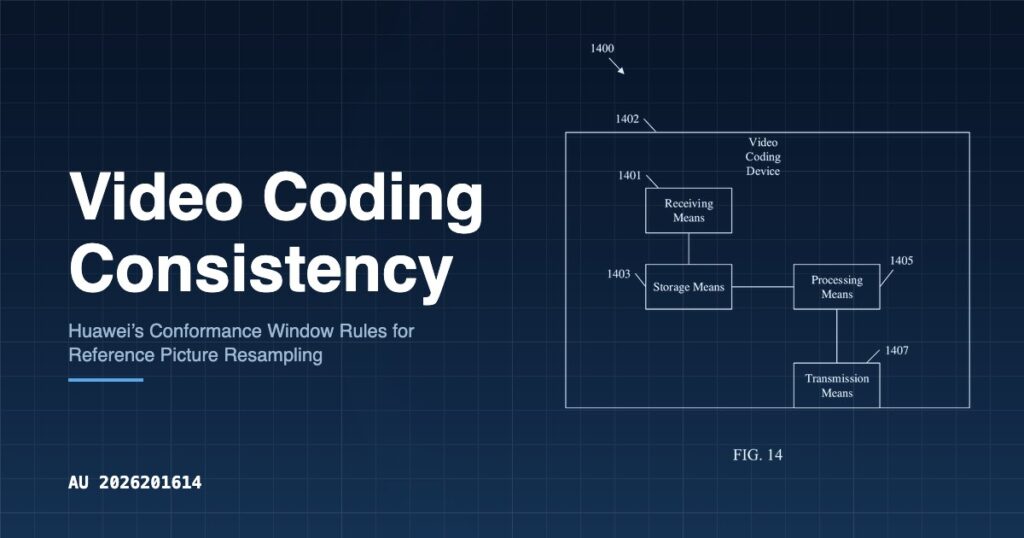
Video Coding Consistency

Transform-Based Image Coding Method, and Apparatus Therefor
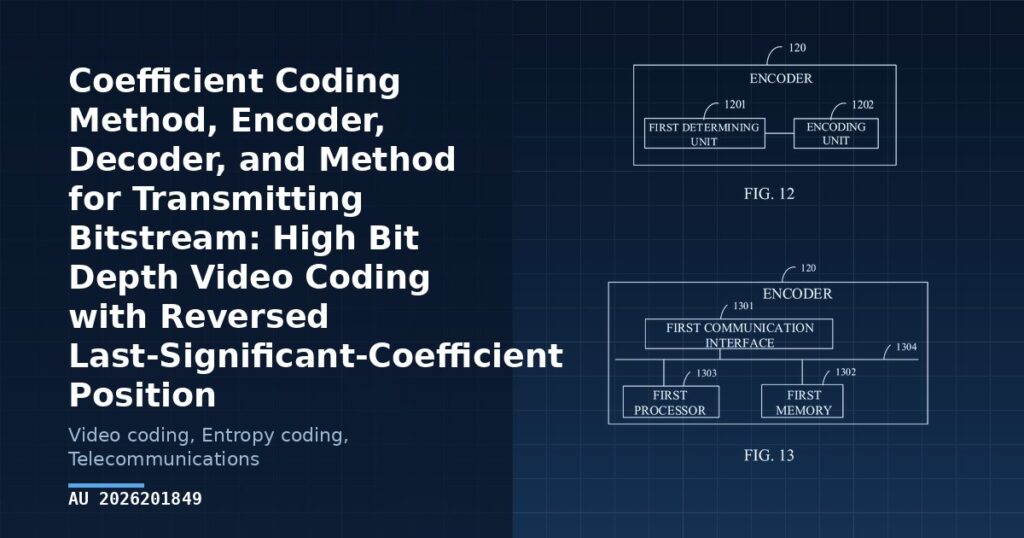
Coefficient Coding Method, Encoder, Decoder, and Method for Transmitting Bitstream
Disclaimer
The information presented in this article is provided for general informational and illustrative purposes only.
Content on this page may be derived from publicly available intellectual property records, including patent documentation and related materials. While reasonable care is taken in compiling and summarising this information, ATMOSS does not guarantee the accuracy, completeness, currency, or reliability of any content presented.
This article is not a substitute for reviewing the original source documents. Patent applications, specifications, claims, and related records may contain detailed technical, legal, and contextual information that is not fully represented in this summary.
ATMOSS does not provide legal, technical, or commercial advice. Users should not rely on this content for decision-making purposes.
For authoritative and up-to-date information, users should refer directly to the official records available via IP Australia and other relevant intellectual property databases. Links to these official sources are provided where applicable.
ATMOSS accepts no liability for any loss, damage, or consequences arising from the use of, or reliance on, the information contained in this article.