
Application Number: AU 2024216549
Smart Heat Pump Water Heating With Predictive Demand Control
The control system collects detailed operational data during an initial learning period, capturing hot water consumption volumes and heat pump operating hours. It then analyzes this data to identify consumption trends and predict future demand with precision. Based on these predictions, the system automatically adjusts heating schedules and operating periods for upcoming delivery windows. The
View the Smart Heat Pump Water Heating With Predictive Demand Control PDF
Download the PDF version of this Application Open to Public Inspection
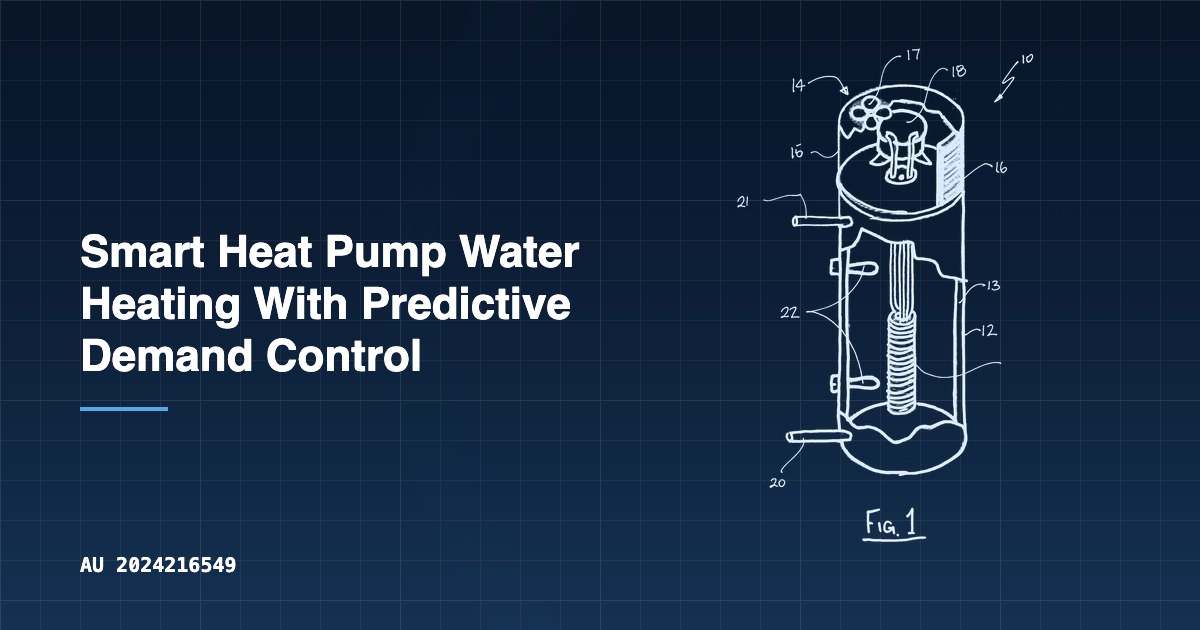
This invention introduces an intelligent control system for storage-type heat pump water heaters that learns household hot water consumption patterns and automatically optimizes heating schedules. By predicting future demand based on historical usage trends, the system reduces energy waste and operational costs while ensuring hot water is available when needed.
The Problem
Traditional heat pump water heaters operate on fixed schedules or respond only to immediate demand, leading to inefficient energy use. Households have varying hot water consumption patterns that change seasonally and throughout the week. Without understanding these patterns, the heating system either runs continuously (wasting energy) or fails to deliver adequate hot water during peak demand periods. This one-size-fits-all approach results in higher operating costs and unnecessary energy consumption, particularly problematic given the growing emphasis on energy efficiency in residential appliances.
What This Invention Does
The control system collects detailed operational data during an initial learning period, capturing hot water consumption volumes and heat pump operating hours. It then analyzes this data to identify consumption trends and predict future demand with precision. Based on these predictions, the system automatically adjusts heating schedules and operating periods for upcoming delivery windows. The result is a water heater that becomes more efficient over time, adapting to the specific household while maintaining water temperature and availability.
Key Features
- Predictive Demand Analysis. The system automatically determines consumption trends from collected historical data, enabling accurate forecasting of future hot water needs without requiring manual input from users.
- Autonomous Schedule Optimization. Heat pump operating hours are adjusted proactively based on predicted demand patterns, eliminating wasted heating cycles while guaranteeing adequate supply.
- Real-Time Adaptation. The control system continuously monitors consumption and updates its predictions, allowing it to adapt to seasonal changes or lifestyle modifications throughout the year.
- Data-Driven Efficiency. By operating the heat pump only when needed and at optimal times, the system significantly reduces electricity consumption and operational costs compared to conventional water heaters.
- User Transparency. The system tracks and displays consumption data and heating efficiency metrics, allowing users to understand their hot water usage patterns and identify conservation opportunities.
Who Is Behind It?
Sanden International (Australia) is a leading manufacturer of heating and air conditioning systems, with this invention developed by inventors Nguyen Van and Mark Irvine. The application was managed by mdp Patent and Trade Mark Attorneys. Sanden brings significant expertise in thermal systems and has a strong track record in developing efficient heating solutions for residential and commercial markets.
Why It Matters
As households and businesses seek to reduce energy consumption and carbon footprints, intelligent heating systems represent a significant opportunity. Water heating accounts for approximately 17-25% of residential energy use in many developed countries. A system that learns and adapts to actual household behavior can deliver meaningful cost savings while improving environmental performance. This technology aligns with global energy efficiency standards and regulatory trends favoring smart, adaptive appliances that optimize resource use without sacrificing comfort.
Related Concepts
Heat pump water heaters use refrigeration cycle technology to extract thermal energy from ambient air, achieving efficiencies two to three times higher than conventional electric resistance heaters. Combining this technology with predictive demand algorithms is part of the broader push toward smart grid-compatible appliances.
Machine learning-based demand forecasting is increasingly applied to residential energy systems to reduce peak load and lower operating costs. As water heating accounts for a substantial share of household energy consumption, autonomous schedule optimisation delivers measurable savings while maintaining user comfort.
AU 2024216549 was published in the Australian Official Journal of Patents on 19 March 2026 and is open for public inspection. Patent applications represent inventions that are sought to be protected and do not necessarily reflect commercially available products.
Related Patents Open to Public Inspections
See related Patents open to public inspection.

Heating Device with Advanced Harmonics Control Enables Better Food Roasting

Precision Ohmic Heating

Isolated Switching Architecture for Battery Heating Management

Predictive Vehicle Monitoring and Operational Control System
Disclaimer
The information presented in this article is provided for general informational and illustrative purposes only.
Content on this page may be derived from publicly available intellectual property records, including patent documentation and related materials. While reasonable care is taken in compiling and summarising this information, ATMOSS does not guarantee the accuracy, completeness, currency, or reliability of any content presented.
This article is not a substitute for reviewing the original source documents. Patent applications, specifications, claims, and related records may contain detailed technical, legal, and contextual information that is not fully represented in this summary.
ATMOSS does not provide legal, technical, or commercial advice. Users should not rely on this content for decision-making purposes.
For authoritative and up-to-date information, users should refer directly to the official records available via IP Australia and other relevant intellectual property databases. Links to these official sources are provided where applicable.
ATMOSS accepts no liability for any loss, damage, or consequences arising from the use of, or reliance on, the information contained in this article.