
Application Number: AU 2026201910
System and Method for Bag Closure Clip Production Making the Little Clips That Seal Your Bread Bag, Faster and Cleaner
The patent provides a system and method for bag closure clip production that defines how clips are formed from a sheet or web of material, covering the cutting and forming steps and the equipment that carries them out. By specifying the production approach, the invention aims to make clip manufacture faster, more material-efficient and more
View the System and Method for Bag Closure Clip Production PDF
Download the PDF version of this Application Open to Public Inspection
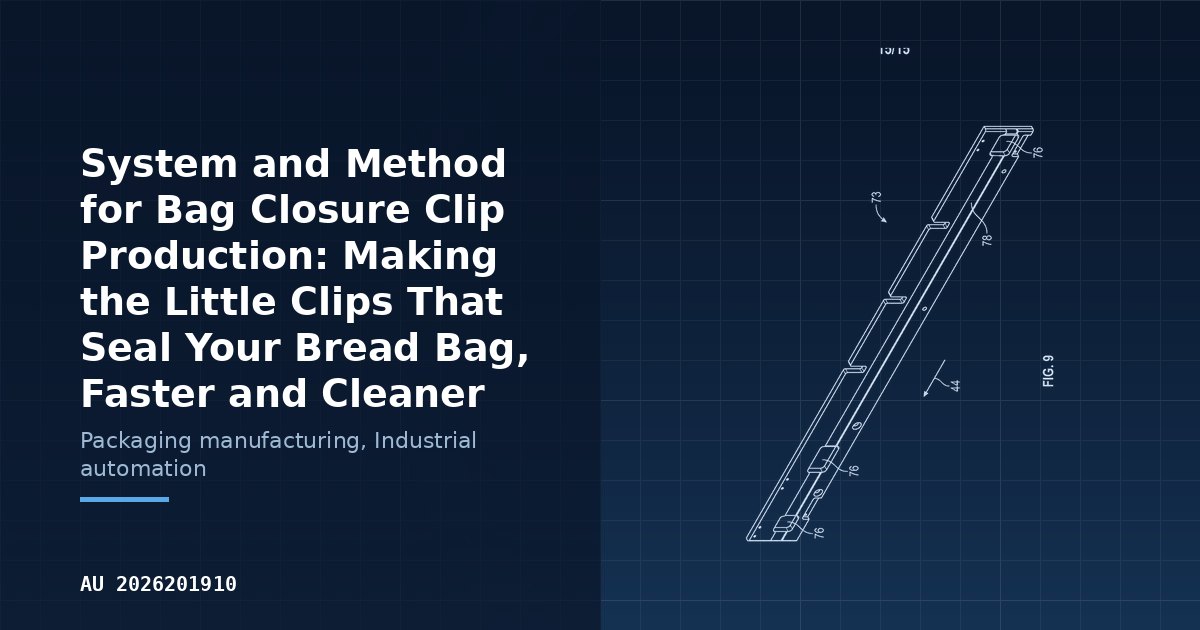
This patent describes a system and method for producing bag closure clips, the small flat clips used to seal bread, produce and other bags. It covers how the clips are manufactured from sheet stock so they can be made efficiently and consistently at scale.
The Problem
The humble bread clip is produced in enormous quantities, which means even tiny inefficiencies in manufacturing add up. Clips must be formed to precise dimensions so they grip a bag’s neck reliably, release cleanly from the production tooling, and can be printed or shaped for branding. Traditional production has to balance speed, material use and accuracy, and any wasted material or jammed tooling on a high-volume line is costly. Improving how clips are cut and formed from the source material is therefore worth real money across millions of units.
What This Invention Does
The patent provides a system and method for bag closure clip production that defines how clips are formed from a sheet or web of material, covering the cutting and forming steps and the equipment that carries them out. By specifying the production approach, the invention aims to make clip manufacture faster, more material-efficient and more consistent, while supporting features such as custom shapes or printing. In practice this means a more streamlined route from raw sheet stock to finished closure clips ready for use on packaging lines.
Key Features
- Sheet-to-clip production. Clips are formed from sheet or web material through defined cutting and forming steps.
- High-volume focus. The method targets the efficient, repeatable output needed for a very high-volume product.
- Consistent dimensions. The approach supports clips formed to reliable, precise dimensions.
- Material efficiency. Streamlined forming helps reduce waste across large production runs.
- System and method. The claims cover both the production equipment and the manufacturing process.
Who Is Behind It
The applicant is Bedford Industries, Inc., a United States company known for twist ties, bag closures and related packaging products. The named inventors are Mark Green, Trevor Wintz and Isaac Christopher Steele. The application is a divisional that entered the national phase from an international filing.
Why It Matters
Closure clips are a small but ubiquitous part of food and produce packaging, and the economics of making them depend on squeezing out waste and downtime. A more efficient production system supports both cost and sustainability goals, since less wasted material means a lighter footprint per clip. Protecting the method in Australia supports Bedford’s supply and licensing interests in the local packaging market.
Related Concepts
- Bread clip – the everyday product this system makes.
- Twist tie – a related bag-closure product from the same field.
- Die cutting) – a forming method used to shape parts from sheet material.
- Packaging – the broader industry the clips serve.
- Mass production – the high-volume context that drives the efficiency gains.
AU 2026201910 was published in the Australian Official Journal of Patents on 9 April 2026 and is open for public inspection. Patent applications represent inventions that are sought to be protected and do not necessarily reflect commercially available products.
Related Patents Open to Public Inspections
See related Patents open to public inspection.
No Spills, No Waste
Spout Unit with Advanced Tamper-Proof Design for Packaging

Smarter Condom Packaging
Disclaimer
The information presented in this article is provided for general informational and illustrative purposes only.
Content on this page may be derived from publicly available intellectual property records, including patent documentation and related materials. While reasonable care is taken in compiling and summarising this information, ATMOSS does not guarantee the accuracy, completeness, currency, or reliability of any content presented.
This article is not a substitute for reviewing the original source documents. Patent applications, specifications, claims, and related records may contain detailed technical, legal, and contextual information that is not fully represented in this summary.
ATMOSS does not provide legal, technical, or commercial advice. Users should not rely on this content for decision-making purposes.
For authoritative and up-to-date information, users should refer directly to the official records available via IP Australia and other relevant intellectual property databases. Links to these official sources are provided where applicable.
ATMOSS accepts no liability for any loss, damage, or consequences arising from the use of, or reliance on, the information contained in this article.