
Application Number: AU 2026201813
Systems and Methods for Unified Computing on Digital and Quantum Computers One Compiler for Two Architectures
The invention is a compilation system that takes source code written in a conventional programming style and partitions it across digital and quantum execution targets. The compiler analyses the program, identifies workloads where quantum acceleration would be advantageous, transforms those sections into quantum circuits, and emits an integrated executable that orchestrates work across the available
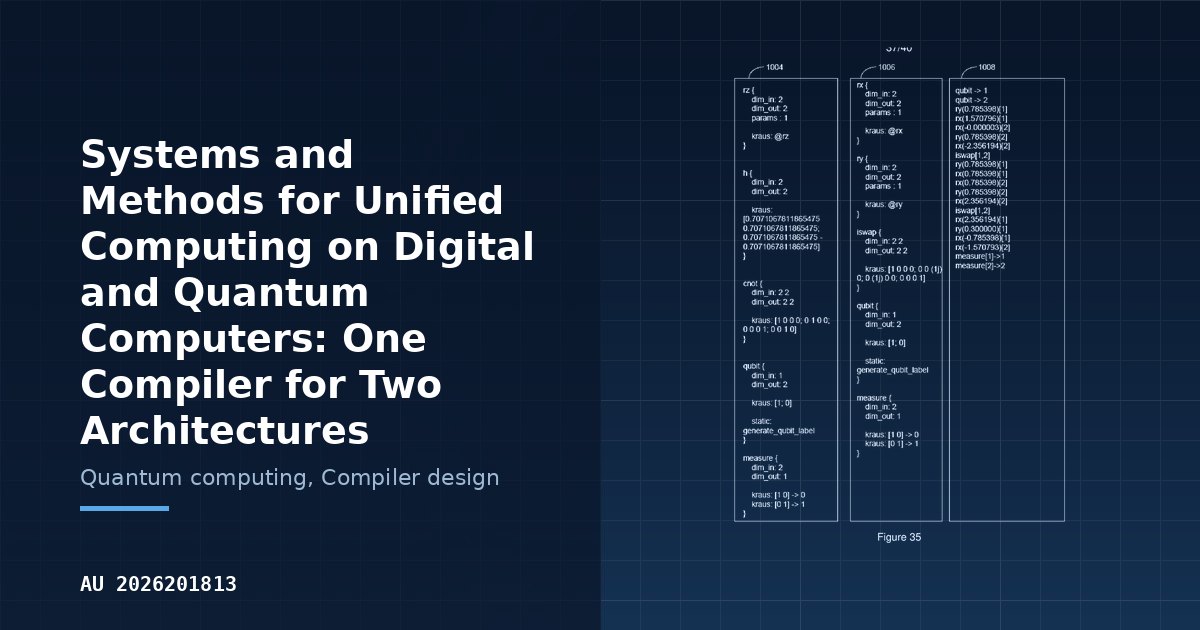
View the Systems and Methods for Unified Computing on Digital and Quantum Computers PDF
Download the PDF version of this Application Open to Public Inspection
This patent describes a software toolchain that lets developers write code in a familiar high-level language and have it automatically compiled to run across both classical and quantum processors, removing the requirement that programmers be expert in quantum algorithm design.
The Problem
Quantum computers have a fundamentally different execution model from classical machines. They operate on qubits, expose primitives like superposition, entanglement and measurement, and require algorithm designs that are alien to most software engineers. Even when quantum hardware is available, the global pool of developers who can hand-craft quantum circuits is small and specialised. Most of the existing open-source quantum SDKs assume that the user already knows quantum mechanics; they offer libraries of gates and measurements rather than a path from ordinary code to a quantum-accelerated execution. As a result, the practical reach of quantum computing has lagged the rate at which the hardware itself has improved.
What This Invention Does
The invention is a compilation system that takes source code written in a conventional programming style and partitions it across digital and quantum execution targets. The compiler analyses the program, identifies workloads where quantum acceleration would be advantageous, transforms those sections into quantum circuits, and emits an integrated executable that orchestrates work across the available classical and quantum resources. The developer does not need to write quantum gates, choose a quantum algorithm, or reason about hardware-specific noise models; the system makes those choices.
The disclosed method covers the compiler stages, the intermediate representation that captures both classical and quantum operations, the partitioning heuristics, and the runtime that schedules and dispatches work to whichever target is best suited.
Key Features
- Single-source programming model. Developers write in a familiar high-level language; the compiler does the work of producing quantum circuits where appropriate.
- Unified intermediate representation. Captures classical and quantum operations together, making cross-target optimisation possible.
- Automatic workload partitioning. Identifies sections of the program suited to quantum execution and rewrites them; everything else stays on classical hardware.
- Runtime scheduling. Dispatches the resulting hybrid program across the available digital and quantum processors during execution.
- Hardware abstraction. Reduces dependence on a particular quantum hardware vendor or gate set, supporting portability as quantum hardware platforms evolve.
Who Is Behind It?
The applicant is Horizon Quantum Computing PTE. LTD., a Singapore-based quantum software company founded in 2018 to make quantum computing accessible to mainstream developers. The named inventors are Joseph Francis Fitzsimons, Horizon’s founder and a known figure in quantum information research, and Si-Hui Tan. The Australian application is a divisional of AU 2023248094 and entered the national phase from PCT/SG2020/050728, with US provisional priority from US 62/945,434 filed in December 2019. The Australian patent agent is RnB IP in Deakin, ACT.
Why It Matters
The commercial breakthrough that the quantum-computing field is collectively waiting for is not bigger hardware; it is software that lets ordinary developers actually use the hardware that already exists. Compiler-level abstractions that hide quantum specifics behind a familiar programming model are arguably the missing layer. If automatic compilation across classical and quantum targets becomes the standard development experience, the population of people who can write useful quantum programs grows by orders of magnitude overnight. The Australian filing places Horizon’s IP in a market with active national investment in quantum technology and several university-spinout quantum-hardware programs.
Related Concepts
The commercial viability of quantum computing depends as much on accessible software tooling as on hardware advances. Existing open-source frameworks such as Qiskit provide gate-level control but still assume users have substantial knowledge of quantum mechanics.
Horizon Quantum Computing’s approach – using a compiler to automatically partition code across classical and quantum targets – targets the much larger pool of mainstream software developers, which could dramatically accelerate adoption of quantum acceleration in practical applications.
AU 2026201813 was published in the Australian Official Journal of Patents on 23 April 2026 and is open for public inspection. Patent applications represent inventions that are sought to be protected and do not necessarily reflect commercially available products.
Related Patents Open to Public Inspections
See related Patents open to public inspection.

Universal Linear Optical Mesh Layout Innovation Improves Quantum Computing Hardware

Plane Wave Dual Basis for Quantum Simulation

Sportsbook Odds Optimization and Correlated Proposition Bet Analysis

One View to Rule Them All
Disclaimer
The information presented in this article is provided for general informational and illustrative purposes only.
Content on this page may be derived from publicly available intellectual property records, including patent documentation and related materials. While reasonable care is taken in compiling and summarising this information, ATMOSS does not guarantee the accuracy, completeness, currency, or reliability of any content presented.
This article is not a substitute for reviewing the original source documents. Patent applications, specifications, claims, and related records may contain detailed technical, legal, and contextual information that is not fully represented in this summary.
ATMOSS does not provide legal, technical, or commercial advice. Users should not rely on this content for decision-making purposes.
For authoritative and up-to-date information, users should refer directly to the official records available via IP Australia and other relevant intellectual property databases. Links to these official sources are provided where applicable.
ATMOSS accepts no liability for any loss, damage, or consequences arising from the use of, or reliance on, the information contained in this article.