
Application Number: AU 2026201523
The Gaming Machine That Moves With the Game A Variable-Position Display That Responds to Game Events
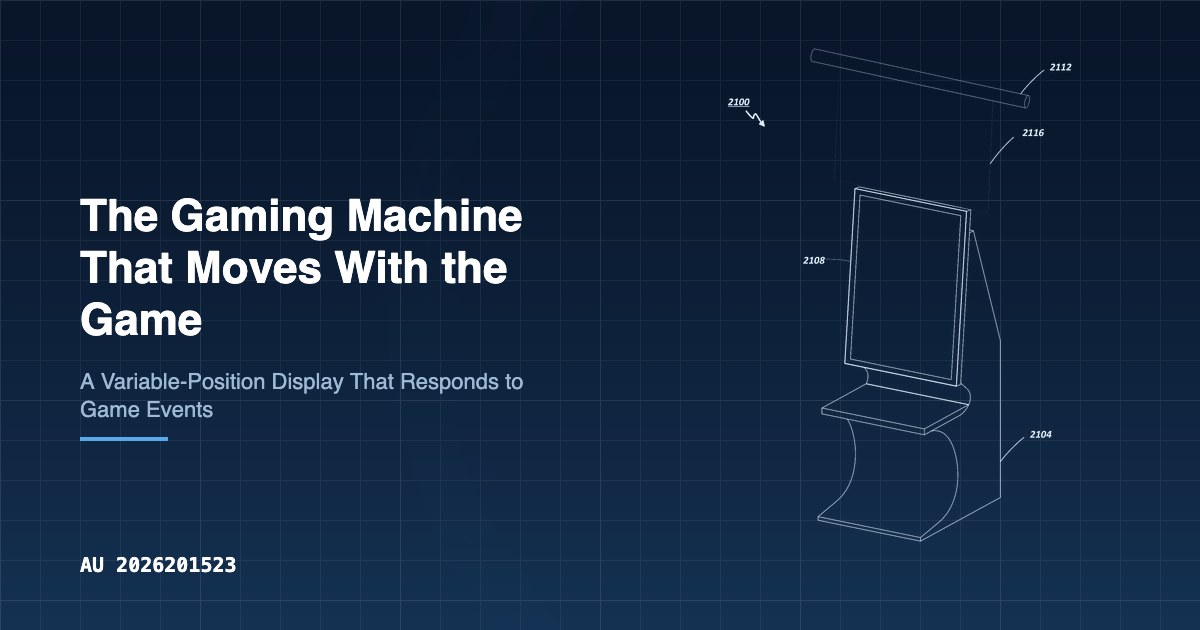
Aristocrat's invention combines two display elements in a single gaming machine: a variable position display that can rotate, tilt, pan or translate in relation to the cabinet, and an extendable display screen that retracts and extends physically. Both are controlled by the machine's game controller.
View the The Gaming Machine That Moves With the Game PDF
Download the PDF version of this Application Open to Public Inspection
Aristocrat Technologies has patented an electronic gaming machine with a display that physically moves – rotating, tilting and panning – in response to what is happening in the game, while a second extendable flexible screen expands outward to provide additional visual real estate during key moments. Together, the two display elements create a gaming experience where the physical machine itself becomes part of the performance, reacting dynamically to bonus events, wins and other game conditions.
The Problem
The standard electronic gaming machine has changed relatively little in its physical form over many years – a cabinet with a fixed upright screen, perhaps augmented by a small secondary display above. While the game content displayed on these screens has become increasingly sophisticated, the hardware itself remains static. The screen does not move, enlarge or respond physically to what is happening in the game.
As the gaming industry seeks to distinguish physical EGM experiences from the convenience of digital gaming at home, static hardware design becomes a limiting factor. Players accustomed to immersive console gaming, virtual reality experiences and interactive digital entertainment increasingly expect the environment itself to respond to their actions. A gaming machine that physically reacts to game events – moving, expanding, transforming – offers a qualitatively different and more engaging experience than one that simply changes what appears on a fixed screen.
The challenge is designing a system where physical display movement and screen extension are reliably coordinated with game logic, so that the hardware behaviour enhances rather than distracts from the game experience.
What This Invention Does
Aristocrat’s invention combines two display elements in a single gaming machine: a variable position display that can rotate, tilt, pan or translate in relation to the cabinet, and an extendable display screen that retracts and extends physically. Both are controlled by the machine’s game controller.
When specific predefined gaming conditions are met – such as a bonus round triggering, a jackpot being awarded or a particular symbol combination landing – the controller initiates a movement sequence. The variable position display moves from its first position to a second position, and simultaneously the extendable screen extends outward relative to the cabinet, expanding the total display area available to present the game. The game presentation itself is tailored to take advantage of this expanded display canvas, delivering content specifically designed for the extended configuration.
When the special game condition ends, the displays can return to their standard positions, ready for the next trigger. The result is a gaming machine that physically transforms during the most exciting moments of play – making those moments feel genuinely special.
Key Features
Variable position display. The primary display can rotate, tilt, pan, translate, or combine these movements in response to game conditions, transforming the visual angle and presentation geometry of the game at key moments.
Extendable flexible screen. A second screen extends outward from the cabinet during game events, enlarging the total display area available and enabling game content that cannot be presented on the standard fixed screen.
Game-triggered movement sequences. All physical display movement is governed by the game controller, which initiates specific movement sequences in response to defined gaming conditions – ensuring hardware behaviour is always purposeful and game-relevant.
Coordinated movement and content. The game program is tailored to the display configuration, meaning the content shown when the screens are in their extended positions is specifically designed for that configuration – not simply stretched from the standard layout.
Return-to-base capability. After a game event concludes, the displays can return to their standard positions, ensuring the machine always presents a consistent baseline experience between special events.
Who Is Behind It?
Aristocrat Technologies, Inc. is the US entity within the Aristocrat Leisure group. The inventors are Bruce Urban, Rajendrasinh Jadeja, Roberto Coppola and Craig Paulsen. This application is a divisional of AU 2020203798. The application is managed by Griffith Hack in Melbourne.
Why It Matters
Physical interactivity in gaming hardware is an emerging differentiator in the premium EGM segment. Machines that move, expand and transform in response to game events create memorable, shareable moments that drive both player engagement and floor differentiation for operators. As casinos compete with online gaming on convenience, they have an advantage in delivering physical, sensory experiences that screens cannot replicate – and kinetic gaming hardware is a compelling expression of that advantage.
From a technical perspective, coordinating physical display movement reliably with real-time game logic is a meaningful engineering achievement. The patent reflects Aristocrat’s investment in hardware innovation that goes beyond screen content to the physical experience of using the machine. With the IPC classification covering gaming machine coin-freed apparatus (G07F 17/32), the patent is directly relevant to the core product segment where Aristocrat competes globally.
AU 2026201523 was published in the Australian Official Journal of Patents on 19 March 2026 and is open for public inspection. Patent applications represent inventions that are sought to be protected and do not necessarily reflect commercially available products.
Related Concepts
Electronic gaming machines have traditionally competed on game content and themes rather than physical hardware innovation. As casinos seek to differentiate in-venue play from the convenience of online alternatives, kinetic hardware – displays that move, expand, and transform with game events – offers a sensory experience that digital screens cannot replicate. This aligns with broader trends in immersive technology where the physical environment responds dynamically to digital content.
Related Patents Open to Public Inspections
See related Patents open to public inspection.

Above the Floor

Tamper-Proof at Boot

Play More, Win More

A method of operating a gaming machine and a gaming machine
Disclaimer
The information presented in this article is provided for general informational and illustrative purposes only.
Content on this page may be derived from publicly available intellectual property records, including patent documentation and related materials. While reasonable care is taken in compiling and summarising this information, ATMOSS does not guarantee the accuracy, completeness, currency, or reliability of any content presented.
This article is not a substitute for reviewing the original source documents. Patent applications, specifications, claims, and related records may contain detailed technical, legal, and contextual information that is not fully represented in this summary.
ATMOSS does not provide legal, technical, or commercial advice. Users should not rely on this content for decision-making purposes.
For authoritative and up-to-date information, users should refer directly to the official records available via IP Australia and other relevant intellectual property databases. Links to these official sources are provided where applicable.
ATMOSS accepts no liability for any loss, damage, or consequences arising from the use of, or reliance on, the information contained in this article.