
Application Number: AU 2026201567
Tipping the Load An NT Company’s Innovative Road and Rail Bin Assembly
The invention solves this problem through a carefully designed countermovement mechanism. The bin assembly is mounted on a chassis for angular movement transverse to the direction of travel - meaning the bin tilts sideways to discharge its contents. The lid is separately mounted on the chassis, also capable of angular movement transverse to the direction
View the Tipping the Load PDF
Download the PDF version of this Application Open to Public Inspection
A Northern Territory welding and fabrication company has filed a patent for a road and rail bin assembly designed to transport and discharge flowable materials – featuring an ingenious lid and bin mechanism where both components move in opposite directions during discharge, ensuring clean, controlled unloading without spillage or interference.
The Problem
Transporting bulk flowable materials – materials such as grain, mineral ore, sand or liquid slurries that flow under gravity – presents persistent engineering challenges in both road and rail contexts. The material must be contained securely during transport to prevent spillage and environmental contamination, yet must also be discharged efficiently and completely at the destination without requiring manual intervention or complex external equipment.
Side-tipping vehicles and rail wagons have long been used for bulk material transport, but they frequently encounter a practical problem during the discharge sequence: the lid and the bin must both move to enable unloading, and if they move in the same direction or are not carefully coordinated, the lid can obstruct discharge, trap material or require manual operation to get out of the way. In some designs, the lid must be removed entirely before tipping can occur, which introduces handling complexity and the risk of the lid being misplaced, damaged or forgotten.
The geometry of the problem becomes particularly acute for road-rail vehicles, which must manage the additional constraint of a chassis that may be operating on curved track or sloped ground. A bin assembly that works reliably under these varying conditions, while ensuring the lid automatically clears the discharge path, has proven difficult to achieve with conventional engineering approaches.
What This Invention Does
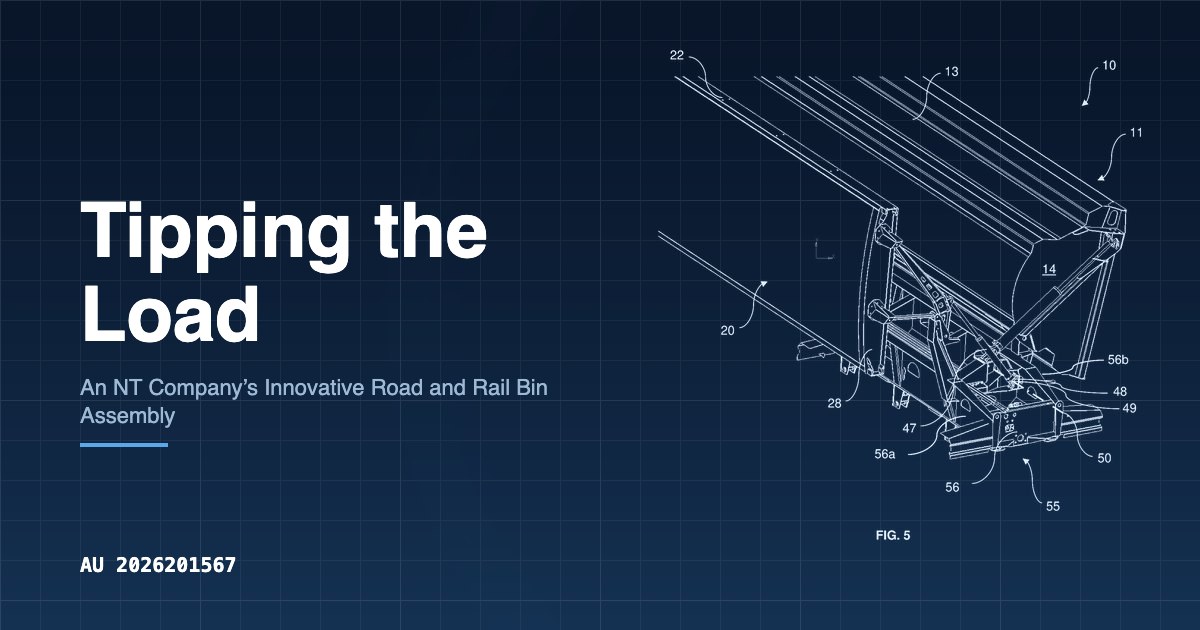
The invention solves this problem through a carefully designed countermovement mechanism. The bin assembly is mounted on a chassis for angular movement transverse to the direction of travel – meaning the bin tilts sideways to discharge its contents. The lid is separately mounted on the chassis, also capable of angular movement transverse to the direction of travel.
The critical design feature is the directionality of these movements: the bin tips in a first angular direction, while the lid simultaneously moves in a second angular direction that is opposite to the first. As the bin begins to tip for discharge, the lid automatically moves away from the bin’s open top in the opposite direction, swinging clear of the discharge path rather than towards it. This means the lid cannot obstruct the material flow, and no manual intervention is needed to position it out of the way.
When the bin returns to the transport position after discharge, the lid follows suit, returning to cover the open top and securing the load for the next journey. The result is a bin and lid combination that operates in a coordinated, automatic manner – the geometry of opposite angular movements handling the coordination mechanically without requiring sensors, actuators or complex control systems.
Key Features
Opposite angular movement design. The bin tips in one angular direction while the lid simultaneously moves in the opposite direction, ensuring the lid automatically clears the discharge path without manual intervention or separate control systems.
Transport position security. When the bin is in the transport position with its open top facing upward, the lid covers the open top to prevent spillage, contamination or loss of material during transit.
Gravity-driven discharge. Material discharges from the bin via the open top under gravity when the bin tips to the discharge position, eliminating the need for powered conveyor or auger systems at the receiving end.
Road and rail compatibility. The assembly is designed to be mounted on a chassis suitable for both road and rail use, providing flexibility for transport operations that may involve both modes.
Australian design for Australian conditions. Developed by a Northern Territory company, the invention reflects practical experience with bulk material handling in Australian mining, agricultural and infrastructure environments.
Who Is Behind It?
Mick Murray Welding (N.T.) Pty Ltd is a Northern Territory-based fabrication and engineering company. The sole inventor named is Mick Murray, whose background in practical welding and fabrication is evident in the mechanical simplicity of the solution. The patent is filed through Spruson and Ferguson, one of Australia’s leading intellectual property law firms. This application is a divisional of an earlier filing (AU 2019261723), indicating the invention has been in development and refinement for several years.
Why It Matters
Bulk material transport is fundamental to Australia’s mining, agriculture and construction industries. The efficiency with which flowable materials can be loaded, transported and discharged directly affects the economics of mining operations, grain harvests, civil construction projects and a range of other industries where bulk haulage is central to the supply chain.
A bin assembly that solves the lid-and-discharge coordination problem through simple mechanical geometry – rather than through electronics, hydraulics or complex interlocking systems – offers several advantages. It is inherently more reliable because there are fewer components that can fail. It is easier to maintain and repair in remote locations where sophisticated diagnostic equipment may not be available. And it reduces operator training requirements because the system behaves predictably and automatically. For Australian operators managing bulk materials across the vast distances typical of this country’s mining and agricultural regions, a simpler, more reliable bin assembly design could deliver real operational benefits – and this patent suggests Mick Murray Welding has found an elegant solution to a long-standing practical problem.
AU 2026201567 was published in the Australian Official Journal of Patents on 19 March 2026 and is open for public inspection. Patent applications represent inventions that are sought to be protected and do not necessarily reflect commercially available products.
Related Concepts
Bulk material handling is a core engineering discipline in Australia’s mining, agriculture and construction sectors. The efficient and loss-free transport of flowable materials – from mineral ore to grain – directly affects supply chain economics. Side-tipping and bottom-discharge vehicles are widely used, but reliable lid-and-bin coordination has historically required complex mechanical or electronic solutions.
The use of road-rail vehicles adds further complexity, as the chassis must function on both paved roads and rail tracks. Innovations that achieve reliable discharge through purely mechanical geometry – with no electronics or hydraulics – are particularly valuable in remote Australian environments where maintenance resources are limited.
Related Patents Open to Public Inspections
See related Patents open to public inspection.

Innovative Road Train Configuration for Heavy-Duty Transport Efficiency

High-Performance Pump Assembly for Hydraulic Brake Systems

Better Shoulder Replacement

An Insulation Spacer Assembly
Disclaimer
The information presented in this article is provided for general informational and illustrative purposes only.
Content on this page may be derived from publicly available intellectual property records, including patent documentation and related materials. While reasonable care is taken in compiling and summarising this information, ATMOSS does not guarantee the accuracy, completeness, currency, or reliability of any content presented.
This article is not a substitute for reviewing the original source documents. Patent applications, specifications, claims, and related records may contain detailed technical, legal, and contextual information that is not fully represented in this summary.
ATMOSS does not provide legal, technical, or commercial advice. Users should not rely on this content for decision-making purposes.
For authoritative and up-to-date information, users should refer directly to the official records available via IP Australia and other relevant intellectual property databases. Links to these official sources are provided where applicable.
ATMOSS accepts no liability for any loss, damage, or consequences arising from the use of, or reliance on, the information contained in this article.