
Application Number: AU 2025220742
Advanced Air Circulation System for Material Handling Vehicle Batteries
The Raymond Corporation's design incorporates a metal base plate, sealed battery case, organized row of battery cells, and innovative top tray assembly featuring dual fans. The first fan blows air in one direction within the battery case, while the second fan blows air in the opposite direction, creating counter-flowing circulation patterns. This opposing airflow generates

View the Advanced Air Circulation System for Material Handling Vehicle Batteries PDF
Download the PDF version of this Application Open to Public Inspection
Battery performance degrades rapidly when internal temperatures exceed safe operating ranges. The Raymond Corporation introduces an innovative thermal management approach using dual fans within the battery enclosure to create opposing airflow patterns that efficiently circulate cooling air throughout battery cells. This advanced circulation system maintains optimal operating temperatures, extends battery life, and improves reliability in demanding material handling applications.
The Problem
Industrial batteries powering material handling vehicles (forklifts, reach trucks, order pickers) generate substantial internal heat during charging and discharging cycles. Thermal buildup accelerates battery degradation, reducing cycle life and operational capacity. In confined battery compartments, heat accumulation can damage cells, reduce available power output, and potentially create safety hazards. Effective temperature management requires active circulation of cooling air throughout the battery case, distributing thermal loads evenly across cell arrangements.
Current battery designs often lack sophisticated thermal management, relying on passive air exchange or inadequate ventilation. Charging fast enough to support continuous warehouse operations while managing internal temperatures presents a fundamental engineering challenge. Battery cells at the center of densely packed arrays experience higher temperatures than peripheral cells, creating uneven aging and reducing overall pack reliability. Traditional single-fan designs prove insufficient for complex three-dimensional heat distribution within the constrained geometry of vehicle battery cases.
What This Invention Does
The Raymond Corporation’s design incorporates a metal base plate, sealed battery case, organized row of battery cells, and innovative top tray assembly featuring dual fans. The first fan blows air in one direction within the battery case, while the second fan blows air in the opposite direction, creating counter-flowing circulation patterns. This opposing airflow generates turbulence and mixing that distributes cooling air throughout the battery enclosure rather than creating simple through-flow.
The counter-rotating fan design efficiently addresses thermal stratification and creates dynamic circulation that reaches cells throughout the battery pack. Rather than simple linear airflow where some cells receive abundant cooling while others are poorly ventilated, the dual fan approach generates complex fluid dynamics that improve heat distribution. The opposing flows create recirculation zones and mixing patterns that ensure even thermal conditioning across the entire battery case, maximizing cooling effectiveness within the constrained space.
Key Features
- Dual-Fan Architecture. The top tray includes two independent fans, each capable of generating substantial airflow volumes in opposite directions, creating sophisticated circulation patterns within the sealed enclosure.
- Counter-Flow Design. The opposing fan directions generate crossing and recirculating airflow that penetrates deep into the battery case, reaching cells throughout the pack rather than just near intake or exhaust points.
- Even Temperature Distribution. The complex circulation patterns created by counter-flowing fans ensure uniform thermal conditioning across the entire battery assembly, eliminating hot spots and thermal stratification.
- Sealed Case Design. The battery case forms a sealed enclosure that works with the dual fan system to create controlled internal circulation, preventing uncontrolled bypass flows.
- Metal Base Plate Construction. The metal base acts as a thermal conductor and structural platform for the cell arrangement, supporting efficient heat distribution to the base of the assembly.
- Industrial Battery Application. The design specifically addresses the demanding thermal environment of material handling vehicle batteries that undergo frequent charging and high-discharge-rate operation.
Who Is Behind It?
The Raymond Corporation, based in the United States, manufactures material handling equipment and batteries for warehouse and logistics applications. The invention credits four inventors: Daniel Harris, Stuart Barter, Mark Mathias, and Robert S. Foley, representing the company’s battery engineering and thermal management expertise. The application prioritizes US Patent Application 63/688,186, filed 28 August 2024. GLMR provides patent representation.
Why It Matters
Battery thermal management directly impacts operational reliability in material handling environments where vehicle downtime costs money. This innovation enables batteries to operate at peak capacity for extended periods by maintaining optimal operating temperatures. The dual-fan approach is particularly effective for retrofitting into existing battery case designs, offering manufacturers a thermal management solution that improves battery performance without major redesign. As electric material handling vehicles proliferate and duty cycles become more demanding, advanced thermal management becomes increasingly important for competitive battery products. The opposing airflow design represents an elegant engineering solution that leverages fluid dynamics principles to optimize heat distribution in constrained geometries. Extended battery life reduces operational costs for fleet operators and improves vehicle availability.
Related Concepts
Effective battery thermal management is essential for maximising cycle life in industrial applications. Cells that consistently operate above their optimal temperature window degrade faster, reducing pack capacity and ultimately requiring costly early replacement in high-utilisation warehouse fleets.
Fluid dynamics principles underpin the dual-fan counter-flow design. Counter-rotating flows create recirculation zones that prevent hot spots forming at the geometric centre of densely packed cell arrays – a problem that simple single-direction airflow cannot solve within the constrained geometry of a vehicle battery case.
AU 2025220742 was published in the Australian Official Journal of Patents on 19 March 2026 and is open for public inspection. Patent applications represent inventions that are sought to be protected and do not necessarily reflect commercially available products.
Related Patents Open to Public Inspections
See related Patents open to public inspection.

Isolated Switching Architecture for Battery Heating Management

Intelligent Charging System with Safety Interlock for Material Handling Batteries
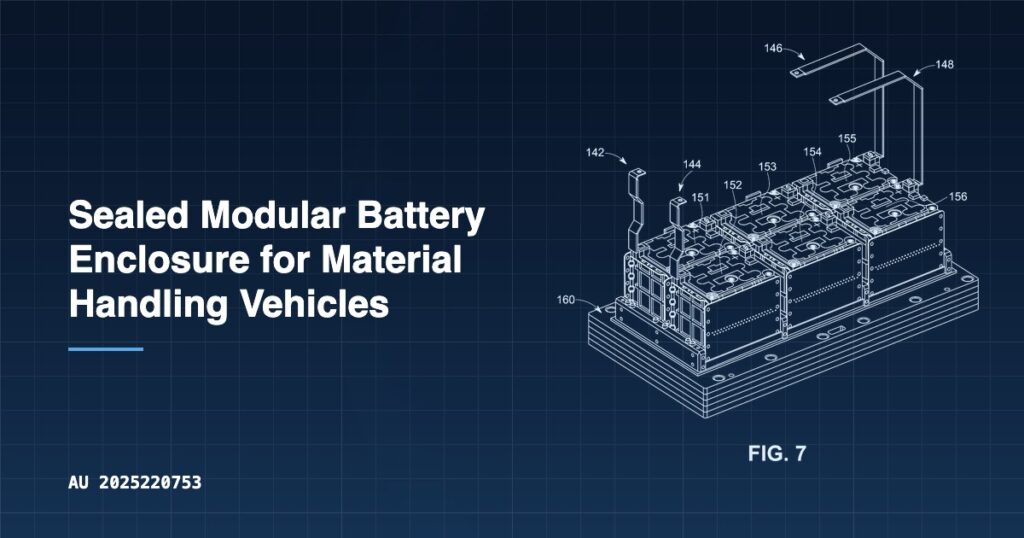
Sealed Modular Battery Enclosure for Material Handling Vehicles
Disclaimer
The information presented in this article is provided for general informational and illustrative purposes only.
Content on this page may be derived from publicly available intellectual property records, including patent documentation and related materials. While reasonable care is taken in compiling and summarising this information, ATMOSS does not guarantee the accuracy, completeness, currency, or reliability of any content presented.
This article is not a substitute for reviewing the original source documents. Patent applications, specifications, claims, and related records may contain detailed technical, legal, and contextual information that is not fully represented in this summary.
ATMOSS does not provide legal, technical, or commercial advice. Users should not rely on this content for decision-making purposes.
For authoritative and up-to-date information, users should refer directly to the official records available via IP Australia and other relevant intellectual property databases. Links to these official sources are provided where applicable.
ATMOSS accepts no liability for any loss, damage, or consequences arising from the use of, or reliance on, the information contained in this article.