
Application Number: AU 2025220749
Intelligent Charging System with Safety Interlock for Material Handling Batteries
The Raymond Corporation's battery includes a charger connector port with integrated proximity sensor and temperature sensor communicatively coupled to the battery controller. When the charger is connected, the proximity sensor detects the connection and communicates this status to the controller, which immediately prevents vehicle movement through the propulsion system. This interlock ensures vehicles cannot operate
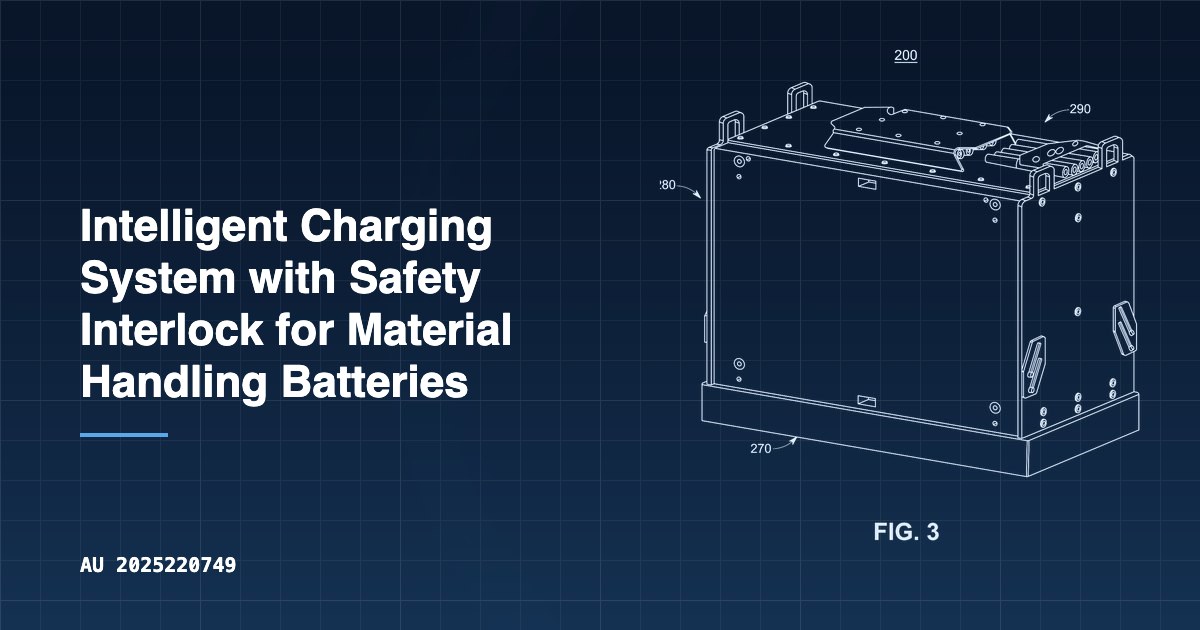
View the Intelligent Charging System with Safety Interlock for Material Handling Batteries PDF
Download the PDF version of this Application Open to Public Inspection
Safely connecting charging equipment to vehicle batteries requires reliable detection of proper connections and prevention of vehicle movement during charging. The Raymond Corporation introduces a charging system with integrated proximity and temperature sensors in the charger connector port that prevent vehicle operation when connected, detect incomplete connections, and monitor charging port condition. This safety-first design eliminates accidents caused by attempting to operate vehicles while charging.
The Problem
Current material handling vehicle charging systems lack integrated safety mechanisms to prevent operation during active charging. Operators may inadvertently attempt to move vehicles while charging cables remain connected, potentially damaging the vehicle, charger, or creating safety hazards. Incomplete charger connections remain undetected, leaving batteries partially charged or exposing electrical contacts to environmental contamination. Charger connector ports degrade over time, developing poor contact or environmental seal failures that reduce charging efficiency and reliability.
Manual verification of proper charger connection relies on operator awareness and attention, which are unreliable safety mechanisms. Fleet operators need automated systems that positively prevent vehicle operation when charging is in progress, regardless of operator intent. Detecting incomplete or improper connections requires real-time assessment of connection quality and contact status. Monitoring port condition over time supports predictive maintenance and prevents charging failures due to corroded or worn connectors. Integration of these safety features into the battery itself eliminates dependence on external charger design or operator protocols.
What This Invention Does
The Raymond Corporation’s battery includes a charger connector port with integrated proximity sensor and temperature sensor communicatively coupled to the battery controller. When the charger is connected, the proximity sensor detects the connection and communicates this status to the controller, which immediately prevents vehicle movement through the propulsion system. This interlock ensures vehicles cannot operate while charging equipment is connected.
The proximity sensor also detects incomplete connections where the charger device is partially engaged but not fully seated, providing an indication to operators that connection is improper. The temperature sensor monitors the charger port condition, detecting increases in temperature that indicate electrical resistance problems or connection degradation. When temperature data indicates port condition changes, the controller alerts operators to service the port or charger. This multi-layered approach prevents most charging-related accidents and degrades gracefully when port condition deteriorates.
Key Features
- Proximity Sensor Integration. The charger connector port includes a proximity sensor that detects connection status and communicates with the controller to enable or prevent vehicle operation accordingly.
- Vehicle Movement Prevention. When the proximity sensor indicates charger connection, the controller prevents propulsion system operation, making vehicle movement physically impossible regardless of operator commands.
- Incomplete Connection Detection. The proximity sensor can distinguish between complete and incomplete charger connections, providing status indication when connections are not fully seated.
- Temperature Monitoring. The integrated temperature sensor continuously monitors charger port temperature, detecting contact degradation or electrical resistance problems that could affect charging reliability.
- Temperature-Based Port Status Indication. Changes in temperature data indicate charger port condition changes, alerting operators to deteriorating electrical contacts or seal failures.
- Multi-Charger Compatibility. The system accommodates multiple charger connector ports with separate proximity and temperature sensors, enabling dual-charging configurations.
- Automated Safety Interlock. The integration of sensors and controller logic creates an automatic safety interlock that requires no operator intervention to prevent charging-related accidents.
Who Is Behind It?
The Raymond Corporation continues its material handling battery innovation with this advanced charging safety system. The invention credits five inventors: Robert S. Foley, Daniel Harris, Stuart Barter, Kim Griffith, and Blake Dickinson, representing multidisciplinary engineering expertise in battery systems, charging electronics, and vehicle control. The application prioritizes US Patent Application 63/688,194, filed 28 August 2024. GLMR provides patent representation.
Why It Matters
Charging-related accidents represent a preventable source of workplace injuries and vehicle damage in material handling environments. This integrated safety system eliminates a category of accidents by making vehicle operation physically impossible when charging equipment is connected. The incomplete connection detection feature supports maintenance by alerting operators to charger problems before they prevent charging. Temperature monitoring enables predictive maintenance of the charger port, extending connector life and preventing reliability problems. Fleet operators benefit from reduced accidents, fewer charging-related failures, and simplified operational protocols that no longer depend on operator discipline for safety. The integrated approach establishes a safety standard that should become industry norm as charging infrastructure expands in electrified vehicle fleets.
Related Concepts
Safety interlocks are widely used in industrial machinery to prevent hazardous operations when conditions are not safe. In electric vehicle charging, an interlock that physically prevents propulsion when a charger is connected eliminates a class of workplace accidents that manual procedures cannot reliably prevent.
Predictive maintenance uses real-time sensor data to anticipate component failures before they occur. Embedding temperature monitoring directly in the charger port enables fleet managers to schedule connector servicing before degradation leads to charging failures or electrical hazards, reducing unplanned downtime.
AU 2025220749 was published in the Australian Official Journal of Patents on 19 March 2026 and is open for public inspection. Patent applications represent inventions that are sought to be protected and do not necessarily reflect commercially available products.
Related Patents Open to Public Inspections
See related Patents open to public inspection.

Advanced Air Circulation System for Material Handling Vehicle Batteries
Sealed Modular Battery Enclosure for Material Handling Vehicles

Isolated Switching Architecture for Battery Heating Management
Disclaimer
The information presented in this article is provided for general informational and illustrative purposes only.
Content on this page may be derived from publicly available intellectual property records, including patent documentation and related materials. While reasonable care is taken in compiling and summarising this information, ATMOSS does not guarantee the accuracy, completeness, currency, or reliability of any content presented.
This article is not a substitute for reviewing the original source documents. Patent applications, specifications, claims, and related records may contain detailed technical, legal, and contextual information that is not fully represented in this summary.
ATMOSS does not provide legal, technical, or commercial advice. Users should not rely on this content for decision-making purposes.
For authoritative and up-to-date information, users should refer directly to the official records available via IP Australia and other relevant intellectual property databases. Links to these official sources are provided where applicable.
ATMOSS accepts no liability for any loss, damage, or consequences arising from the use of, or reliance on, the information contained in this article.