
Application Number: AU 2025234272
Antenna Pole Design Simplifies Installation for Robot Positioning Systems
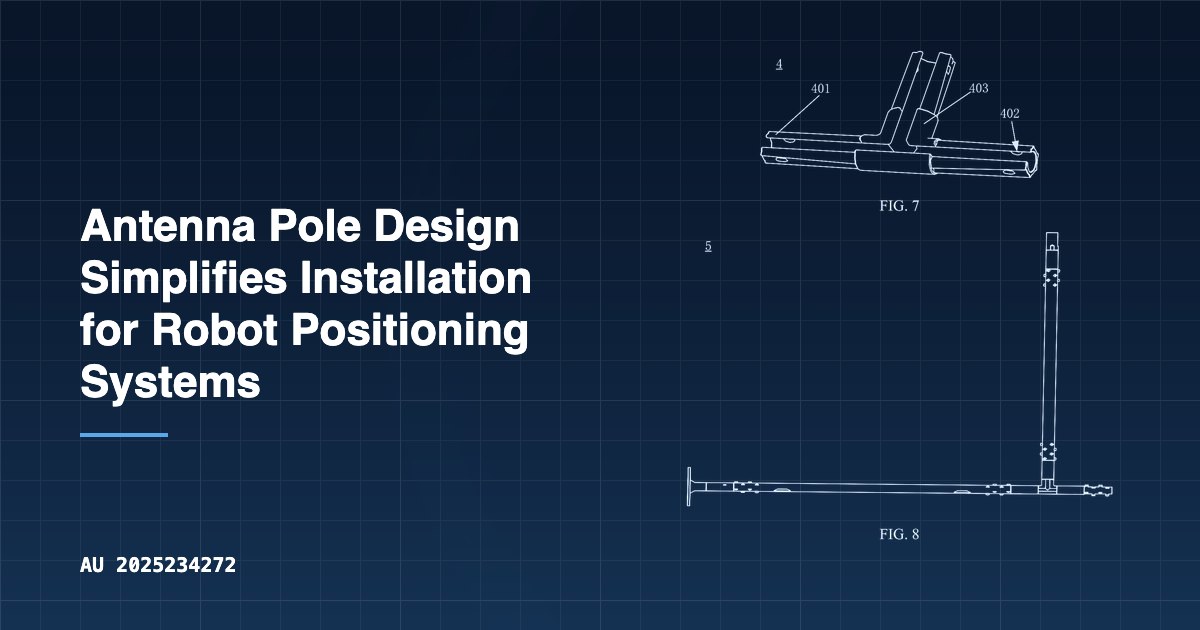
Shenzhen Hanyang's redesigned antenna pole fundamentally simplifies the assembly process by using a modular structure with multiple connecting rods that can be combined in various configurations.
View the Antenna Pole Design Simplifies Installation for Robot Positioning Systems PDF
Download the PDF version of this Application Open to Public Inspection
Garden robots performing precise agricultural tasks rely on satellite-based positioning systems to navigate. A Chinese engineering team has redesigned the antenna pole used to mount positioning base stations, making installation faster and more intuitive for farmers and field technicians without specialized training.
The Problem
Modern garden robots use Real-Time Kinematic (RTK) satellite positioning technology to achieve centimeter-level accuracy in crop monitoring, spraying, and soil analysis applications. An RTK system consists of two components: a base station that receives satellite signals and calculates positioning corrections, and rover stations that use those corrections to achieve precise positioning.
The antenna pole must be elevated to ensure clear line-of-sight to satellites and maintain signal strength across the required operating distance. Currently, antenna poles ship disassembled for storage and transportation efficiency. Before deploying a garden robot, users must reassemble the pole, which involves multiple steps that must follow a rigid sequence. The installation process is cumbersome, prone to mistakes, and creates a poor user experience. For farmers trying to get equipment into the field quickly, the assembly complexity represents a genuine obstacle.
What This Invention Does
Shenzhen Hanyang’s redesigned antenna pole fundamentally simplifies the assembly process by using a modular structure with multiple connecting rods that can be combined in various configurations.
The new design includes at least two connecting rods, a base, multiple sleeve members (both upper and lower sleeves), and connecting members at different positions. The upper sleeves attach directly to the connecting rods, while lower sleeves attach to the base. Connecting members bridge between the rods at different heights and connect to these lower sleeves.
The genius of this design is that users no longer need to follow a strict assembly sequence. The modular structure allows flexible configuration, enabling different installation orders and combinations. This flexibility dramatically improves user experience while maintaining the structural integrity and signal reception performance required for RTK positioning.
The pole maintains excellent electromagnetic properties for satellite signal transmission while being dramatically easier to assemble than previous designs.
Key Features
Modular Multi-Rod Structure. Using multiple connecting rods in various configurations allows flexible assembly without a single required sequence.
Integrated Sleeve System. Upper and lower sleeves provide secure attachment points that work intuitively for users without specialized training.
Positioning Stability. The base and connecting member arrangement ensures stable positioning on the ground while maintaining antenna height for clear satellite signal reception.
Signal Transmission Optimization. The design maintains clear transmission paths between the positioning base station and rover stations, extending operating distances for garden robots.
Simplified Disassembly. The modular design that simplifies assembly also simplifies disassembly, making packing and transport more convenient.
User-Friendly Installation. Flexible assembly sequences reduce installation errors and frustration, improving the overall user experience for farmers deploying the equipment.
Who Is Behind It?
Shenzhen Hanyang Technology Co., Ltd. is a Chinese company specializing in robotics and positioning technology. The antenna pole was developed by engineers Huang Yang, Zhu Taotao, Song Yongqi, and Han Baofeng. The company filed priority patent applications in China on 29 August 2024 and 3 June 2025 before seeking Australian protection in July 2025, showing strong commercial confidence in this design innovation.
Why It Matters
The invention addresses a real pain point in the emerging agricultural robotics market. As garden robots proliferate for precision agriculture applications – from autonomous spray systems to soil sampling robots – the positioning infrastructure must become as accessible as the robots themselves. A complex, error-prone antenna pole installation discourages adoption even if the robot itself is excellent.
The patent covers antenna technology and positioning base station design (IPC codes H01Q 1/12, H01Q 1/24, H01Q 1/20, H01Q 23/00), reflecting the electromagnetic and mechanical innovation in this solution. By removing a friction point in the user experience, this design innovation could meaningfully accelerate adoption of RTK-based agricultural robotics. For manufacturers of positioning base stations, offering simpler installation is a valuable differentiation point. For farmers, faster setup means getting equipment into fields quicker during critical growing seasons.
AU 2025234272 was published in the Australian Official Journal of Patents on 19 March 2026 and is open for public inspection. Patent applications represent inventions that are sought to be protected and do not necessarily reflect commercially available products.
Related Concepts
Real-Time Kinematic (RTK) positioning uses carrier-phase measurements from satellite navigation signals to achieve centimetre-level accuracy, making it the standard technology for precision guidance in agricultural robots. The base station antenna must have an unobstructed view of the sky to receive signals from multiple satellites simultaneously, which is why pole height and stability matter.
The shift toward modular design in field equipment reflects a broader trend in precision agriculture hardware – reducing setup complexity so that farmers without specialist training can deploy sophisticated positioning infrastructure quickly and correctly in the field.
Related Patents Open to Public Inspections
See related Patents open to public inspection.

Magnetic Toy Design Enables Smooth Magnet Rotation and Perfect Polarity Alignment

Multimode Autonomous Farming Machine Transforms Plant Treatment Flexibility

Rugged Wireless Bridge

Variable Rate Treatment System Uses AI to Optimize Crop Management
Disclaimer
The information presented in this article is provided for general informational and illustrative purposes only.
Content on this page may be derived from publicly available intellectual property records, including patent documentation and related materials. While reasonable care is taken in compiling and summarising this information, ATMOSS does not guarantee the accuracy, completeness, currency, or reliability of any content presented.
This article is not a substitute for reviewing the original source documents. Patent applications, specifications, claims, and related records may contain detailed technical, legal, and contextual information that is not fully represented in this summary.
ATMOSS does not provide legal, technical, or commercial advice. Users should not rely on this content for decision-making purposes.
For authoritative and up-to-date information, users should refer directly to the official records available via IP Australia and other relevant intellectual property databases. Links to these official sources are provided where applicable.
ATMOSS accepts no liability for any loss, damage, or consequences arising from the use of, or reliance on, the information contained in this article.