
Application Number: AU 2025297462
Magnetic Toy Design Enables Smooth Magnet Rotation and Perfect Polarity Alignment
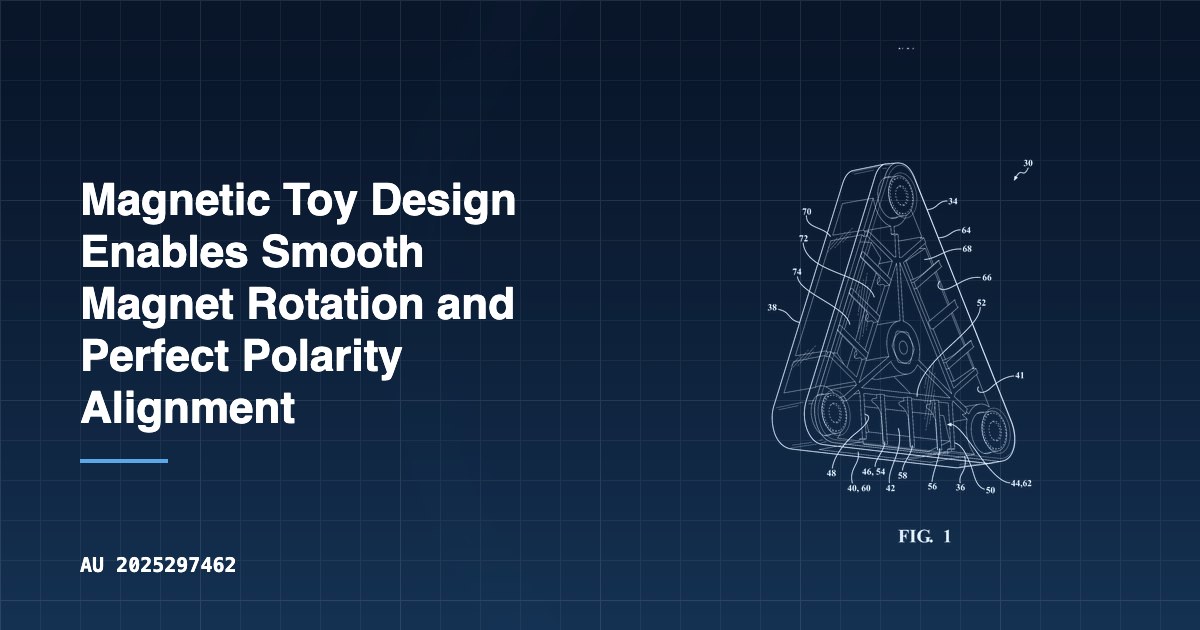
MVW Holdings' solution is elegant in its simplicity: add a support rib inside the magnet pocket that guides the magnet and allows it to rotate smoothly.
View the Magnetic Toy Design Enables Smooth Magnet Rotation and Perfect Polarity Alignment PDF
Download the PDF version of this Application Open to Public Inspection
Magnetic construction toys are wildly popular with children and adults alike, but they have a persistent design flaw that frustrates users. Magnets in these toys often get stuck in corners of their pockets, preventing proper polarity alignment and blocking the magnetic connection between tiles. An American toy company has solved this problem with an elegant design using a simple support rib that lets magnets rotate freely and align themselves perfectly.
The Problem
Magnetic construction toys – whether square tiles or cube-shaped – rely on precisely aligned magnets to snap together. The magnets sit in pockets within the toy housing. In current designs, particularly when magnets are sized smaller than their pockets (allowing movement), the magnets frequently get trapped in corners of the square pocket, preventing smooth rotation.
When a magnet cannot rotate and align properly, its polarity remains misaligned with the adjacent tile’s magnet. Users become frustrated having to manually reposition the toy multiple times just to get it to snap together. This fundamental design flaw directly undermines the user experience and satisfaction with these toys.
What This Invention Does
MVW Holdings’ solution is elegant in its simplicity: add a support rib inside the magnet pocket that guides the magnet and allows it to rotate smoothly.
The support rib is configured to support and allow the magnet to rotate with respect to the magnet pocket axis. By providing this central support point, the rib prevents the magnet from getting trapped in corners while enabling smooth rotation around the pocket axis.
The magnet can now freely rotate and align its poles with the magnet in an adjacent tile. When the user brings two tiles together, the magnetic forces automatically guide the magnets to proper alignment, and the tiles snap together smoothly without manual adjustment.
Key Features
Support Rib Technology. A strategically positioned rib in the magnet pocket supports the magnet and enables frictionless rotation around the pocket axis.
Corner-Trapping Prevention. By preventing the magnet from settling in corners, the rib eliminates the most common cause of polarity misalignment and assembly frustration.
Improved Performance and Alignment. Magnets can now quickly respond to opposing magnetic fields and self-align, dramatically improving overall toy performance.
Faster Connection Assembly. Users no longer need to repeatedly reposition tiles to achieve magnetic connection – they snap together on the first attempt with proper polarity alignment.
Reduced User Frustration. The frictionless rotation means tiles connect smoothly and intuitively, improving the overall play experience.
Scalable Design. The support rib concept applies to any shaped magnetic toy – tiles, cubes, triangles, hexagons, and other geometries.
Multi-Pocket Configuration. Toys can incorporate multiple magnet pockets with support ribs, enabling more complex play patterns and structures.
Who Is Behind It?
MVW Holdings, Inc., a United States-based toy company, developed this magnetic toy improvement. The invention was created by inventors Maryam Syed and Henry Hillstrom. The company filed a US provisional patent on 29 August 2024 before filing the full Australian application in August 2025, indicating confidence in the market appeal of this user experience improvement.
Why It Matters
Magnetic construction toys represent a multi-billion-dollar market segment. The ability to enhance user satisfaction through improved engineering directly impacts consumer adoption and brand loyalty. This invention addresses one of the most common and frustrating complaints from users of magnetic construction systems.
The patent covers magnetic toy design and construction (IPC code A63H 33/26), reflecting the toy industry classification. For toy manufacturers, implementing this support rib technology offers a way to differentiate products and improve customer satisfaction without substantially increasing manufacturing costs. The elegant simplicity of the solution – adding a rib to enable rotation – demonstrates that sometimes the most impactful innovations come from deep observation of user frustration. For consumers, the improvement means toys that work the way they intuitively expect them to work, with magnets aligning automatically rather than requiring manual adjustment.
AU 2025297462 was published in the Australian Official Journal of Patents on 19 March 2026 and is open for public inspection. Patent applications represent inventions that are sought to be protected and do not necessarily reflect commercially available products.
Related Concepts
Magnetic construction toys use permanent magnets embedded in tile edges or surfaces to create snap-together connections between pieces. The key to reliable assembly is ensuring each magnet can freely rotate to align its poles with an adjacent tile’s opposing pole – a problem governed by basic magnetism principles but frustrated by mechanical geometry.
The patent’s support rib concept is a simple mechanical solution to a rotational freedom problem. By preventing corner-trapping while maintaining a central pivot, the rib enables smooth rotation around the pocket axis, allowing magnetic self-alignment forces to do their work reliably – improving the play experience without changes to the magnet grade or pocket dimensions.
Related Patents Open to Public Inspections
See related Patents open to public inspection.

Antenna Pole Design Simplifies Installation for Robot Positioning Systems

Smooth Plant Milks

Protective Cap Assembly Adds Magnetic Retention to Secure Bar Ends Against Accidental Displacement

Disclaimer
The information presented in this article is provided for general informational and illustrative purposes only.
Content on this page may be derived from publicly available intellectual property records, including patent documentation and related materials. While reasonable care is taken in compiling and summarising this information, ATMOSS does not guarantee the accuracy, completeness, currency, or reliability of any content presented.
This article is not a substitute for reviewing the original source documents. Patent applications, specifications, claims, and related records may contain detailed technical, legal, and contextual information that is not fully represented in this summary.
ATMOSS does not provide legal, technical, or commercial advice. Users should not rely on this content for decision-making purposes.
For authoritative and up-to-date information, users should refer directly to the official records available via IP Australia and other relevant intellectual property databases. Links to these official sources are provided where applicable.
ATMOSS accepts no liability for any loss, damage, or consequences arising from the use of, or reliance on, the information contained in this article.