
Application Number: AU 2026201851
Automated Tool Data Generation in Automated Asset Management Camera-Based Self-Updating Tool Cribs for Aerospace and Industrial Inventory Control
The invention provides an automated asset management system that automatically generates and updates the underlying tool database from observations of the storage locations themselves. The system comprises a plurality of storage locations, a camera, a processor, and a database that holds, for each object, a unique identifier encoded on the object's tag, an image attribute
View the Automated Tool Data Generation in Automated Asset Management PDF
Download the PDF version of this Application Open to Public Inspection
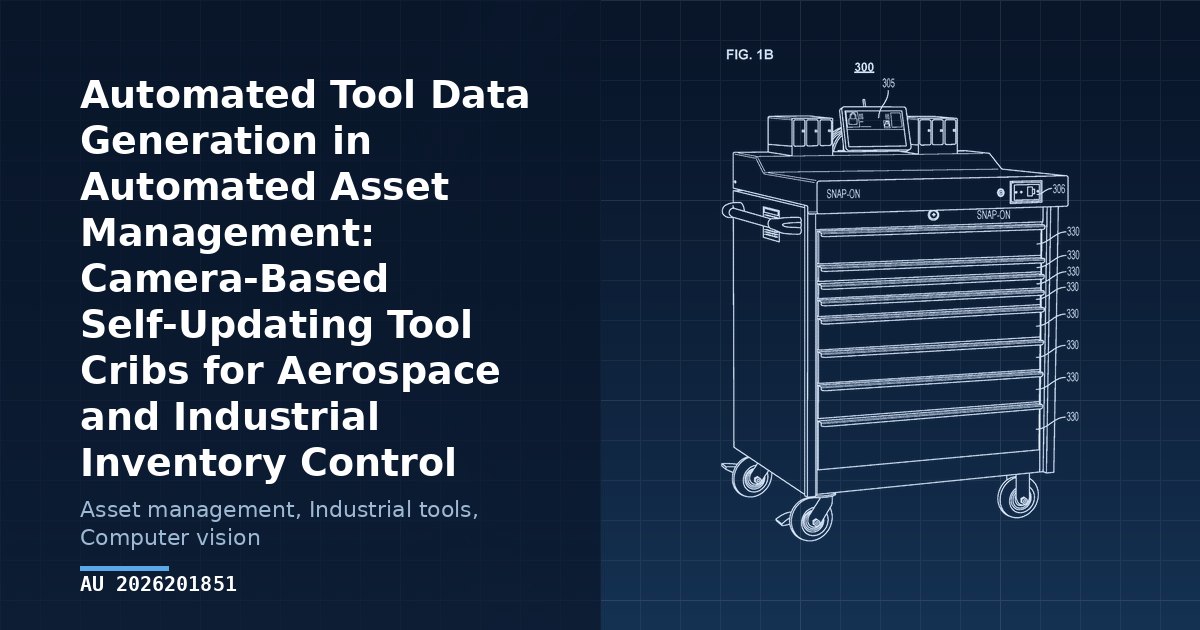
This patent covers a tool control system that uses a camera, tagged tools, and a self-updating database to automatically generate and maintain inventory data for tool cribs, including the case where two storage locations are physically identical and a tool that was pre-assigned to one slot has been put back in the other.
The Problem
In industries with high inventory discipline, a missing tool is a safety event, not a logistics inconvenience. The aerospace industry’s foreign object debris (FOD) program is the classic example: a spanner left behind in a wing cavity or engine nacelle during assembly can destroy an airframe. Hospitals, defence, nuclear, oil and gas, and rail maintenance run similar protocols. Modern automated tool control systems use sensorised tool boxes (contact, magnetic, infrared, or image-based) to detect whether each tool has been returned to its pre-assigned slot. They work only when the database describing each tool, its identifier, its expected image, and its expected slot is accurate and current. Maintaining that database is laborious: new tools get added, old tools get retired, sensors change, images age, and operators have always put physically identical tools back into the “wrong” twin slot. Manual database curation is slow, error-prone, and a recurring cost of ownership for the customer.
What This Invention Does
The invention provides an automated asset management system that automatically generates and updates the underlying tool database from observations of the storage locations themselves. The system comprises a plurality of storage locations, a camera, a processor, and a database that holds, for each object, a unique identifier encoded on the object’s tag, an image attribute of each storage location, and a pre-designation linking each common object to a particular slot. When two slots have substantially identical shapes that can each receive the same common object, the system performs a camera scan, recognises the identifier tag of the common object inside the alternative slot, and automatically updates the database to replace the pre-designation so the common object is now associated with the slot it is actually in. The invention also covers methods of automatically recognising a unique identifier on a new tool, automatically choosing which inventory record to associate it with, and automatically populating the database, end-to-end self-maintenance of tool control data. The application is the second-generation divisional in the family rooted in AU 2018219356.
Key Features
- Camera-based identification of tool tags. Each tool carries a tag encoding a unique identifier. The system uses cameras (rather than contact or magnetic sensors alone) to read identifiers and decide what is in each storage slot.
- Automatic handling of twin slots. When two slots have substantially identical shapes, the database tracks which one a given tool is “expected” in. If the camera sees the tool in the other slot, the database is silently updated to match what the user actually does, removing a common false-positive missing-tool alarm.
- Self-populating new-tool workflow. When a new tool is added, the system automatically recognises its identifier, picks the matching inventory record, and writes the association into the database, removing a manual data-entry step.
- Updatable image attributes per slot. The image attribute of each storage location is itself part of the database, so when lighting, tray inserts, or tool wear changes the visual appearance of a slot, the system can update the reference image rather than continually generating false misreads.
- FOD-grade inventory accuracy. The patent specifically calls out the aerospace foreign object damage problem as the motivation for accurate, current tool data, situating the system in the highest-tier inventory control market.
Who Is Behind It?
The applicant is Snap-on Incorporated, the Wisconsin-based maker of professional tools, diagnostic equipment, and asset management systems best known for its Snap-on Industrial brand of automated tool control cabinets used in commercial aviation, defence, and high-reliability manufacturing. The named inventors are Matthew J. Lipsey, David C. Fly, Preston C. Phillips, Jason Newport, Andrew R. Lobo, Joseph Chwan, Frederick J. Rogers, Sean W. Ryan, and Thomas L. Kassouf, a team consistent with Snap-on’s product-engineering and software organisation. The Australian patent attorney is Phillips Ormonde Fitzpatrick in Melbourne. The application is a divisional of AU 2024200817, which is itself a divisional of AU 2018219356.
Why It Matters
Snap-on Industrial’s automated tool control systems are sold into the major Australian airlines, the Royal Australian Air Force, defence prime contractors, and a range of MRO operations. Patents that protect the smart-database backbone of those products, not just the cabinet hardware, are core to defending market position against newer entrants offering RFID or vision-based competitors. The shift the patent claims (cameras plus identifier tags plus self-updating databases, with explicit handling of duplicate slots) tracks the wider industrial move from hard-wired sensor cabinets to camera-and-software-led tool control. For Australian aviation and defence operators, this filing is part of the IP context that shapes which automated tool control systems are commercially available and at what licence cost.
Related Concepts
Automated tool cribs sit at the intersection of high-stakes inventory management and aviation safety, where foreign object damage programs treat a missing spanner as a potential aircraft-loss event.
The move from contact sensors to camera-driven tag reading is part of a broader shift towards computer vision in industrial control, with end customers including airline MRO providers and defence operators like the Royal Australian Air Force.
AU 2026201851 was published in the Australian Official Journal of Patents on 2 April 2026 and is open for public inspection. Patent applications represent inventions that are sought to be protected and do not necessarily reflect commercially available products.
Related Patents Open to Public Inspections
See related Patents open to public inspection.

Management System

Dual-Speed Control Module for Power Tool Directional Flexibility

Outside Corner Finishing Tool Simplifies Drywall Application

Downhole Apparatus with a Valve Arrangement
Disclaimer
The information presented in this article is provided for general informational and illustrative purposes only.
Content on this page may be derived from publicly available intellectual property records, including patent documentation and related materials. While reasonable care is taken in compiling and summarising this information, ATMOSS does not guarantee the accuracy, completeness, currency, or reliability of any content presented.
This article is not a substitute for reviewing the original source documents. Patent applications, specifications, claims, and related records may contain detailed technical, legal, and contextual information that is not fully represented in this summary.
ATMOSS does not provide legal, technical, or commercial advice. Users should not rely on this content for decision-making purposes.
For authoritative and up-to-date information, users should refer directly to the official records available via IP Australia and other relevant intellectual property databases. Links to these official sources are provided where applicable.
ATMOSS accepts no liability for any loss, damage, or consequences arising from the use of, or reliance on, the information contained in this article.