
Application Number: AU 2024426105
Dual-Speed Control Module for Power Tool Directional Flexibility
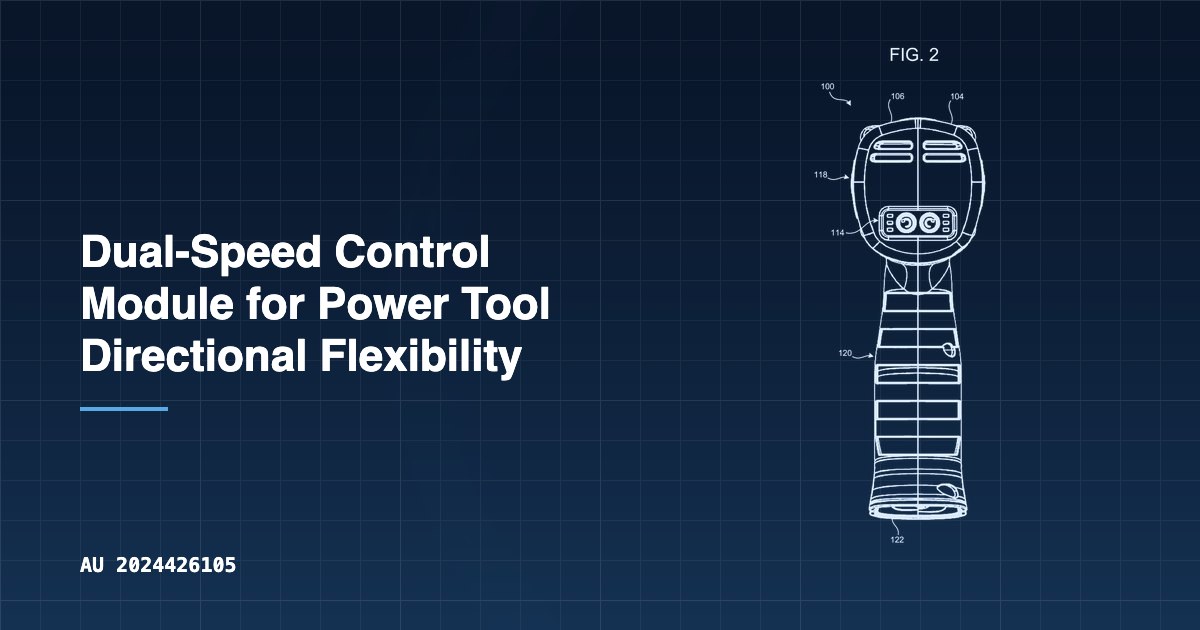
The speed selection module employs a dedicated printed circuit board with separate selection buttons and illumination elements for forward and reverse operations. Each directional button controls its own speed setting independently, with integrated LED indicators showing the selected speed for that direction. The system architecture allows the tool's microcontroller to recognize distinct speed commands for
View the Dual-Speed Control Module for Power Tool Directional Flexibility PDF
Download the PDF version of this Application Open to Public Inspection
This innovative speed selection module enables independent control of rotational speed settings for forward and reverse directions on power tools, allowing users to optimize performance for specific tasks in each direction. The technology improves power tool versatility and performance consistency by eliminating the need to compromise with a single speed setting suitable for both directional modes.
The Problem
Professional power tools often require different operating speeds depending on the task direction. For impact wrenches, drills, and similar tools, users frequently need high speed in forward rotation to drive fasteners quickly but lower speed in reverse to remove fasteners without stripping them. Conversely, high torque in reverse direction may be needed to break stuck fasteners while lower torque in forward direction suffices for installation. Traditional power tools use a single speed adjustment that applies equally to both rotation directions, forcing users to compromise with a middle-ground speed that isn’t optimal for either direction. This limitation reduces efficiency and increases the risk of fastener damage, tool slippage, or user injury. Professional users have long desired independent speed control but existing tool designs cannot economically or practically support dual-channel control electronics.
What This Invention Does
The speed selection module employs a dedicated printed circuit board with separate selection buttons and illumination elements for forward and reverse operations. Each directional button controls its own speed setting independently, with integrated LED indicators showing the selected speed for that direction. The system architecture allows the tool’s microcontroller to recognize distinct speed commands for each rotation direction and apply appropriate motor control accordingly. When the user presses the forward button, only forward-direction speed settings are adjusted and displayed. When the reverse button is pressed, only reverse-direction settings change. This allows users to set forward rotation to high speed for fastener installation while independently setting reverse rotation to lower speed for removal, optimizing performance for each task.
Key Features
- Independent Directional Control. Forward and reverse rotation speeds are selected completely independently, allowing optimization for specific application requirements in each direction.
- Dedicated User Interface. Separate selection buttons and LED indicators for each direction eliminate confusion and ensure users clearly understand which direction they’re controlling.
- Visual Feedback. Individual LED indicators corresponding to each direction show selected speed levels, providing immediate confirmation and preventing unintended speed selections.
- Professional Flexibility. The dual-speed architecture accommodates the diverse requirements of professional users who employ power tools for many different applications requiring different optimal speeds.
- Seamless Integration. The module integrates directly into tool housing without requiring external add-ons or modifications, maintaining the tool’s professional appearance and ergonomics.
Who Is Behind It?
SNAP-ON INCORPORATED, a leading global manufacturer of professional tools and diagnostic equipment, developed this innovation with inventors Jianjun Zhou, Hangyu Ma, and Haolun He. Griffith Hack patent attorneys managed the application. Snap-On’s expertise in professional tool development and deep understanding of user requirements shaped this innovation addressing genuine practitioner needs.
Why It Matters
Professional tools represent substantial investments, with high-performance equipment expected to deliver versatile functionality across diverse applications. Power tools that limit users to single-speed operation are increasingly seen as under-performing alternatives to more capable systems. This innovation enables manufacturers to differentiate their tools through genuinely superior functionality that professionals demonstrably value. Beyond professional markets, the technology has applications in consumer power tools, where DIY enthusiasts performing varied home improvement projects benefit from optimized speed control. As tool technology becomes increasingly electronic and microcontroller-dependent, features like independent directional speed control become feasible and economical, supporting manufacturer differentiation and user satisfaction.
Related Concepts
Impact wrenches and cordless drills are among the most widely used professional power tools, with performance requirements that vary significantly by application and direction of rotation. The integration of electronic microcontrollers into power tools has enabled features like variable speed, torque limiting, and directional memory that were previously impossible.
Independent speed control per direction addresses a genuine workflow need: fastener installation and removal often require different torque and speed profiles. This concept builds on advances in brushless DC motor technology, where electronic commutation already allows precise, programmable speed and torque management across the full rotation range.
AU 2024426105 was published in the Australian Official Journal of Patents on 19 March 2026 and is open for public inspection. Patent applications represent inventions that are sought to be protected and do not necessarily reflect commercially available products.
Related Patents Open to Public Inspections
See related Patents open to public inspection.

Precision Bending Tool Simplifies Complex Metal Tubing Work

Clip Assemblies for Displacement Tools

Outside Corner Finishing Tool Simplifies Drywall Application

Automated Tool Data Generation in Automated Asset Management
Disclaimer
The information presented in this article is provided for general informational and illustrative purposes only.
Content on this page may be derived from publicly available intellectual property records, including patent documentation and related materials. While reasonable care is taken in compiling and summarising this information, ATMOSS does not guarantee the accuracy, completeness, currency, or reliability of any content presented.
This article is not a substitute for reviewing the original source documents. Patent applications, specifications, claims, and related records may contain detailed technical, legal, and contextual information that is not fully represented in this summary.
ATMOSS does not provide legal, technical, or commercial advice. Users should not rely on this content for decision-making purposes.
For authoritative and up-to-date information, users should refer directly to the official records available via IP Australia and other relevant intellectual property databases. Links to these official sources are provided where applicable.
ATMOSS accepts no liability for any loss, damage, or consequences arising from the use of, or reliance on, the information contained in this article.