
Application Number: AU 2025226756
Clip Assemblies for Displacement Tools Faster, Easier Fastening Systems
The patented clip assembly provides a streamlined solution that decreases the time required to use a displacement tool for particular tasks. The innovative design features detent mechanisms that enable quick, reliable attachment to structural members while allowing precise positioning adjustments. Technicians can now rapidly move and resecure tools without disassembly.
View the Clip Assemblies for Displacement Tools PDF
Download the PDF version of this Application Open to Public Inspection
Tiger Tool International introduces innovative clip assemblies designed to enhance the efficiency and effectiveness of displacement tool systems. The patent describes detachable clip mechanisms that significantly reduce setup time and improve usability when positioning displacement tools for rod extraction and similar operations.
The Problem
Displacement tools are essential in automotive repair, maintenance, and industrial applications where precision rod member movement is required. Traditional fastening methods require multiple steps to position and secure tools correctly. Technicians spend considerable time adjusting positions, which delays job completion and increases labor costs. The complexity of positioning creates frustration and introduces potential for errors or safety issues.
Current clip systems lack the sophistication needed for quick, reliable attachment while maintaining precise positioning. Workers must use multiple securing mechanisms or settle for limited positioning flexibility. The inability to quickly reposition tools mid-task forces unnecessary tool changes or extended downtime. Inefficient fastening systems represent a hidden productivity cost across industries relying on displacement technology.
What This Invention Does
The patented clip assembly provides a streamlined solution that decreases the time required to use a displacement tool for particular tasks. The innovative design features detent mechanisms that enable quick, reliable attachment to structural members while allowing precise positioning adjustments. Technicians can now rapidly move and resecure tools without disassembly.
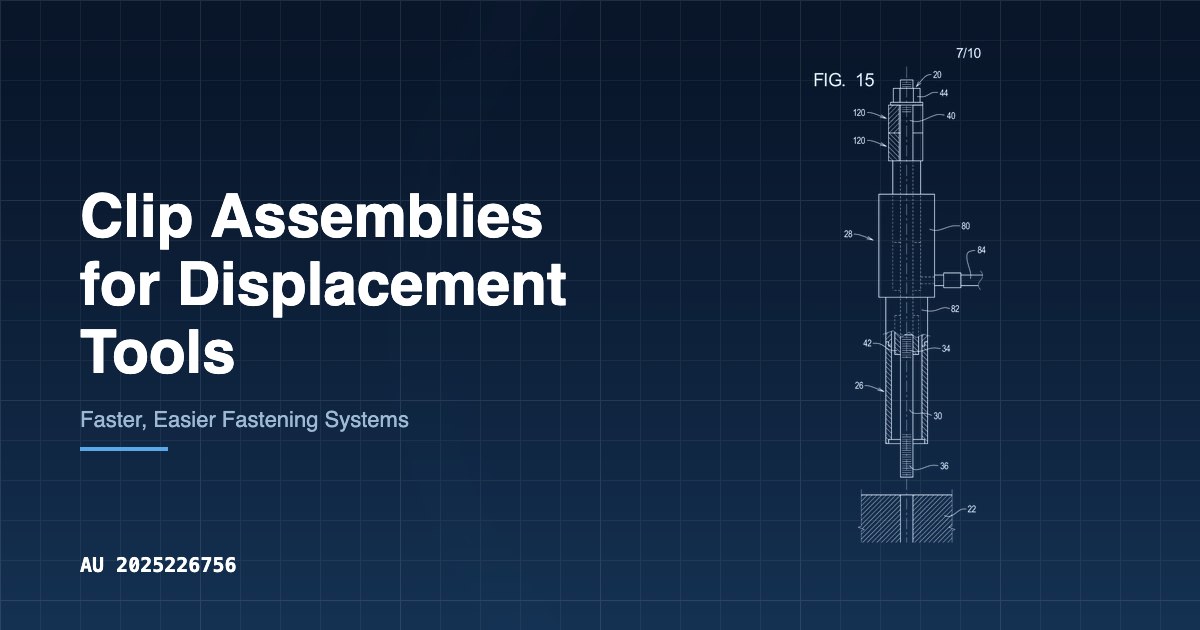
The clip body contains a channel designed to receive the rod member, with integrated detent assemblies that hold the rod in place when extended. Resilient members bias the detents toward the extended position, ensuring reliable engagement automatically. This design combines quick-release functionality with secure holding force, addressing both efficiency and safety requirements in demanding work environments.
Key Features
Detachable Attachment. The clip assembly attaches and detaches from rod members quickly, without requiring specialized tools or complex procedures, enabling rapid repositioning.
Integrated Detent System. Multiple detent assemblies provide secure holding force while allowing controlled release when needed, combining safety with operational ease.
Resilient Biasing. Resilient members maintain detent position engagement automatically, requiring minimal operator input to maintain secure positioning.
Precision Channel Design. The clip channel precisely accommodates the rod member, ensuring consistent positioning without slippage or misalignment during operation.
Modular Architecture. The design allows multiple clips to be used in series or adapted for different displacement system configurations.
Who Is Behind It?
Tiger Tool International Incorporated, a specialty tools manufacturer, developed this innovation with inventor Michael Andrews credited on the patent. The application is represented by Phillips Ormonde Fitzpatrick patent attorneys in Melbourne. Priority is claimed from a U.S. provisional application filed in September 2024.
Why It Matters
Tool efficiency improvements directly impact labor costs and job completion times. For professional technicians, faster setup and repositioning translates to completing more jobs per day and improving profitability. For fleet maintenance operations managing multiple vehicles, time savings multiply across thousands of services annually.
The enhanced usability of displacement tool systems reduces training requirements for new technicians, enabling them to become productive more quickly. Better positioning control improves work quality and reduces the risk of tool slippage or misalignment that could damage components. Industries relying on these tools in automotive repair, mechanical systems maintenance, and industrial applications all benefit from innovation that reduces labor while improving outcomes. Tiger Tool’s focus on practical efficiency gains demonstrates deep understanding of professional tool user needs.
AU 2025226756 was published in the Australian Official Journal of Patents on 19 March 2026 and is open for public inspection. Patent applications represent inventions that are sought to be protected and do not necessarily reflect commercially available products.
Related Concepts
Detent mechanisms are spring-loaded or friction-based components used to hold a part in a defined position until deliberate force releases it – a principle central to quick-attach tooling. Automotive repair and fleet maintenance operations depend on reliable, rapidly repositionable tools to keep workshop throughput high and labour costs under control.
Related Patents Open to Public Inspections
See related Patents open to public inspection.

Advanced Screeding Tools for Precise Surface Preparation and Level Setting

Outside Corner Finishing Tool Simplifies Drywall Application

Precision Bending Tool Simplifies Complex Metal Tubing Work

Dual-Speed Control Module for Power Tool Directional Flexibility
Disclaimer
The information presented in this article is provided for general informational and illustrative purposes only.
Content on this page may be derived from publicly available intellectual property records, including patent documentation and related materials. While reasonable care is taken in compiling and summarising this information, ATMOSS does not guarantee the accuracy, completeness, currency, or reliability of any content presented.
This article is not a substitute for reviewing the original source documents. Patent applications, specifications, claims, and related records may contain detailed technical, legal, and contextual information that is not fully represented in this summary.
ATMOSS does not provide legal, technical, or commercial advice. Users should not rely on this content for decision-making purposes.
For authoritative and up-to-date information, users should refer directly to the official records available via IP Australia and other relevant intellectual property databases. Links to these official sources are provided where applicable.
ATMOSS accepts no liability for any loss, damage, or consequences arising from the use of, or reliance on, the information contained in this article.