
Application Number: AU 2024219539
Autonomous Fuel Purchasing System for Commodity Price Protection
The system overcomes the critical technical challenge of enabling remote third parties to authoritatively determine commodity consumption without backend system integration or manual reporting. When a user initiates a transaction at a commodity terminal using the system's payment mechanism, a commodity service device sends a transaction request to the management system. The system determines the
View the Autonomous Fuel Purchasing System for Commodity Price Protection PDF
Download the PDF version of this Application Open to Public Inspection
This system revolutionizes how consumers purchase fuel by enabling advance purchasing at known prices with later redemption at any fuel station. By decoupling the purchase decision from the redemption location and time, the technology protects consumers from volatile fuel price fluctuations while eliminating supplier lock-in, providing genuine purchasing flexibility that fuel cards and existing loyalty programs cannot match.
The Problem
Fuel prices exhibit significant volatility driven by geopolitical events, currency fluctuations, and supply-demand dynamics. Retail consumers have minimal control over fuel costs and must absorb price increases through reduced discretionary income or deferred purchases. Existing mitigation strategies are limited: fuel cards lock consumers into specific supplier networks, offer only modest discounts, have limited security protections, and leave users with limited control over what discounts are offered. No existing solution enables retail consumers to purchase fuel in advance at locked-in prices for later redemption at competing retailers, essentially requiring real-time transaction settlement that would be prohibitively complex to coordinate across multiple independent fuel stations.
What This Invention Does
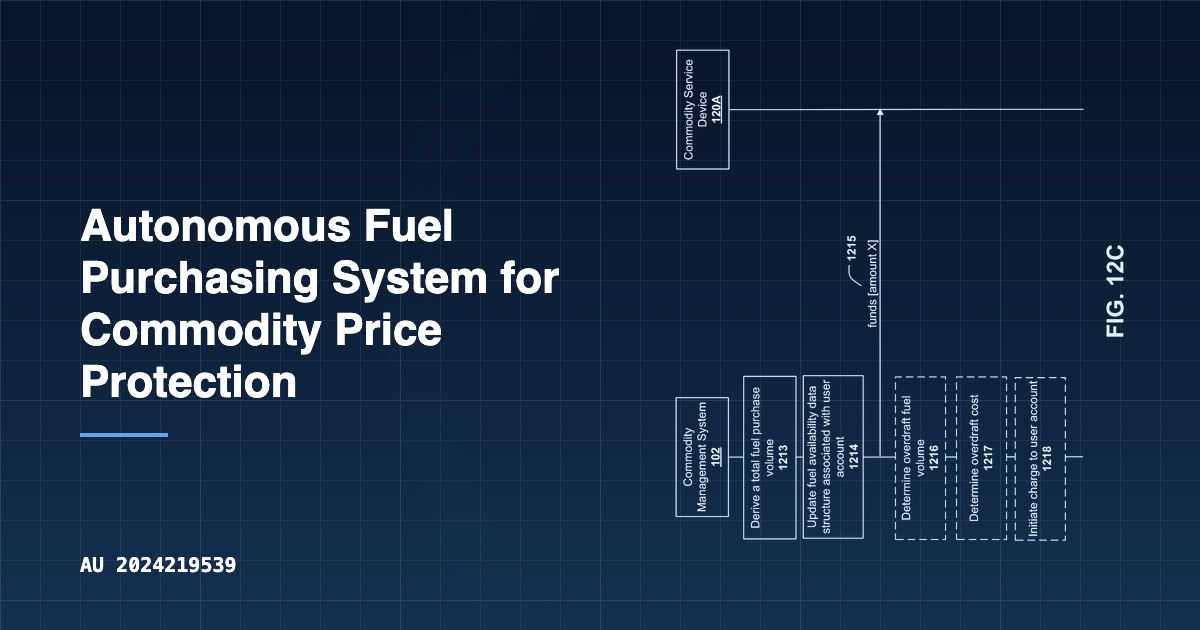
The system overcomes the critical technical challenge of enabling remote third parties to authoritatively determine commodity consumption without backend system integration or manual reporting. When a user initiates a transaction at a commodity terminal using the system’s payment mechanism, a commodity service device sends a transaction request to the management system. The system determines the terminal location from transaction details, queries an integrated database for the current commodity price at that specific location, calculates the total commodity volume the user can redeem based on their account balance and the current price, and updates the user’s available commodity data structure. Crucially, the retailer experiences the transaction as a normal sale with immediate payment, while the user achieves the benefit of advance purchasing and price protection.
Key Features
- Real-Time Price Determination. The system automatically determines current commodity prices at any location using an integrated database, eliminating guesswork and enabling accurate calculations of redemption volumes.
- Autonomous Verification. The system autonomously verifies transaction authenticity by checking user device location proximity to the commodity terminal, automatically declining suspicious transactions without manual review.
- Flexible Redemption. Users can redeem commodities at any participating terminal, not just affiliated retailers, providing true purchasing flexibility that supplier-specific cards cannot offer.
- Advance Price Protection. Users purchase commodities at predetermined prices and redeem them later at various locations, protecting themselves against subsequent price increases.
- Real-Time Settlement. Retailers receive payment immediately, ensuring their operational flow is uninterrupted while users benefit from advance purchasing flexibility.
Who Is Behind It?
Kerpower UK Ltd developed this system with an international team of inventors: Jamie Mark Shedley, James Colin McNicol, Benjamin Adam Keith, Sebastian Ferraccu, Richard Marriott, and Peter Hotchkiss. K&L Gates legal firm, a major international practice with Australian offices in Melbourne, managed the patent application. The innovation represents significant technical sophistication in solving complex real-time transaction requirements.
Why It Matters
Fuel price volatility significantly impacts consumer budgets and business operations globally. This system addresses a fundamental gap between retail and wholesale fuel markets by enabling retail consumers to achieve wholesale-like purchasing benefits without requiring bulk purchases or wholesale access. The technology is particularly valuable for commercial fleet operators, delivery services, and transportation businesses that consume substantial fuel volumes. Beyond fuel, the system’s underlying architecture enables similar applications for any commodity with volatile pricing – electricity, food staples, and other essentials where consumers benefit from advance purchasing and price locking. The innovation aligns with growing consumer expectations for dynamic, transparent pricing and control over purchasing decisions.
Related Concepts
This invention sits at the intersection of commodity markets and consumer payment technology. Price hedging is a well-established strategy in wholesale energy markets; this patent extends similar price-protection principles to retail fuel consumers for the first time.
The underlying architecture draws on real-time payment settlement and geolocation-based fraud detection – technologies increasingly central to modern fintech platforms. Beyond fuel, the same framework could apply to any commodity where retail consumers seek protection from price volatility.
AU 2024219539 was published in the Australian Official Journal of Patents on 19 March 2026 and is open for public inspection. Patent applications represent inventions that are sought to be protected and do not necessarily reflect commercially available products.
Related Patents Open to Public Inspections
See related Patents open to public inspection.

Advanced Machine Learning for Risk Modeling With Missing Data

Securities Trading With Net Pricing For Retail Investors

Sportsbook Odds Optimization and Correlated Proposition Bet Analysis

Cashless Casino
Disclaimer
The information presented in this article is provided for general informational and illustrative purposes only.
Content on this page may be derived from publicly available intellectual property records, including patent documentation and related materials. While reasonable care is taken in compiling and summarising this information, ATMOSS does not guarantee the accuracy, completeness, currency, or reliability of any content presented.
This article is not a substitute for reviewing the original source documents. Patent applications, specifications, claims, and related records may contain detailed technical, legal, and contextual information that is not fully represented in this summary.
ATMOSS does not provide legal, technical, or commercial advice. Users should not rely on this content for decision-making purposes.
For authoritative and up-to-date information, users should refer directly to the official records available via IP Australia and other relevant intellectual property databases. Links to these official sources are provided where applicable.
ATMOSS accepts no liability for any loss, damage, or consequences arising from the use of, or reliance on, the information contained in this article.