
Application Number: AU 2025226711
Advanced Machine Learning for Risk Modeling With Missing Data
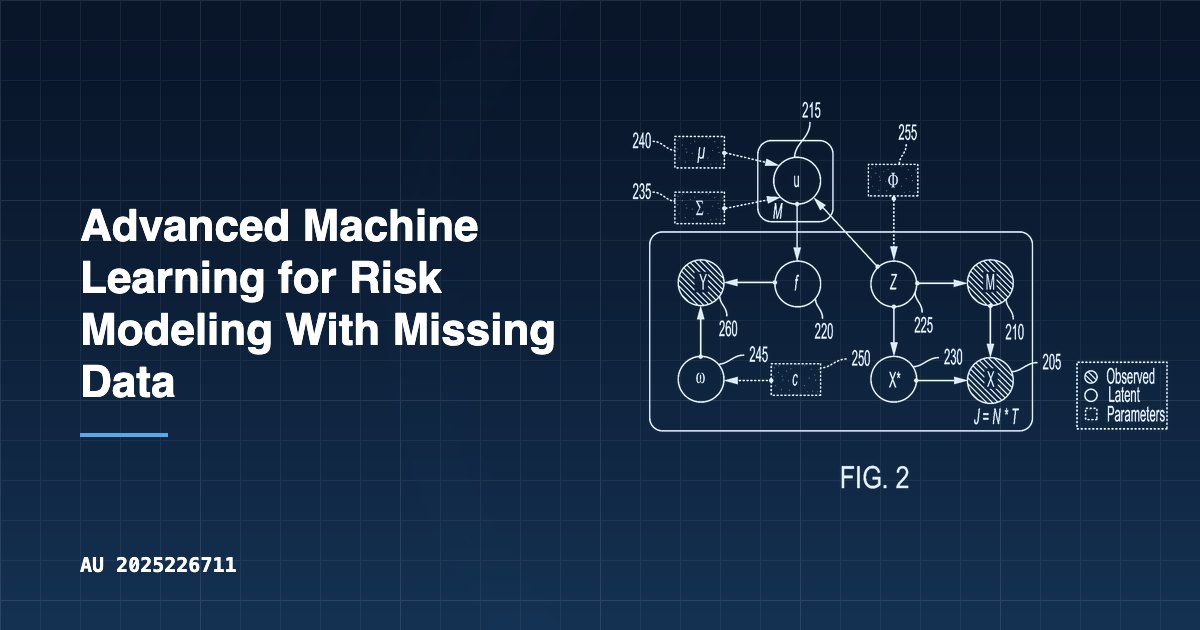
This patent describes systems and methods for training machine learning models using deep kernel learning techniques specifically designed to function effectively even when training data contains high-dimensional missingness. The approach utilizes Gaussian processes as a foundational framework, combining them with deep neural network architectures to capture non-linear relationships while properly managing uncertainty from missing values.
View the Advanced Machine Learning for Risk Modeling With Missing Data PDF
Download the PDF version of this Application Open to Public Inspection
Equifax’s latest patent introduces a sophisticated approach to training and deploying machine learning models for risk assessment when dealing with incomplete datasets. The invention leverages deep kernel learning combined with Gaussian processes to handle the practical reality that real-world data often contains significant gaps and missing values.
The Problem
Financial risk modeling and credit assessment routinely encounter incomplete data. Missing values present a fundamental challenge when building predictive models. Traditional approaches either discard records with missing values (losing valuable information) or use simplistic imputation methods that may distort the underlying patterns in the data. This limitation becomes especially acute when modeling complex financial relationships where missingness itself carries informational value.
The absence of robust methods for handling high-dimensional data with extensive missing information forces organizations to choose between statistical purity and practical utility. Complex financial behaviors and creditworthiness cannot always be captured through complete datasets, yet existing techniques fail to appropriately weight uncertainty introduced by missing values. This gap reduces model reliability and potentially introduces bias in risk assessment outcomes.
What This Invention Does
This patent describes systems and methods for training machine learning models using deep kernel learning techniques specifically designed to function effectively even when training data contains high-dimensional missingness. The approach utilizes Gaussian processes as a foundational framework, combining them with deep neural network architectures to capture non-linear relationships while properly managing uncertainty from missing values.
The innovation enables more accurate risk modeling by leveraging the partial information available in incomplete records rather than discarding them entirely. By treating missingness as a component of the modeling process rather than an obstacle to overcome, the system improves both prediction accuracy and the reliability of uncertainty quantification. The result is a more nuanced understanding of risk that reflects real-world data conditions.
Key Features
Deep Kernel Learning Integration. The system combines deep neural networks with kernel methods to capture complex, non-linear relationships in the data while maintaining interpretability.
Gaussian Process Framework. Probabilistic modeling through Gaussian processes provides principled uncertainty quantification, essential for high-stakes financial decision making.
High-Dimensional Missingness Handling. Rather than treating missing values as a limitation, the approach incorporates them into the modeling framework, leveraging partial information more effectively.
Uncertainty Quantification. The method provides confidence intervals and probability distributions for predictions, enabling risk-aware decision making by lending institutions.
Scalability. The framework is designed to handle large datasets common in financial risk assessment without sacrificing model sophistication.
Who Is Behind It?
Equifax Inc., a leading provider of credit information and risk assessment services, filed this patent with inventors TIAN, Longxiu, ZHAO, Tian, and MILLER, Stephen. The patent is represented by FB Rice Pty Ltd in Sydney. Priority is claimed from a U.S. application filed in September 2024.
Why It Matters
The financial services industry relies heavily on predictive models for credit decisions, fraud detection, and risk management. Improvements in handling incomplete data directly translate to better business outcomes and more equitable lending practices. This patent addresses a technical limitation that has affected model performance across the industry.
By enabling more effective use of partially complete records, this approach potentially improves the inclusion of previously underserved populations who may have limited credit histories or scattered financial data. The enhanced ability to quantify uncertainty is particularly valuable in risk assessment, where overconfidence in predictive models can lead to significant financial losses or inappropriate lending decisions. Organizations using this technology gain competitive advantage through more accurate, defensible risk models.
AU 2025226711 was published in the Australian Official Journal of Patents on 19 March 2026 and is open for public inspection. Patent applications represent inventions that are sought to be protected and do not necessarily reflect commercially available products.
Related Concepts
Gaussian processes are probabilistic models widely used in machine learning to represent distributions over functions, making them valuable for uncertainty quantification in high-stakes applications. When combined with kernel methods and deep architectures, they can capture complex patterns in financial data even when records are incomplete – a common challenge in credit risk modelling.
Related Patents Open to Public Inspections
See related Patents open to public inspection.

Intelligent Risk Assessment

Intelligent Home Appliance Control Through Advanced Command Processing

One View to Rule Them All

Autonomous Fuel Purchasing System for Commodity Price Protection
Disclaimer
The information presented in this article is provided for general informational and illustrative purposes only.
Content on this page may be derived from publicly available intellectual property records, including patent documentation and related materials. While reasonable care is taken in compiling and summarising this information, ATMOSS does not guarantee the accuracy, completeness, currency, or reliability of any content presented.
This article is not a substitute for reviewing the original source documents. Patent applications, specifications, claims, and related records may contain detailed technical, legal, and contextual information that is not fully represented in this summary.
ATMOSS does not provide legal, technical, or commercial advice. Users should not rely on this content for decision-making purposes.
For authoritative and up-to-date information, users should refer directly to the official records available via IP Australia and other relevant intellectual property databases. Links to these official sources are provided where applicable.
ATMOSS accepts no liability for any loss, damage, or consequences arising from the use of, or reliance on, the information contained in this article.