
Application Number: AU 2026201418
Intelligent Risk Assessment AI Recommends Precise Actions to Improve Entity Scores
This patent describes a system that uses machine learning and statistical analysis to generate personalized recommendations for risk score improvement. The system operates in several steps: An entity submits a request for a recommendation to improve from a current risk assessment score to a target score. The system accesses the entity's attribute vector-their specific characteristics
View the Intelligent Risk Assessment PDF
Download the PDF version of this Application Open to Public Inspection
Risk assessment scores fundamentally govern access to credit, employment, insurance, and other critical services. Individuals and businesses often receive scores that limit their opportunities but lack clear understanding of what actions would improve their standing. This patent describes an advanced artificial intelligence system that analyzes the gap between a current risk score and a target score, then recommends specific attribute changes that would move an entity from their current assessment to a target assessment. By providing personalized, evidence-based recommendations for score improvement, the system transforms risk assessment from a passive evaluation into an active pathway for improvement.
The Problem
Risk assessment scores are used extensively in financial services, credit decisions, employment screening, insurance underwriting, and other high-consequence determinations. These scores aggregate multiple attributes into a single number that predicts the likelihood of positive or negative outcomes. When an individual or business receives a low risk score, access to credit is restricted, insurance premiums increase, or employment opportunities diminish.
The challenge is that score improvement requires understanding what actions matter. Different attribute changes have different impacts on scores. Some changes require substantial effort to achieve. Some are more achievable for certain types of entities than others. A truly useful system would not just evaluate current risk but also recommend specific improvements tailored to the individual entity’s characteristics and circumstances.
Traditional approaches provide generic advice-improve payment history, reduce debt, increase savings-but don’t account for an entity’s starting position and what pathways are most achievable for their specific circumstances. Machine learning systems that power risk assessment could theoretically identify optimal improvement pathways, but developing this capability and implementing it effectively requires sophisticated algorithms and statistical analysis.
What This Invention Does
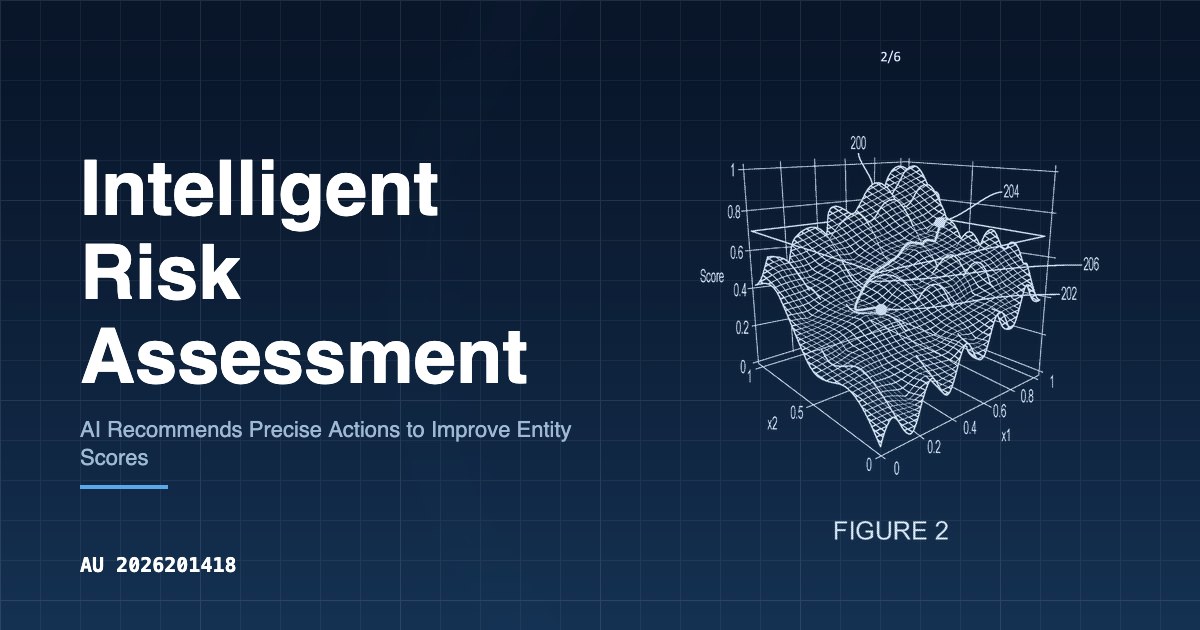
This patent describes a system that uses machine learning and statistical analysis to generate personalized recommendations for risk score improvement. The system operates in several steps: An entity submits a request for a recommendation to improve from a current risk assessment score to a target score. The system accesses the entity’s attribute vector-their specific characteristics and measurements across multiple dimensions-and also analyzes clusters of entities defined by historical attribute vectors.
The system assigns the entity’s attributes to a particular cluster of similar entities based on similarity measures. These clusters represent groups of entities with comparable characteristics. Within each cluster, the system computes statistics about the relationship between attributes and risk scores.
Based on these cluster statistics, the system determines what movements in attribute space would be required to move from the current risk score to the target score. This is conceptualized as movement in multi-dimensional space, where each dimension represents an attribute, the first point corresponds to current score, and the second point corresponds to the target score.
The system then computes an attribute-change vector-a specific set of attribute changes-that would achieve the target score while complying with the statistical patterns observed in the cluster. The system generates recommendations from this attribute-change vector, translating mathematical optimization into actionable guidance. These recommendations are presented to the user, providing a personalized roadmap for score improvement.
Key Features
Personalized Recommendations. Rather than generic advice, the system recommends changes tailored to the individual entity’s current state, characteristics, and the specific cluster of similar entities they belong to. Recommendations reflect what’s statistically achievable for entities similar to the user.
Evidence-Based Pathways. Recommendations are grounded in historical data about what attribute changes actually result in score improvement, not on untested assumptions about what should help.
Multi-Attribute Optimization. The system considers interactions between attributes and identifies paths that optimize across multiple dimensions simultaneously, rather than focusing on single variables.
Achievable Targets. By analyzing clusters of similar entities, the system identifies improvement pathways that are genuinely achievable within the statistical bounds of entities with similar starting characteristics.
Transparency in Decision-Making. Users receive specific, understandable recommendations rather than black-box assessments, creating clarity about what actions matter for score improvement.
Who Is Behind It?
Equifax Inc., one of the world’s largest credit data and analytics companies based in the United States, developed this invention with a team of five inventors: Stephen Miller, Lewis Jordan, Matthew Turner, Mark Day, and Allan Joshua. This represents a divisional patent application from an earlier patent (2020333769), indicating Equifax’s sustained development of machine learning systems for risk assessment with progressively refined embodiments and claims.
Why It Matters
Risk assessment affects billions of people globally. Credit scores determine access to mortgages, car loans, and personal credit. Employment screening influences hiring decisions affecting career trajectories. Insurance assessments determine coverage and premium rates. Any innovation that makes risk assessment more transparent and provides individuals with actionable pathways to improve their standing has broad social significance.
From a business perspective, entities that can offer customers clear improvement pathways differentiate themselves in competitive markets. Lending companies, insurance providers, and employers increasingly compete on transparency and fairness. A system that provides personalized improvement recommendations addresses that market need.
Particularly in the credit market, improved access to credit benefits individuals and drives economic activity. If lower-scored individuals can understand and implement specific improvements to access credit at better terms, consumer spending and economic participation increase. For lending companies, helping customers improve their creditworthiness increases the pool of qualified borrowers.
The system also has potential applications beyond credit. Employment screening, insurance underwriting, and other risk assessment domains all face similar challenges: how to help assessed entities understand improvement pathways. The underlying machine learning approach applies across these diverse domains.
From a fairness and equity perspective, systems that provide transparent recommendations may reduce bias in assessments by making explicit what factors drive decisions. Rather than opaque black-box scoring, personalized recommendations illuminate the relationship between attributes and outcomes.
The IPC classifications (G06Q 10/04, G06Q 40/02, G06Q 10/06) confirm this is recognized as a significant innovation in business systems, financial assessment, and management information systems, reflecting the technical sophistication and commercial importance of the machine learning system.
AU 2026201418 was published in the Australian Official Journal of Patents on 19 March 2026 and is open for public inspection. Patent applications represent inventions that are sought to be protected and do not necessarily reflect commercially available products.
Related Concepts
Credit scoring and broader risk assessment systems have long been criticised for opacity – they produce a number but rarely explain what specific changes would improve it. Machine learning has made scoring more accurate, but also more opaque. This patent addresses that tension directly, using cluster-based statistical analysis to generate personalised, evidence-backed improvement pathways rather than generic advice – an important step toward more transparent and equitable underwriting and lending decisions.
Related Patents Open to Public Inspections
See related Patents open to public inspection.

Advanced Machine Learning for Risk Modeling With Missing Data

Intelligent Home Appliance Control Through Advanced Command Processing

Neural Networks Enable Intelligent Entity Matching in Database Systems

One View to Rule Them All
Disclaimer
The information presented in this article is provided for general informational and illustrative purposes only.
Content on this page may be derived from publicly available intellectual property records, including patent documentation and related materials. While reasonable care is taken in compiling and summarising this information, ATMOSS does not guarantee the accuracy, completeness, currency, or reliability of any content presented.
This article is not a substitute for reviewing the original source documents. Patent applications, specifications, claims, and related records may contain detailed technical, legal, and contextual information that is not fully represented in this summary.
ATMOSS does not provide legal, technical, or commercial advice. Users should not rely on this content for decision-making purposes.
For authoritative and up-to-date information, users should refer directly to the official records available via IP Australia and other relevant intellectual property databases. Links to these official sources are provided where applicable.
ATMOSS accepts no liability for any loss, damage, or consequences arising from the use of, or reliance on, the information contained in this article.