
Application Number: AU 2025226810
Intelligent Home Appliance Control Through Advanced Command Processing
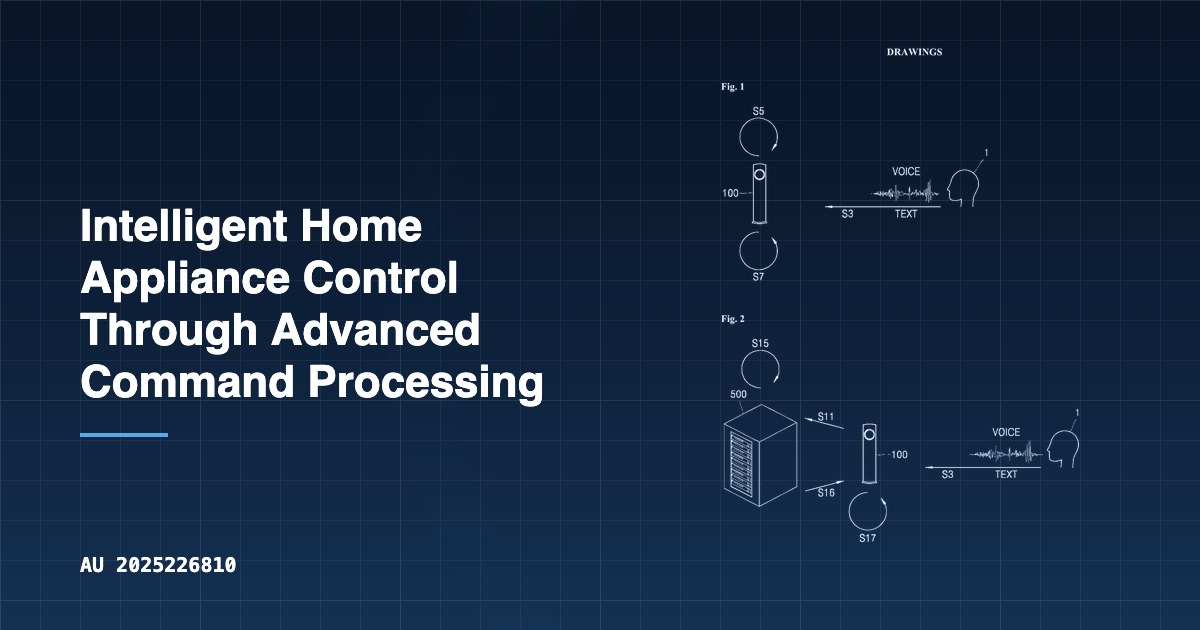
The patented method enables intelligent interpretation of appliance control commands through advanced processing that understands user intent even when phrased in varied ways. The system incorporates machine learning and natural language understanding to interpret commands contextually, recognizing synonyms, variations, and implied meanings. By focusing on user intention rather than exact command syntax, the appliance responds
View the Intelligent Home Appliance Control Through Advanced Command Processing PDF
Download the PDF version of this Application Open to Public Inspection
LG Electronics presents an advanced method for controlling home appliances based on command processing that incorporates intelligent interpretation of user intentions. The system enables more natural, context-aware appliance control that understands nuanced user requests and adapts to individual preferences and communication styles.
The Problem
Current home appliance control systems require precise command syntax or navigation through predetermined menu structures. Users must learn specific commands or remember complex control sequences. The inability to interpret varied or contextual commands limits the naturalness of human-appliance interaction. Users frequently become frustrated when their intuitive command phrasing fails to produce expected results because the system lacks flexibility in interpretation.
Appliances cannot distinguish between similar requests phrased differently or understand contextual nuance in user commands. This limitation becomes particularly evident in multi-appliance scenarios where users expect coordinated responses. The absence of intelligent command interpretation reduces user satisfaction and adoption of advanced control features. Appliance manufacturers recognize that control systems requiring memorization of command syntax represent a usability barrier.
What This Invention Does
The patented method enables intelligent interpretation of appliance control commands through advanced processing that understands user intent even when phrased in varied ways. The system incorporates machine learning and natural language understanding to interpret commands contextually, recognizing synonyms, variations, and implied meanings. By focusing on user intention rather than exact command syntax, the appliance responds more naturally and intuitively.
The implementation employs neural networks and language processing to understand command semantics, allowing users to control appliances through natural conversation. The system learns individual user preferences and adapts control responses based on previous interactions. This intelligent approach transforms appliance control from a command-based system to a conversational interaction experience.
Key Features
Intent Recognition. The system interprets user commands based on intended outcome rather than exact syntax, accepting varied phrasings that express the same intent.
Neural Network Processing. Deep learning models enable sophisticated understanding of natural language commands and contextual nuance.
Contextual Interpretation. Commands are understood within context of recent interactions and appliance state, enabling more accurate intent recognition.
User Preference Learning. The system adapts control behavior based on individual user preferences and previous interaction patterns.
Multi-Appliance Coordination. Commands can coordinate across multiple appliances when context suggests integrated responses are appropriate.
Who Is Behind It?
LG Electronics Inc., the global home appliance leader, developed this innovation with inventor LEE, Eunah credited on the patent. The patent is represented by Dentons Patent Attorneys Australasia in Auckland. Priority is claimed from a South Korean application filed in September 2024, with PCT international filing in April 2025.
Why It Matters
Intelligent command processing represents a significant advancement in making home appliance technology intuitive and accessible. Users benefit from appliance control that responds to natural speech rather than requiring memorization of rigid command structures. Elderly users and those with cognitive limitations find this approach far more approachable than traditional menu-based systems.
The competitive advantage for appliance manufacturers comes from delivering experiences that feel natural and responsive to user needs. LG’s investment in intelligent command processing distinguishes their products in the smart home market. Integration with emerging AI assistants and smart home platforms becomes more seamless when appliances understand intent rather than requiring rigid command formatting. Users gain more satisfaction and feature utilization when control systems adapt to their communication patterns. This innovation represents a fundamental shift toward more human-centered appliance design that prioritizes user experience over command syntax.
AU 2025226810 was published in the Australian Official Journal of Patents on 19 March 2026 and is open for public inspection. Patent applications represent inventions that are sought to be protected and do not necessarily reflect commercially available products.
Related Concepts
Natural language processing (NLP) is the branch of artificial intelligence that enables computers to understand human language. Combined with neural networks, NLP allows home appliances to move beyond rigid command syntax toward genuinely conversational control.
The broader field of smart home automation connects appliances, security systems, and entertainment devices into a unified ecosystem. As intent-recognition technology matures, machine learning enables appliances to proactively adapt to individual user habits without requiring explicit programming.
Related Patents Open to Public Inspections
See related Patents open to public inspection.

Voice-Controlled Home Appliance Feature Adjustment System

Intelligent Risk Assessment

Advanced Machine Learning for Risk Modeling With Missing Data

One View to Rule Them All
Disclaimer
The information presented in this article is provided for general informational and illustrative purposes only.
Content on this page may be derived from publicly available intellectual property records, including patent documentation and related materials. While reasonable care is taken in compiling and summarising this information, ATMOSS does not guarantee the accuracy, completeness, currency, or reliability of any content presented.
This article is not a substitute for reviewing the original source documents. Patent applications, specifications, claims, and related records may contain detailed technical, legal, and contextual information that is not fully represented in this summary.
ATMOSS does not provide legal, technical, or commercial advice. Users should not rely on this content for decision-making purposes.
For authoritative and up-to-date information, users should refer directly to the official records available via IP Australia and other relevant intellectual property databases. Links to these official sources are provided where applicable.
ATMOSS accepts no liability for any loss, damage, or consequences arising from the use of, or reliance on, the information contained in this article.