
Application Number: AU 2025210883
Engineered Pit System Combines Plastic Components with Reinforced Metal Frame for Underground Infrastructure
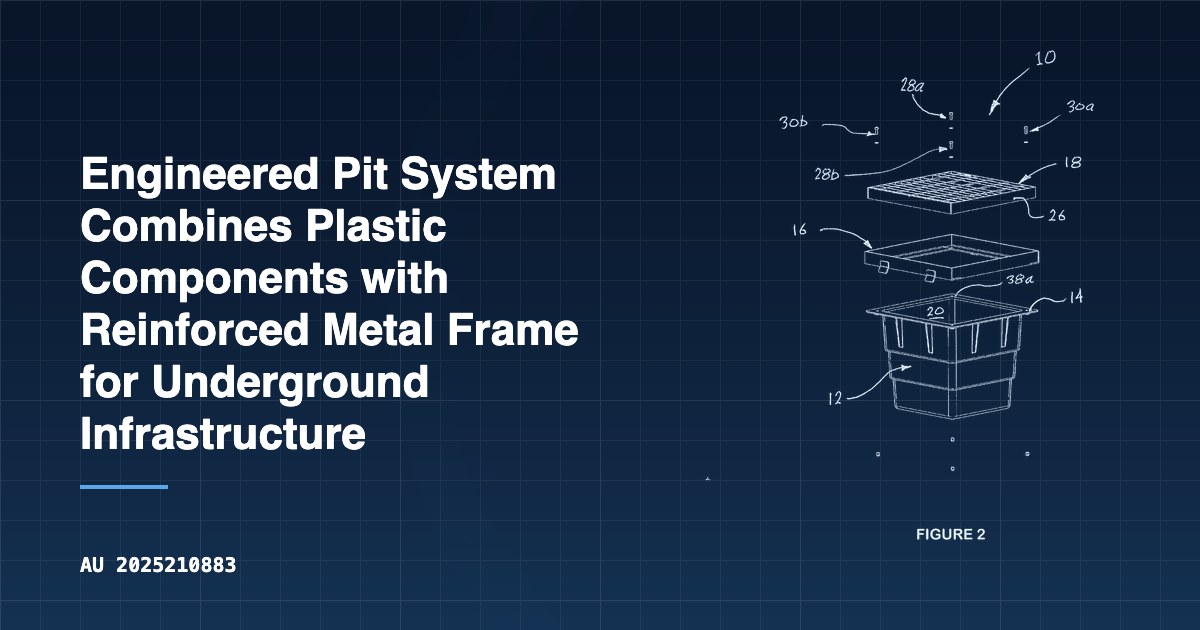
The assembly combines a durable plastic pit body with a precisely engineered metal reinforcing frame. The plastic pit includes a flanged rim designed to accept the reinforcing frame, which seats on the flange with an inner flange sandwiched between the pit rim and the grate or cover above. The reinforcing frame features a perimeter wall
View the Engineered Pit System Combines Plastic Components with Reinforced Metal Frame for Underground Infrastructure PDF
Download the PDF version of this Application Open to Public Inspection
When underground stormwater systems fail or utilities infrastructure becomes damaged, the repair costs and disruption cascade through entire city blocks. Traditional pit assemblies struggle with inadequate reinforcement, poor long-term stability, and installation complications. This innovation addresses these challenges through an integrated approach combining high-strength recycled plastic construction with strategic metal reinforcement.
The Problem
Stormwater and utilities pits must endure decades of exposure to soil pressure, temperature fluctuations, water infiltration, and heavy vehicular traffic passing overhead. Conventional designs either use heavy concrete structures (requiring specialized equipment and creating installation bottlenecks) or lightweight plastic alone (lacking sufficient structural integrity for demanding environments). When pit components fail prematurely, entire sections of underground infrastructure require emergency replacement, stranding residents without essential services.
The typical pit assembly also struggles with alignment between the pit opening, the protective grate or cover, and the surrounding concrete collar. Misalignment causes uneven weight distribution, accelerates material fatigue, and creates safety hazards where grates can shift or sink unexpectedly. Fastening multiple components using inconsistent methods leads to localized stress points where corrosion initiates and structural failure begins.
What This Invention Does
The assembly combines a durable plastic pit body with a precisely engineered metal reinforcing frame. The plastic pit includes a flanged rim designed to accept the reinforcing frame, which seats on the flange with an inner flange sandwiched between the pit rim and the grate or cover above. The reinforcing frame features a perimeter wall that rises to match the grate height, creating a unified structural system where each component supports and stabilizes the others.
The metal frame includes multiple external projections adapted for encasement in a concrete collar. These projections inhibit floating and lateral movement of the entire assembly when underground water pressure fluctuates. The frame is fabricated from metal while the pit itself uses high-strength recycled plastic, creating a hybrid approach that balances weight reduction with structural rigidity.
Fastener arrangements use diagonally opposite bolt pairs that engage directly with the flanged rim through threaded inserts. This symmetrical clamping approach distributes forces evenly, prevents rotational movement, and accommodates both vertical and lateral loading. Optional clamp plates bridge the grate load-bearing bars, creating a unified top that resists point-load failures.
Key Features
- Dual-Material Construction. The plastic pit body reduces weight while the metal reinforcing frame provides the structural strength needed for buried applications. Recycled plastic offers environmental benefits while maintaining chemical resistance and long-term stability in moist underground conditions.
- Integrated Fastening System. Diagonally opposite fastener pairs mounted at corner regions eliminate rotational movement and create balanced load distribution across the flange rim. Each fastener includes an internally threaded insert precisely aligned for screw engagement.
- Floating Prevention Through Projections. External projections on the reinforcing frame extend into the concrete collar, physically preventing the assembly from rising when water pressure builds beneath the structure during flooding events.
- Adaptable for Multiple Applications. The design accommodates stormwater drainage systems, utilities pits for telecommunications, gas, water and sewerage infrastructure, and enclosed utilities pits using alternative covers instead of grates.
- Dimensionally Matched Components. The perimeter wall height matches the grate frame height, ensuring proper seating and preventing binding during installation. The inner flange positioning eliminates gaps between critical interfaces.
Who Is Behind It?
Reln Pty Ltd, an Australian company, developed this innovation with inventors Luke Nigel Nattrass and Steven Adams. The patent application was filed on 2 August 2025, claiming priority from an earlier Australian provisional application filed 28 August 2024. Integrated IP of North Sydney provides legal representation for the application.
Why It Matters
Underground infrastructure failures create cascading problems for municipalities and utility operators. A single failed pit can require emergency excavation, service disruptions affecting thousands of customers, and substantial repair budgets. This integrated pit assembly reduces maintenance emergencies by combining proven plastic durability with engineered metal reinforcement designed specifically for buried service conditions.
The hybrid material approach also addresses sustainability concerns in modern infrastructure. Using recycled plastic for the primary pit body reduces virgin material consumption while the metal reinforcement ensures structures remain serviceable for 50+ years. For municipal water, sewerage, and stormwater departments managing aging infrastructure networks, this design offers a maintenance-efficient alternative to complete replacement of failing pit systems.
Related Concepts
Stormwater management infrastructure, including pits and storm drains, forms an essential layer of urban water systems that must withstand decades of traffic loading, ground movement, and water pressure. Failures in these buried systems are costly to repair and can disrupt entire city blocks, driving demand for longer-lasting hybrid material solutions.
Recycled plastic is increasingly used in civil infrastructure components for its corrosion resistance, light weight, and lower environmental footprint compared to concrete or virgin polymer products. Combining recycled plastic with metal reinforcement creates composite systems that balance sustainability goals with the structural demands of buried utility applications.
AU 2025210883 was published in the Australian Official Journal of Patents on 19 March 2026 and is open for public inspection. Patent applications represent inventions that are sought to be protected and do not necessarily reflect commercially available products.
Related Patents Open to Public Inspections
See related Patents open to public inspection.

Advanced Method for Installing Rock Strata Tendons Improves Underground Construction

Precision Bending Tool Simplifies Complex Metal Tubing Work

Clip Assemblies for Displacement Tools

Connected Vehicle Roads
Disclaimer
The information presented in this article is provided for general informational and illustrative purposes only.
Content on this page may be derived from publicly available intellectual property records, including patent documentation and related materials. While reasonable care is taken in compiling and summarising this information, ATMOSS does not guarantee the accuracy, completeness, currency, or reliability of any content presented.
This article is not a substitute for reviewing the original source documents. Patent applications, specifications, claims, and related records may contain detailed technical, legal, and contextual information that is not fully represented in this summary.
ATMOSS does not provide legal, technical, or commercial advice. Users should not rely on this content for decision-making purposes.
For authoritative and up-to-date information, users should refer directly to the official records available via IP Australia and other relevant intellectual property databases. Links to these official sources are provided where applicable.
ATMOSS accepts no liability for any loss, damage, or consequences arising from the use of, or reliance on, the information contained in this article.