
Application Number: AU 2026201464
High-Frequency Tracking for Mobile Bricklaying Robots Fastbrick IP’s Real-Time Interaction System Configuration
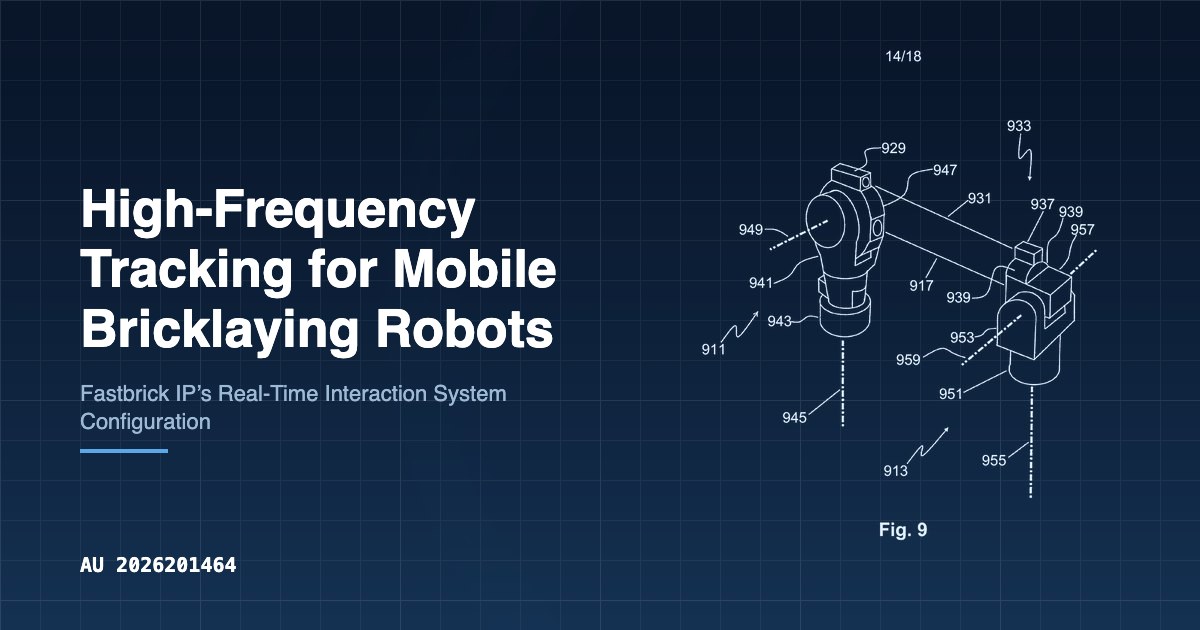
The patent describes a system configuration for performing interactions within a physical environment. The system includes a robot with a mobile robot base, a robot arm mounted on that base with an end effector for performing interactions, a tracking system, and a control system. The tracking system measures a robot position indicative of the position
View the High-Frequency Tracking for Mobile Bricklaying Robots PDF
Download the PDF version of this Application Open to Public Inspection
Automated construction robotics requires extremely precise real-time tracking of robot arm positions as the machine moves through a building site. A divisional patent from Western Australian company Fastbrick IP Pty Ltd – the intellectual property arm behind the Hadrian bricklaying robot – describes a system configuration that achieves both the measurement frequency and spatial accuracy needed to control a robot arm mounted on a moving base while maintaining the sub-millimetre placement precision required for structural construction work.
The Problem
In automated bricklaying and similar construction robotics applications, a robot arm is mounted on a mobile base – typically a truck or self-propelled vehicle – that moves around the building site. The robot’s end effector must place objects such as bricks at precise predetermined positions in three-dimensional space, often to within a few millimetres. This requires accurate knowledge of the end effector’s position and orientation relative to the structure being built, updated fast enough to allow real-time servo control of the arm’s motion.
The standard solution involves a laser tracker that measures the position of an active target mounted on the robot arm, providing high-accuracy position data. However, existing laser tracker systems have limitations for construction robotics applications. Wireless connections between the tracker and the active target introduce time delays that make the data unusable for real-time dynamic motion control. Hard-wired connections require cables to be routed through the multi-stage telescopic boom of a construction machine, requiring multiple plug and socket connectors that add weight, reduce reliability, and complicate maintenance. When multiple laser trackers and targets are needed, the cabling complexity multiplies accordingly.
Orientation measurements using vision-based systems on commercial laser trackers are typically limited to 100 Hz update rates, while the position measurement may run at much higher frequencies, creating a mismatch between position and orientation data streams that complicates integrated control.
What This Invention Does
The patent describes a system configuration for performing interactions within a physical environment. The system includes a robot with a mobile robot base, a robot arm mounted on that base with an end effector for performing interactions, a tracking system, and a control system. The tracking system measures a robot position indicative of the position of at least part of the robot relative to the environment with a frequency of at least 10 Hz and an accuracy of at least better than 10 mm. The control system runs at a matching minimum frequency of 10 Hz, determining the robot position and controlling the robot arm accordingly.
The specification describes a range of performance tiers: measurement frequencies from 10 Hz up to 10 kHz, and position accuracy from better than 10 mm down to better than 5 micrometres. Orientation accuracy is described from better than 1 degree down to fractions of a degree. The system architecture addresses the cable management problem by enabling wireless data transfer between the tracking system components at rates sufficient for real-time control, or by using an integrated tracking and control approach that minimises the number of separate communication links.
The interaction being performed by the end effector is described in the context of construction, with explicit reference to bricklaying as an application – building walls and structures by placing individual bricks at predetermined positions derived from a building information model.
Key Features
High-frequency position measurement. The tracking system operates at a minimum of 10 Hz – with preferred embodiments extending to 300 Hz, 1 kHz, 2 kHz, and 10 kHz – providing the real-time position feedback needed for dynamic control of a moving robot arm.
Sub-millimetre accuracy. Preferred embodiments specify position accuracy better than 2 mm, 1 mm, 0.2 mm, 0.02 mm, 0.01 mm, and 5 micrometres, covering the range of precision requirements from construction rough-positioning to high-precision manufacturing applications.
Synchronised control system. The control system operates at a matching minimum frequency of 10 Hz, ensuring that robot arm control commands are issued at a rate consistent with the incoming position data.
Mobile robot base. The system explicitly addresses the challenge of tracking a robot whose base undergoes movement relative to the environment – the core challenge in mobile construction robotics where the vehicle carrying the robot arm is continuously repositioning.
Construction application focus. The specification describes the system in the context of automated construction, particularly bricklaying, where the end effector places bricks at predetermined positions derived from a building information model.
Who Is Behind It?
The applicant is Fastbrick IP Pty Ltd, the intellectual property holding company for the technology behind the Hadrian X bricklaying robot developed in Western Australia. The named inventor is Mark Joseph Pivac, founder and principal inventor of the Fastbrick robotic construction system. This divisional was filed on 26 February 2026, derived from parent application AU 2024278303, which was itself a divisional of AU 2018317936. Davies Collison Cave Pty Ltd in Milton, Queensland are the Australian patent attorneys.
Why It Matters
The construction industry is one of the largest and least automated sectors of the global economy. Robotic bricklaying that can operate at commercial productivity rates would significantly reduce labour costs, improve safety for workers, and address skilled trades shortages in growing markets. The Hadrian X system, backed by the IP in applications such as this one, has demonstrated the ability to lay bricks at rates far exceeding human bricklayers, but achieving that performance requires solving the tracking and control problem described in this patent – how to know precisely where the robot’s end effector is, fast enough to make real-time corrections as the machine moves.
The measurement frequency and accuracy specifications in this patent – particularly the 10 Hz minimum frequency and sub-10 mm accuracy – reflect the practical minimums for real-time control of a construction robot, while the higher-end specifications provide headroom for more demanding applications including precision manufacturing and industrial assembly robotics.
AU 2026201464 was published in the Australian Official Journal of Patents on 19 March 2026 and is open for public inspection. Patent applications represent inventions that are sought to be protected and do not necessarily reflect commercially available products.
Related Concepts
Construction robotics encompasses automated systems designed to perform tasks such as bricklaying, welding, and demolition on building sites. High-frequency position tracking – using technologies such as laser trackers and inertial measurement units – is essential to servo control accuracy in mobile robotic arms. The use of building information modelling provides the spatial reference frame from which target brick positions are derived.
Related Patents Open to Public Inspections
See related Patents open to public inspection.

Antenna Pole Design Simplifies Installation for Robot Positioning Systems

Terminal Device, Network Node, and Methods Therein

Building Better Ground

One Machine to Rule Them All
Disclaimer
The information presented in this article is provided for general informational and illustrative purposes only.
Content on this page may be derived from publicly available intellectual property records, including patent documentation and related materials. While reasonable care is taken in compiling and summarising this information, ATMOSS does not guarantee the accuracy, completeness, currency, or reliability of any content presented.
This article is not a substitute for reviewing the original source documents. Patent applications, specifications, claims, and related records may contain detailed technical, legal, and contextual information that is not fully represented in this summary.
ATMOSS does not provide legal, technical, or commercial advice. Users should not rely on this content for decision-making purposes.
For authoritative and up-to-date information, users should refer directly to the official records available via IP Australia and other relevant intellectual property databases. Links to these official sources are provided where applicable.
ATMOSS accepts no liability for any loss, damage, or consequences arising from the use of, or reliance on, the information contained in this article.