
Application Number: AU 2026201406
Intelligent Beverage Dispenser Alert System
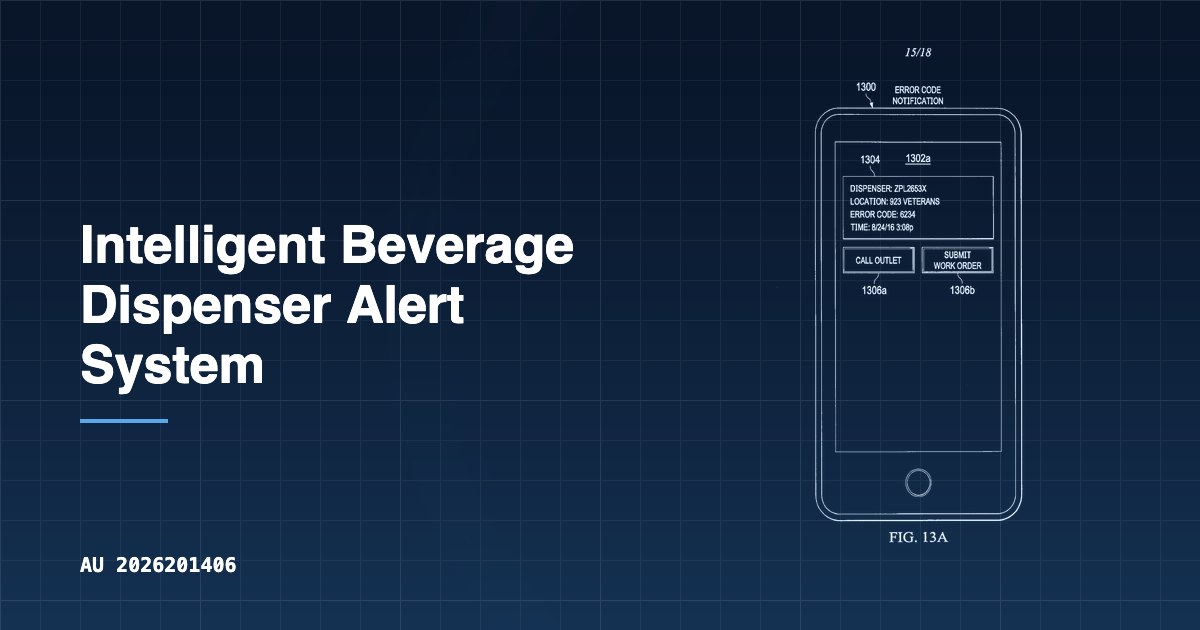
The Coca-Cola Company has developed an innovative proactive alert system that continuously monitors dispenser status and sends real-time notifications to operator mobile devices. The system proactively alerts operators to maintenance issues, supply needs, and malfunctions before they impact customer service.
View the Intelligent Beverage Dispenser Alert System PDF
Download the PDF version of this Application Open to Public Inspection
The Coca-Cola Company has developed a proactive dispenser to operator mobile alert system that sends real-time notifications to operator mobile devices. This patent describes innovative technology for monitoring beverage dispensers and alerting service personnel to maintenance needs, supply issues, and system malfunctions, enabling rapid response to keep dispensers operational.
The Problem
Beverage dispensers are ubiquitous in retail, foodservice, and hospitality environments, and maintaining dispenser availability is critical for business operations and customer satisfaction. Dispensers can experience numerous issues: beverage supply depletion, mechanical malfunctions, temperature control problems, electrical faults, and other maintenance issues that prevent normal operation.
Traditional approaches rely on scheduled maintenance visits or customer complaints to identify problems. This reactive approach can result in extended downtime, lost sales, and poor customer experiences when dispensers malfunction unexpectedly. Operators need real-time visibility into dispenser status to respond quickly to issues and minimize downtime.
What This Invention Does
The Coca-Cola Company has developed an innovative proactive alert system that continuously monitors dispenser status and sends real-time notifications to operator mobile devices. The system proactively alerts operators to maintenance issues, supply needs, and malfunctions before they impact customer service.
By providing real-time information directly to operator mobile phones, the system enables rapid response to dispenser issues. Operators can address problems immediately, reducing downtime and maintaining dispenser availability. This shift from reactive to proactive maintenance significantly improves operational efficiency and customer experience.
Key Features
Proactive Monitoring. System continuously monitors dispenser status and alerts operators to issues.
Mobile Notifications. Alerts sent directly to operator mobile devices for rapid response.
Real-Time Status. Provides live dispenser status including supply levels and error conditions.
Service Optimization. Enables quick response to issues, reducing downtime and improving service.
Who Is Behind It?
The Coca-Cola Company is one of the world’s largest beverage companies, operating a vast network of dispensers globally. The company continuously innovates to improve the efficiency and reliability of its distribution and dispensing systems. The patent reflects contributions from four inventors: Udayan Joshi, Marc Katz, Matthew Arnwine, and Scott Harrison, representing combined expertise in systems engineering and IoT technology.
Why It Matters
Maintaining operational efficiency across large networks of dispensers directly impacts business profitability and customer satisfaction. Real-time monitoring and alert systems represent important infrastructure technology that keeps dispensers operational and revenue-generating. This innovation demonstrates how IoT and mobile technology can improve operational efficiency in distributed equipment networks.
The IPC classification B67D 7/74 for beverage dispensing apparatus reflects the focus on dispenser technology. The Coca-Cola Company’s innovation in real-time monitoring demonstrates how modern telecommunications and sensor technology can improve the efficiency of traditional beverage dispensing infrastructure globally.
AU 2026201406 was published in the Australian Official Journal of Patents on 19 March 2026 and is open for public inspection. Patent applications represent inventions that are sought to be protected and do not necessarily reflect commercially available products.
Related Concepts
The Internet of Things (IoT) enables physical devices to collect and transmit operational data over networks, forming the technological backbone of modern connected equipment management. Combined with predictive maintenance approaches, real-time sensor data allows operators to shift from reactive fault-fixing to proactive service scheduling – reducing downtime, improving customer satisfaction, and extending the operational life of equipment deployed across large distributed networks.
Related Patents Open to Public Inspections
See related Patents open to public inspection.

Innovative Evaporator Structure Dramatically Improves Beverage Dispenser Efficiency

Refrigerator

Hygienic Tissue Dispenser With Removable Sensor Housing

Innovative Patient Interfaces for Respiratory Therapy
Disclaimer
The information presented in this article is provided for general informational and illustrative purposes only.
Content on this page may be derived from publicly available intellectual property records, including patent documentation and related materials. While reasonable care is taken in compiling and summarising this information, ATMOSS does not guarantee the accuracy, completeness, currency, or reliability of any content presented.
This article is not a substitute for reviewing the original source documents. Patent applications, specifications, claims, and related records may contain detailed technical, legal, and contextual information that is not fully represented in this summary.
ATMOSS does not provide legal, technical, or commercial advice. Users should not rely on this content for decision-making purposes.
For authoritative and up-to-date information, users should refer directly to the official records available via IP Australia and other relevant intellectual property databases. Links to these official sources are provided where applicable.
ATMOSS accepts no liability for any loss, damage, or consequences arising from the use of, or reliance on, the information contained in this article.