
Application Number: AU 2024219441
Secure Locking Mechanism for Household and Container Closures
The locking mechanism employs a spring-loaded design that creates a positive mechanical lock securing the container cover. The mechanism includes precisely engineered components that engage when the cover is closed and can be released only through deliberate, intentional action. The design minimizes the risk of accidental operation - typical household activities or environmental vibrations will
View the Secure Locking Mechanism for Household and Container Closures PDF
Download the PDF version of this Application Open to Public Inspection
This invention introduces a reliable locking mechanism designed to secure container closures and lids, combining security with user-friendly operation. The mechanism prevents accidental opening while remaining accessible to authorized users, making it suitable for everything from household storage to industrial containers where securing contents is critical.
The Problem
Many containers require secure closures that prevent accidental opening, whether for safety (hazardous materials), security (valuable contents), or functional reasons (containers requiring airtight seals). Existing mechanical locking mechanisms are often complex, difficult to operate for users with limited strength or dexterity, prone to jamming, or vulnerable to accidental release. Users struggle to find solutions that balance the contradictory requirements of being secure against accidental opening while remaining easy for authorized personnel to open intentionally. This is especially problematic in commercial or industrial environments where containers may be opened and closed repeatedly throughout operating days.
What This Invention Does
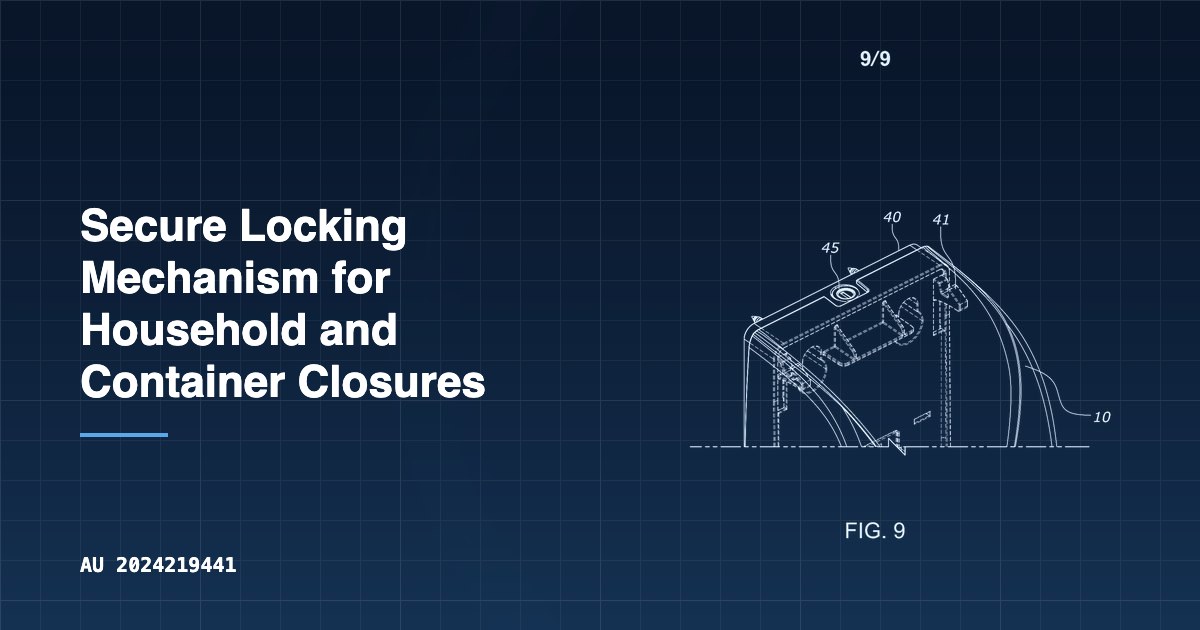
The locking mechanism employs a spring-loaded design that creates a positive mechanical lock securing the container cover. The mechanism includes precisely engineered components that engage when the cover is closed and can be released only through deliberate, intentional action. The design minimizes the risk of accidental operation – typical household activities or environmental vibrations will not trigger release – while ensuring that authorized users can open containers with predictable, reasonable force. The mechanism is compatible with various container types and closure configurations, from household storage bins to commercial waste containers. It can be retrofitted to existing containers or integrated into new designs.
Key Features
- Positive Mechanical Lock. The mechanism employs spring-loaded components that create a definitive locked state, requiring intentional user action to release, effectively preventing accidental opening.
- Fail-Safe Design. The locking components remain engaged unless deliberately released, providing maximum security even in high-vibration environments or during transport and handling.
- Accessibility. The release mechanism functions with standard lever or button operation, requiring reasonable manual force without specialized tools or complex procedures.
- Durable Construction. Industrial-grade materials and engineering ensure the mechanism withstands thousands of open-close cycles without wear degradation or mechanical failure.
- Retrofit Compatibility. The mechanism can be adapted to fit existing container designs and closure types, enabling retrofit installation without container replacement.
Who Is Behind It?
Hysential Pty Ltd developed this locking mechanism with inventor Steven Ugrinovski, who also serves as the patent agent. The company’s focus on practical solutions to security and operational challenges is evident in this straightforward, effective design that prioritizes user experience without compromising safety.
Why It Matters
Container security is essential across numerous industries – waste management (preventing illegal dumping), food service (preventing contamination), pharmaceuticals (preventing unauthorized access to medications), and household storage (securing hazardous materials from children). As environmental regulations tighten and consumer expectations for product safety increase, reliable container locking mechanisms become more important. This innovation provides manufacturers with a proven mechanical solution that requires no electrical components, batteries, or complex electronics, making it cost-effective and reliable across diverse applications. Its straightforward design means minimal maintenance or troubleshooting, supporting long-term operational reliability.
Related Concepts
Child-resistant packaging regulations have long driven innovation in secure container closures, particularly in the pharmaceutical and household chemical sectors. Spring-loaded latch mechanisms represent a mature but continually refined engineering category where reliability and ease of use must be balanced.
Broader fail-safe design principles underpin this invention – the locked state is the default, and release requires deliberate action. This approach is common across industrial safety equipment and is increasingly expected in consumer goods where hazardous or sensitive contents require protection.
AU 2024219441 was published in the Australian Official Journal of Patents on 19 March 2026 and is open for public inspection. Patent applications represent inventions that are sought to be protected and do not necessarily reflect commercially available products.
Related Patents Open to Public Inspections
See related Patents open to public inspection.

Advanced Locking Mechanism Protects Carrier Storage with Mechanical Intelligence

Password-Protected Locking Device Prevents Luggage Theft in Public Spaces

Specialized Strand Lock Combines Combination Mechanism With Cable Bolt for Secure Cable Fastening

Hygienic Tissue Dispenser With Removable Sensor Housing
Disclaimer
The information presented in this article is provided for general informational and illustrative purposes only.
Content on this page may be derived from publicly available intellectual property records, including patent documentation and related materials. While reasonable care is taken in compiling and summarising this information, ATMOSS does not guarantee the accuracy, completeness, currency, or reliability of any content presented.
This article is not a substitute for reviewing the original source documents. Patent applications, specifications, claims, and related records may contain detailed technical, legal, and contextual information that is not fully represented in this summary.
ATMOSS does not provide legal, technical, or commercial advice. Users should not rely on this content for decision-making purposes.
For authoritative and up-to-date information, users should refer directly to the official records available via IP Australia and other relevant intellectual property databases. Links to these official sources are provided where applicable.
ATMOSS accepts no liability for any loss, damage, or consequences arising from the use of, or reliance on, the information contained in this article.