
Application Number: AU 2025226798
Simplified Device Configuration Parser for Complex Systems
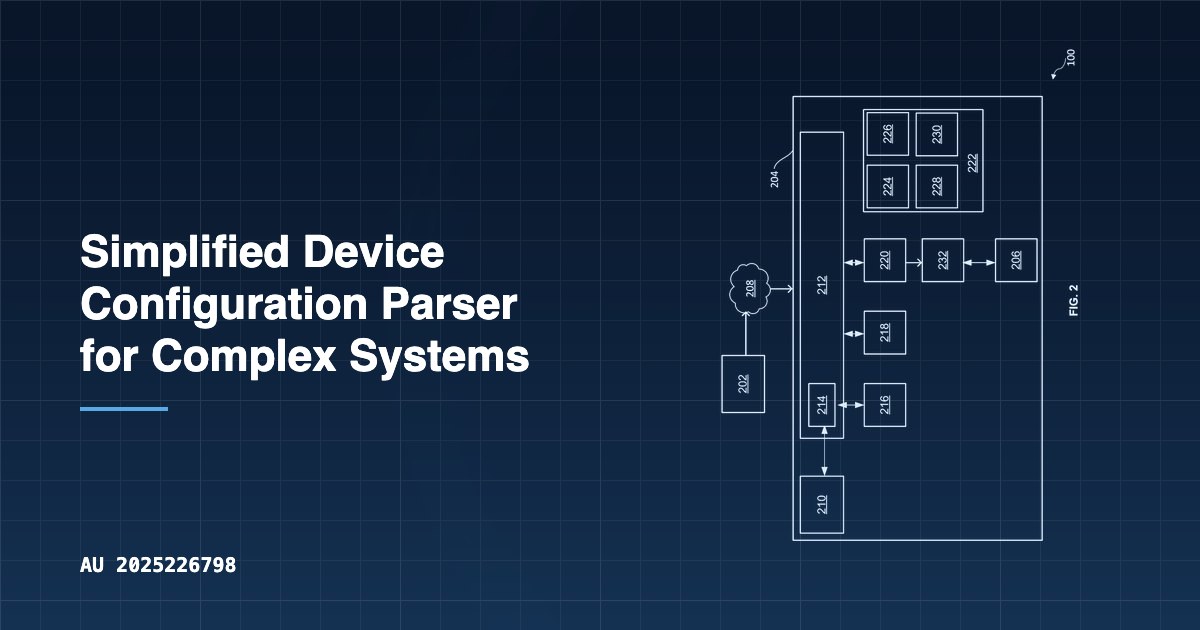
The patented system provides methods for parsing device configurations using simplified approaches that extract relevant information from complex configuration structures. Rather than requiring extensive manual interpretation, the system automatically identifies key configuration elements, normalizes them into standardized formats, and enables systematic analysis and verification.
View the Simplified Device Configuration Parser for Complex Systems PDF
Download the PDF version of this Application Open to Public Inspection
AppViewX introduces a system and method for parsing device configurations using simplified approaches that dramatically reduce complexity in managing network and system configurations. The innovation enables organizations to process intricate device settings efficiently without requiring extensive manual interpretation.
The Problem
Modern IT infrastructure management demands processing vast quantities of device configurations across heterogeneous systems. Configuration files vary widely in format, structure, and terminology across different manufacturers and device types. IT teams struggle to extract meaningful information from these complex documents, leading to configuration errors, security vulnerabilities, and operational inefficiencies. Manual parsing consumes substantial labor and remains error-prone regardless of expertise levels.
Current approaches require deep technical knowledge and specialized tools to interpret device configurations correctly. The lack of standardized methods for configuration interpretation creates bottlenecks in deployment, troubleshooting, and compliance verification. Organizations managing large device fleets face exponential complexity when attempting to verify that all devices conform to security policies and operational standards. The human interpretation burden limits scalability and increases operational costs.
What This Invention Does
The patented system provides methods for parsing device configurations using simplified approaches that extract relevant information from complex configuration structures. Rather than requiring extensive manual interpretation, the system automatically identifies key configuration elements, normalizes them into standardized formats, and enables systematic analysis and verification.
The innovation abstracts away manufacturer-specific syntax and structural differences, presenting operators with clear, actionable configuration information. By simplifying the configuration parsing process, organizations can verify compliance, identify misconfigurations, and respond to security events more rapidly. The system handles diverse configuration formats and device types through unified processing approaches.
Key Features
Simplified Parsing Methods. The system reduces configuration complexity through automated interpretation, eliminating manual reading and analysis of intricate device syntax.
Format Normalization. Diverse configuration formats from different manufacturers are normalized into standardized representations for consistent analysis.
Automated Configuration Extraction. Key configuration elements are automatically identified and extracted without requiring manual identification.
Compliance Verification. The standardized configurations enable rapid verification against security policies and operational standards.
Scalable Processing. The approach handles large numbers of devices and complex configurations efficiently without proportional labor increases.
Who Is Behind It?
AppViewX Inc., a provider of IT configuration and workflow automation solutions, developed this innovation with inventors Nagendran, Sathish Kumar and Ramakrishnan, Sunil Kumar credited on the patent. The patent is represented by Dentons Patent Attorneys Australasia in Auckland. Priority is claimed from a U.S. application filed in September 2024.
Why It Matters
IT operations teams gain significant efficiency improvements through automation of configuration analysis. The ability to rapidly parse and verify configurations across large device fleets reduces the time required for compliance verification and troubleshooting. Security teams benefit from faster identification of misconfigurations that might introduce vulnerabilities.
Organizations managing complex network environments achieve better control over their infrastructure through standardized configuration understanding. The innovation enables scaling of management practices without proportional increases in staffing, improving overall operational efficiency. Cloud service providers and managed service providers particularly benefit from automation that reduces manual intervention in customer configuration management. AppViewX’s focus on practical workflow simplification addresses real pain points in IT operations environments.
AU 2025226798 was published in the Australian Official Journal of Patents on 19 March 2026 and is open for public inspection. Patent applications represent inventions that are sought to be protected and do not necessarily reflect commercially available products.
Related Concepts
Configuration management is the discipline of tracking and controlling the settings of hardware and software components within an IT infrastructure. As networks grow in scale and heterogeneity, automated parsing tools are essential to maintain visibility and enforce consistent security standards.
Automated data normalisation converts diverse vendor-specific formats into a common representation, enabling systematic compliance checks across large device fleets. This supports scalable governance and reduces reliance on specialist knowledge for day-to-day cloud and network operations.
Related Patents Open to Public Inspections
See related Patents open to public inspection.

Voice-Controlled Home Appliance Feature Adjustment System

Intelligent Home Appliance Control Through Advanced Command Processing

Connected Vehicle Roads

Next-Generation Multi-Link WiFi
Disclaimer
The information presented in this article is provided for general informational and illustrative purposes only.
Content on this page may be derived from publicly available intellectual property records, including patent documentation and related materials. While reasonable care is taken in compiling and summarising this information, ATMOSS does not guarantee the accuracy, completeness, currency, or reliability of any content presented.
This article is not a substitute for reviewing the original source documents. Patent applications, specifications, claims, and related records may contain detailed technical, legal, and contextual information that is not fully represented in this summary.
ATMOSS does not provide legal, technical, or commercial advice. Users should not rely on this content for decision-making purposes.
For authoritative and up-to-date information, users should refer directly to the official records available via IP Australia and other relevant intellectual property databases. Links to these official sources are provided where applicable.
ATMOSS accepts no liability for any loss, damage, or consequences arising from the use of, or reliance on, the information contained in this article.