
Application Number: AU 2025226874
Smart Safety Locking System for Frozen Drink Machines
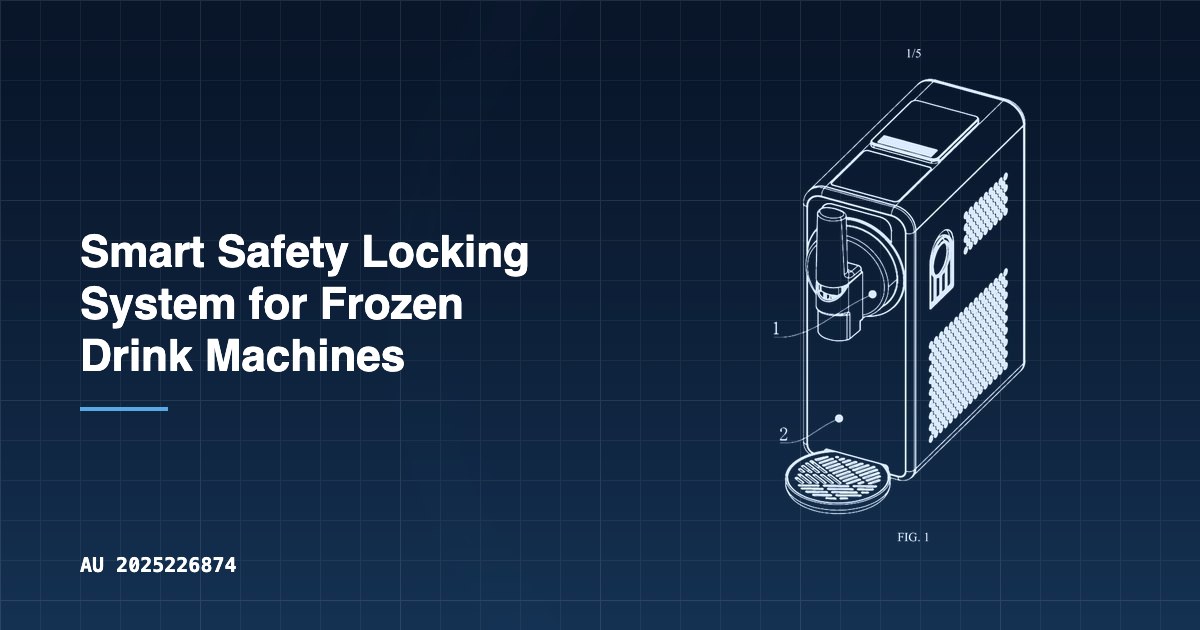
Guangdong Welly's solution equips frozen drink machines with a real-time detection system that automatically confirms the discharge tray is correctly and firmly locked before the machine can operate.
View the Smart Safety Locking System for Frozen Drink Machines PDF
Download the PDF version of this Application Open to Public Inspection
Imagine a frozen drink machine that knows whether its discharge tray is properly locked before it starts dispensing. This invention introduces an intelligent safety system that prevents the costly and messy mishaps that plague modern ice cream and smoothie machines – a real problem in thousands of commercial kitchens and juice bars worldwide.
The Problem
Currently, when staff need to replace the discharge tray on a frozen drink machine, they must rely on subjective judgment and experience to confirm the tray is properly locked. This manual judgment method is not only inefficient but frequently leads to misjudgment.
When a tray is incorrectly assumed to be locked and the machine begins dispensing, the results are predictable: ice cream or smoothie leaks everywhere. The consequences extend beyond immediate waste. Leaking product pollutes the internal structure of the machine, degrading the quality of subsequent batches and requiring time-consuming cleanup that reduces operational efficiency.
For busy commercial operations running multiple machines, these preventable accidents represent significant losses in raw materials, labor time, and equipment maintenance costs.
What This Invention Does
Guangdong Welly’s solution equips frozen drink machines with a real-time detection system that automatically confirms the discharge tray is correctly and firmly locked before the machine can operate.
The system centers on a microswitch positioned at the discharge port of the machine’s housing. When the discharge tray is installed and engaged with the housing through a specialized locking mechanism, the microswitch monitors the tray’s status continuously.
When the microswitch detects that the tray is properly locked, it automatically switches on the machine’s control circuit, enabling normal discharge operation. If the tray is not correctly locked, the microswitch prevents the circuit from activating – the machine simply cannot dispense until the tray is secured.
This approach replaces unreliable visual inspection and experience-based judgment with objective, measurable feedback.
Key Features
Real-time Detection System. The microswitch provides instantaneous feedback on whether the discharge tray is correctly locked and firmly seated, eliminating guesswork from the process.
Automatic Circuit Control. Once the microswitch confirms proper locking, it automatically activates the discharge circuit, streamlining the workflow while maintaining safety.
Detachable Engagement Structure. The locking mechanism uses a specialized engagement structure that securely fastens the discharge tray to the housing while remaining easy to remove and replace when needed.
Sealed Discharge Port. The discharge tray is configured to seal the first discharge port when installed, ensuring the second discharge port (used for actual ice cream or smoothie dispensing) operates correctly without leakage.
Eliminated Manual Assessment. By replacing staff experience-based judgment with automated detection, the system reduces human error and inconsistency across all operators.
Who Is Behind It?
Guangdong Welly Electrical Appliances Co., Ltd. is a Chinese manufacturer specializing in frozen beverage equipment. The invention was developed by a team of four engineers: Wu Xiangan, Mai Linjun, Ma Yangyang, and Hu Wenzhan. The company filed a priority patent application in China on 29 August 2024 before extending protection to Australia in February 2025, indicating the significant commercial interest in this safety innovation.
Why It Matters
This invention addresses a persistent operational frustration in the commercial beverage equipment industry. Frozen drink machines are ubiquitous in cafes, restaurants, and ice cream parlors globally, yet the discharge tray issue remains largely unresolved in conventional designs. Implementing automated locking detection transforms maintenance procedures from error-prone manual tasks into foolproof automated processes.
The patent covers multiple classifications within kitchen equipment and food service technology (IPC codes A47J 31/44, A23G 9/28, A23G 9/22, A47J 43/04), reflecting the broad applicability of this safety solution across different frozen beverage machine types. The solution has clear commercial appeal for manufacturers seeking to differentiate their products through enhanced safety features and reduced operational incidents. For facility operators, adoption means fewer spillage incidents, lower maintenance costs, and improved consistency in product quality.
AU 2025226874 was published in the Australian Official Journal of Patents on 19 March 2026 and is open for public inspection. Patent applications represent inventions that are sought to be protected and do not necessarily reflect commercially available products.
Related Concepts
A microswitch is a miniature snap-action electrical switch that responds to minimal physical force, making it ideal for safety interlock applications. Its precise, repeatable actuation point allows equipment designers to build reliable detection systems that eliminate reliance on operator judgment.
In commercial frozen dessert equipment, automated safety interlocks protect both product quality and operational efficiency. Integrating electronic detection into food service machinery reduces human error and prevents contamination caused by improperly seated components.
Related Patents Open to Public Inspections
See related Patents open to public inspection.

Smart Infrared Induction Revolutionizes Cold Drink Machine Operation

Advanced Discharging Mechanism for Cold Drink Dispensers Eliminates Splashing

Advanced Sealing Assembly Enhances Cold Drink Machine Durability

Integrated Drive Body System for Cold Beverage Makers
Disclaimer
The information presented in this article is provided for general informational and illustrative purposes only.
Content on this page may be derived from publicly available intellectual property records, including patent documentation and related materials. While reasonable care is taken in compiling and summarising this information, ATMOSS does not guarantee the accuracy, completeness, currency, or reliability of any content presented.
This article is not a substitute for reviewing the original source documents. Patent applications, specifications, claims, and related records may contain detailed technical, legal, and contextual information that is not fully represented in this summary.
ATMOSS does not provide legal, technical, or commercial advice. Users should not rely on this content for decision-making purposes.
For authoritative and up-to-date information, users should refer directly to the official records available via IP Australia and other relevant intellectual property databases. Links to these official sources are provided where applicable.
ATMOSS accepts no liability for any loss, damage, or consequences arising from the use of, or reliance on, the information contained in this article.