
Application Number: AU 2025220838
Universal Linear Optical Mesh Layout Innovation Improves Quantum Computing Hardware
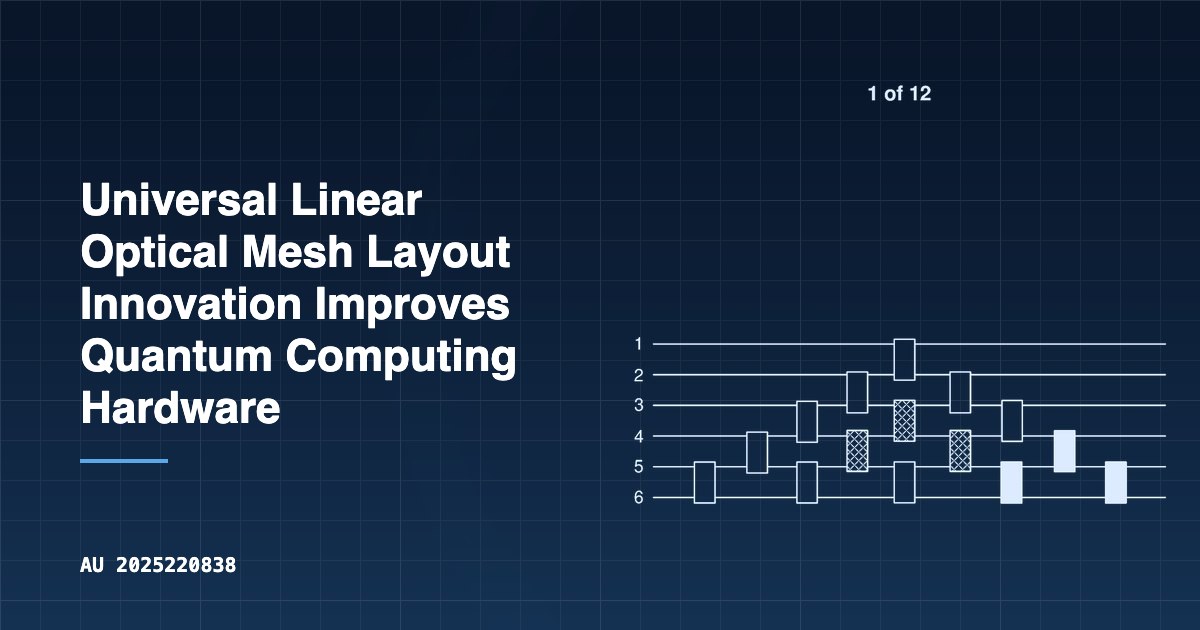
The method starts with a known layout of a universal linear optical mesh and systematically identifies specific arrangements of three couplers across three consecutive waveguides. Once identified, it replaces these arrangements with alternative coupler configurations that are more compatible with actual hardware implementations. By performing targeted replacements of three-coupler arrangements, the system can generate revised
View the Universal Linear Optical Mesh Layout Innovation Improves Quantum Computing Hardware PDF
Download the PDF version of this Application Open to Public Inspection
QuiX Quantum B.V. has developed a method for generating revised layouts of universal linear optical meshes that enable better hardware implementations for quantum computing and optical applications. The technique systematically identifies and replaces coupler arrangements to create meshes that map more effectively to physical optical hardware and overcome limitations of traditional designs.
The Problem
Universal linear optical meshes are fundamental components for quantum computing, optical networking, and advanced signal processing applications. A universal linear optical mesh consists of waveguides, couplers, and phase shifters arranged to implement unitary operations on input light signals. While theoretical designs like the Reck triangular scheme have been proven to work, these layouts often do not map well to existing optical hardware due to manufacturing constraints and component variation.
In particular, the Reck scheme and similar traditional layouts suffer from significant disadvantages. Light signals entering the first waveguide pass through fewer couplers while light in the nth waveguide passes through the maximum number of couplers, creating unequal loss and phase distribution. Additionally, the Reck scheme has a relatively large optical path length of 2n, which increases component requirements and reduces feasibility. Existing designs may not accommodate situations where all hardware components do not perform at expected levels.
What This Invention Does
The method starts with a known layout of a universal linear optical mesh and systematically identifies specific arrangements of three couplers across three consecutive waveguides. Once identified, it replaces these arrangements with alternative coupler configurations that are more compatible with actual hardware implementations. By performing targeted replacements of three-coupler arrangements, the system can generate revised meshes that maintain mathematical universality while improving practical implementability.
The revised layout reduces unequal loss and phase distribution compared to traditional designs, provides more balanced optical path lengths, and creates implementations that tolerate hardware component variations more gracefully. This approach allows researchers and manufacturers to adapt known universal mesh designs to their specific hardware constraints and manufacturing capabilities.
Key Features
- Systematic Layout Transformation. The method identifies and replaces coupler arrangements in a methodical manner that preserves the optical mesh’s universal properties.
- Three-Coupler Arrangement Replacement. The technique focuses on replacing specific three-coupler patterns across consecutive waveguides, creating targeted improvements.
- Hardware-Centric Design. The revised layouts are specifically optimized for practical implementation in actual optical hardware rather than purely theoretical optimization.
- Balanced Loss Distribution. The transformation reduces the unequal loss and phase distribution problems inherent in traditional universal mesh schemes.
- Improved Optical Path Characteristics. The revised layouts reduce overall optical path length compared to traditional Reck-based schemes.
Who Is Behind It?
QuiX Quantum B.V., a quantum computing technology company based in the Netherlands, developed this innovation with inventors Narasimhan Kannan, Jelmer Jan Renema, and Trevor DeMille. The patent was filed on 22 August 2025, claiming priority to British Patent Application 2412507.2 filed on 27 August 2024 and European Patent Application 24197093.8 filed on 28 August 2024. Minter Ellison represents the application in Australia.
Why It Matters
This patent addresses a critical challenge in the emerging quantum computing industry. As researchers and manufacturers work to scale quantum computers beyond laboratory prototypes, optimizing the physical implementation of optical components becomes increasingly important. By enabling more practical hardware implementations of universal optical meshes, this technology accelerates progress toward commercially viable quantum computers and optical processing systems.
The innovation demonstrates the bridge between theoretical quantum computing design and practical engineering constraints. The ability to systematically transform abstract designs into hardware-compatible layouts enables faster development cycles and reduces engineering effort required to bring quantum technologies from research to production scale.
Related Concepts
Linear optical quantum computing (LOQC) is a paradigm of quantum computation that uses photons as information carriers, processed by linear optical elements such as beam splitters, mirrors, and phase shifters. Unlike superconducting qubit systems, photonic approaches can operate at or near room temperature, making them attractive for integration into conventional data centre environments. Key challenges include minimising insertion loss and balancing optical path lengths across all modes in the mesh.
Optical waveguides are physical structures that guide light along defined paths, forming the backbone of integrated photonic circuits. In quantum computing hardware, the arrangement and coupling of waveguides must be precisely engineered to maintain coherence and minimise errors. Translating abstract mesh topologies into manufacturable waveguide layouts is one of the central engineering challenges in scaling photonic quantum processors.
AU 2025220838 was published in the Australian Official Journal of Patents on 19 March 2026 and is open for public inspection. Patent applications represent inventions that are sought to be protected and do not necessarily reflect commercially available products.
Related Patents Open to Public Inspections
See related Patents open to public inspection.

Systems and Methods for Unified Computing on Digital and Quantum Computers

Plane Wave Dual Basis for Quantum Simulation

Detection of Heat-Treated Markings on a Wooden Pallet
Disclaimer
The information presented in this article is provided for general informational and illustrative purposes only.
Content on this page may be derived from publicly available intellectual property records, including patent documentation and related materials. While reasonable care is taken in compiling and summarising this information, ATMOSS does not guarantee the accuracy, completeness, currency, or reliability of any content presented.
This article is not a substitute for reviewing the original source documents. Patent applications, specifications, claims, and related records may contain detailed technical, legal, and contextual information that is not fully represented in this summary.
ATMOSS does not provide legal, technical, or commercial advice. Users should not rely on this content for decision-making purposes.
For authoritative and up-to-date information, users should refer directly to the official records available via IP Australia and other relevant intellectual property databases. Links to these official sources are provided where applicable.
ATMOSS accepts no liability for any loss, damage, or consequences arising from the use of, or reliance on, the information contained in this article.